

TMU’s School of Journalism is one of Canada’s top institutions for learning the craft of reporting. But at a time when the number of journalists killed for their work is climbing in Palestine and headlines are being obscured, some faculty are considering what this means for the generation of reporters they teach
By Daniyah Yaqoob
WALID BATRAWI WAS at home in Ramallah when he first heard reports of an attack on Oct. 7, 2023. He left around 6:30 a.m. to take his daughter to school, where he fiddled with the radio in his car and set it to a station that was blaring sirens alongside news commentary.
When he got home, Batrawi—a journalist and educator for many years in the West Bank—began to learn more about the attacks that had unfolded that morning. Shock consumed him.
Within hours of Hamas’ deadly attack, which killed over 1,100 Israelis and saw 251 more taken hostage, Israel began its relentless bombardment of Gaza, dropping hundreds of missiles on the first day. In the coming weeks, hundreds would be buried beneath rubble. Children would be separated from their parents. Mothers would find parts of their children strewn in the aftermath of bombings. Hospitals would be forced to perform amputations without anesthesia, aid would be turned away and people would be forced from home with nothing but the clothes on their back.
In those first weeks, Batrawi says, Western media often got the story wrong. Headlines decried those who were “killed” in Israel, but in Palestine, victims just “died.” Israeli children were children, but six-year-old Hind Rajab from Palestine was a “woman” who was killed. For Batrawi, who had worked for publications like the BBC and the CBC, the coverage was, in simple terms, a “failure.”
“They failed me, not as a Palestinian, but as a journalist who believed in their values,” Batrawi says.
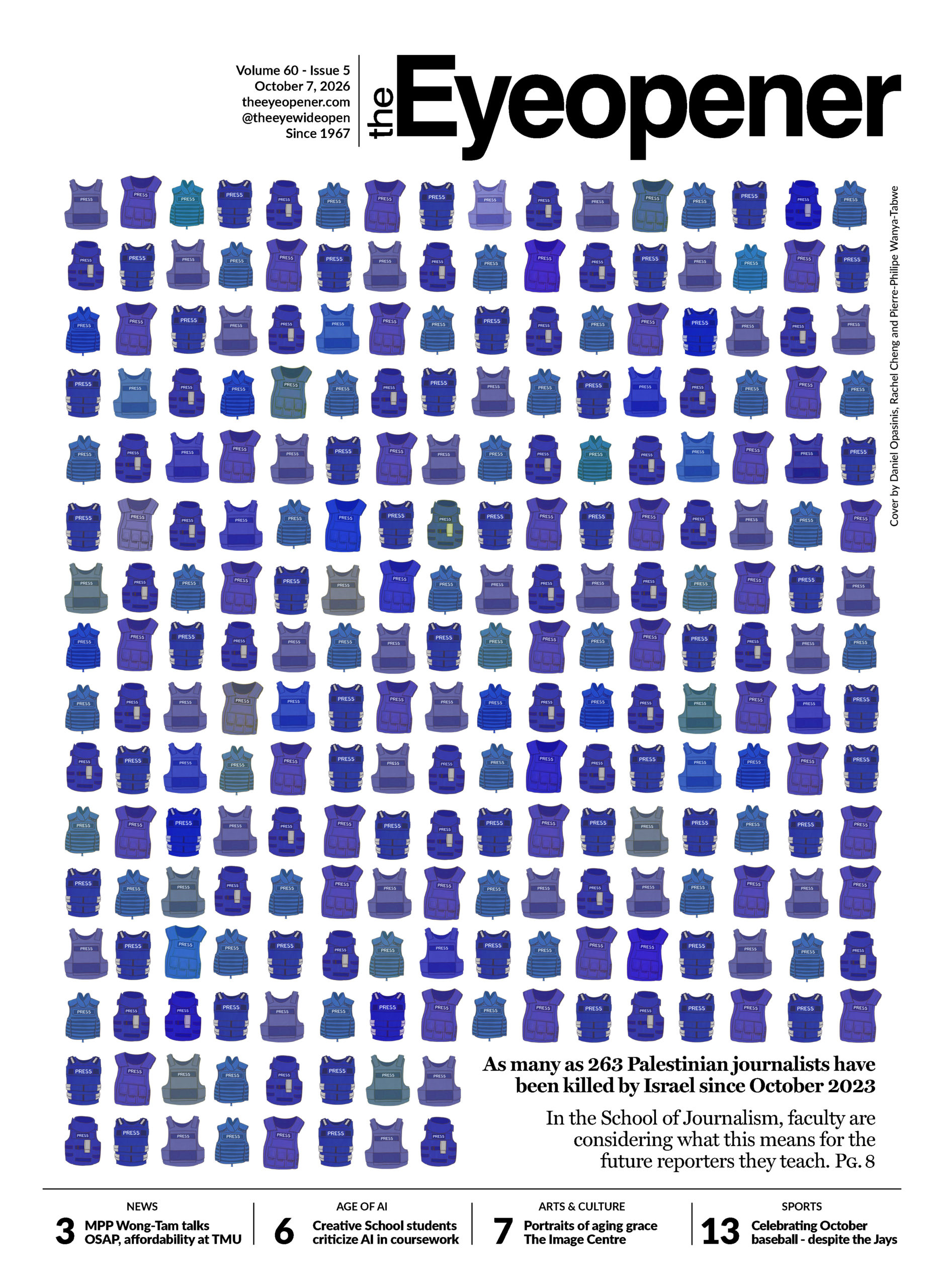
In the midst of the active bloodshed and the media coverage he felt turned a blind eye, Palestinian journalists fought tooth and nail to get the reality Gaza faced out into the world. In blue vests labelled “press,” they separated from their families to follow the truth. Many found out about deceased loved ones on air and some even lost their own lives while covering the emerging genocide.
Months earlier, in May 2023, Batrawi had visited the Gaza Strip to conduct a “hostile environment training” for journalists there. He taught them how to hide, how to find shelter if they found themselves reporting with bombs raining down. But by late 2023, Batrawi felt ridiculous about what he had taught them. Gaza, he said, was not the “ideal war” scenario with places to hide.
“This is actually what makes me sick, because many of those who I have trained have been targeted and killed, and one of them is still missing,” Batrawi says.
Batrawi is now an instructor at Toronto Metropolitan University (TMU)’s School of Journalism. Every day, he comes to campus wearing a press vest pin to keep the memory of his killed colleagues with him. And every day, he resolves to teach future journalists what he believes the journalists of today failed to do for his people.
Since Oct. 7, 2023, hundreds of Palestinian journalists have been killed by Israel. The Committee to Protect Journalists (CPJ) says as of Sept. 30, the number is around 189. A Sept. 30 estimate from Al Jazeera places that figure at as many as 263. They are among the more than 75,000 Palestinians killed since Oct. 7, 2023, which includes more than 20,000 children, according to Al Jazeera. Many organizations, the United Nations (UN) included, had called Gaza the deadliest place in the world to be a journalist in 2025.
“Israel has now killed more journalists and media workers than any other government since CPJ began collecting data in 1992,” CPJ said in a live tracker. An investigation, dubbed The Gaza Project, determined that many of those killed had been targeted, despite clearly labelling themselves as members of the press.
It’s a violation of international law, one that even the UN’s Human Rights Office called out last year. “Directing attacks against protected persons such as journalists is a violation of international humanitarian law and also constitutes a war crime,” they wrote.
Watching her colleagues killed across the world stirs an “indescribable” feeling for Sonya Fatah, a journalist and associate professor in the program. “Every journalist [in Palestine] has written their epitaph, knowing that it’s entirely possible that they’ll be gone the next day,” she says. It’s a sense of duty you can’t teach.
WHEN THE VIOLENCE broke out on Oct. 7, Ravindra Mohabeer, chair of the School of Journalism, was in his second year in the role. He knew that the school had a history of writing statements and outlining a position when something significant happened in the world. But in that moment, he says the school leadership group focused its response to serve the students, not to take a position.
“[Focus] on what our core business is,” is a philosophical approach Mohabeer says a colleague uses. “[We are] working with young people who are navigating a complex world, who don’t always have a full understanding of the pieces of that world,” says Mohabeer.
He says the school focused on their core responsibility to students, “as people and as student journalists.”
The School of Journalism at TMU has a layered staffing system. In addition to full-time faculty, many educators at the school are part-time instructors and journalists by day. Some of them had expressed concerns to Mohabeer early on—they wanted guidance, like a script, on what to say or how to handle discussion on Palestine, because in their newsrooms, they were often given editorial guidelines on what to do. Mohabeer acknowledges that students may have wondered, “How come I feel as though I am unable to talk about something that is incredibly important to me at this particular moment in time?” Fatah shared a similar sentiment, that students would be the better judges of the school’s response.
Universities around the world struggled to facilitate that dialogue, too. Some more famously than others. In the United States, at institutions such as Columbia University, police were called in to arrest students who protested Israel on campus. Columbia’s School of Journalism avoided taking a public stance. But by mid-2024, the Arab and Middle Eastern Journalists Association at Columbia proposed the idea of a memorial in the lobby of the school to honour the journalists whose lives were lost. Some faculty hesitated, but the dean of the school ultimately allowed it to be installed.
By February 2024, the number of Palestinian journalists killed reached somewhere above 80, as previously reported by The Eyeopener. In TMU’s journalism school, Fatah was approached by journalist Pacinthe Mattar, who wanted to organize a vigil for their colleagues who had been killed. She asked if the School of Journalism would host it. The faculty had “mostly” been in support and approved it as a collective, Fatah says, and some attended the vigil.
In the end, over 150 people gathered at Bond and Gould Streets, laying flowers and candles in front of the names of the journalists who lost their lives in Palestine, Lebanon and Israel since Oct. 7, 2023. A moment of silence was held at the event for 83 seconds—one second for each journalist killed.
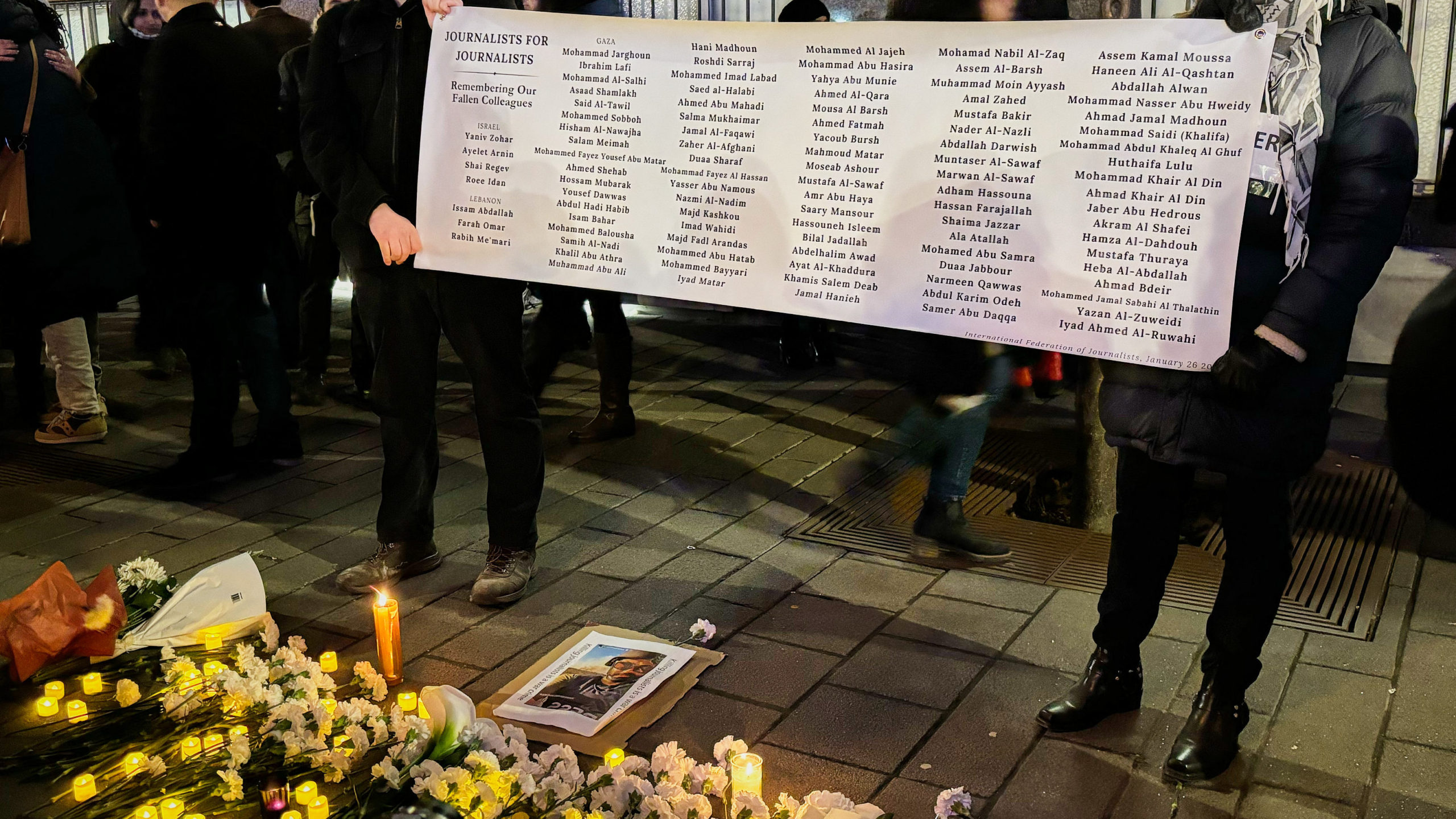
“I felt that that was a good, visible thing that the School of Journalism had participated in, with the support of the chair,” Fatah says. Since the vigil, the number of Palestinian journalists killed has tripled. And many media outlets continued to get the story wrong. So in their classrooms, these journalism educators felt they needed to figure out how to train their reporters more responsibly.
IT IS AUGUST 2025. Palestinian journalist Anas Al-Sharif is in a media tent near the Al-Shifa Hospital—one of the largest medical centres in Gaza, which had been placed under siege by Israel. Around 11:30 p.m., an Israeli airstrike was launched on the media tent and Anas Al-Sharif was killed alongside his colleagues, Mohammed Qreiqeh, Ibrahim Zaher, Mohammed Noufal, and Moamen Aliwa. A witness said their murder was instant. His last words were tweeted after his death: “This is my will and my final message. If these words reach you, know that Israel has succeeded in killing me and silencing my voice. First, peace be upon you and Allah’s mercy and blessings.”
Associate chair of the journalism program, Asmaa Malik, couldn’t understand what she was reading. The pain of his killing—one that Israel confirmed was targeted, according to Reuters (the Israeli military alleged he was a Hamas operative, a claim Al Jazeera rejected)—was visceral: “I felt it in my body.”
In 2023, Malik had been on sabbatical. But she saw in the coverage of Gaza post-Oct. 7 something she had seen in the coverage of Muslims and the Middle East post-9/11: complicity. Malik has a copy of “The New York War Crimes,” a protest publication by advocacy group Writers Against the War on Gaza that interrogates The New York Times’ coverage, pinned to a bulletin board in her office in the Rogers Communications Centre (RCC).
In her introductory classes, Malik educates her students on the importance of knowing where their news is coming from and who their sources are, to avoid the mistakes she believes Western outlets had made in running Israeli government claims without verification. In her literary journalism classes, she teaches duty of care by bringing up incidents in Palestine. In her critical issues in journalism classes, she invites guest speakers who have carved out their own spaces in the media landscape to write about Palestine.
“I always find a way to bring it in,” Malik says. “It always makes sense to see things through that lens. No matter what you’re teaching, it’s always relevant.”
In January 2024, Malik and Fatah published a joint article in The Walrus, arguing in the headline, “Attacks on Press Freedoms Have Chilling Effects Far beyond Gaza.” They wrote about straw-man debates Western media had engaged itself in over bias and objectivity when it came to covering Palestine fairly. They spotlighted Canadian journalists who had been punished for asking for better coverage on Gaza. They argued that Canadian newsrooms’ silencing and censorship “undermines the very standards newsrooms claim to be upholding.” In their view, the genocide in Palestine could teach a thing or two to journalists here.
Malik acknowledges that not all of the faculty in the program have been as comfortable bringing up issues like the genocide in Gaza as examples in their classes. But she also acknowledges the role the school must play in a world where graduates of the program may be asked to obscure the truth in a story—they don’t want to just produce journalists that get jobs, but journalists who change how the industry works.
“The more journalists who are seeking to make change in newsrooms, the better in the long-term,” she says. Fatah has a similar approach to journalism education, hoping to train students so they can make a case for telling a story the way it deserves to be told.
She’s embedded Palestine and Palestinian journalists into her personal and class projects. Her live journalism show, Living With Drones, which her graduates collaborated with her on, has taken on a life of its own, now touring internationally. It shares the story of two Palestinian lawyers who, like all in Gaza, live with the constant hum of drones in the air above them.
“It’s two years since we did it, and it’s exhausting to do. But I think it’s an obligation in a way,” Fatah says. While Western outlets jump to talk about press freedoms on a normal day, she says, they have refused to in the Palestinian context. So with her students, they do this “small thing” to support the work journalists do to bring focused, human stories of Palestine to the world.
“If I’m to work at a place like TMU or at a school of journalism, it’s personally important to me that it’s not just a job—that it is more than that,” she says.
IT IS MAY 2022. Shireen Abu Akleh, a veteran Palestinian journalist for Al Jazeera, admired by many, stands in the West Bank wearing a clearly marked press vest. She is shot while covering the operations of the Israeli military in the area. Well before the events of Oct. 7, 2023, she was one of the Palestinian journalists Israel targeted and killed.
Batrawi once shared an office with Abu Akleh in the West Bank. He still remembers her smiling face, and his shock when her life was stolen. As the genocide escalated, he joined The Gaza Project and found evidence that many of the hundreds of Palestinian journalists killed were being targeted by the Israeli military for trying to report the truth.
In the last year, the School of Journalism has brought on two Palestinian members to join the team: Batrawi, who assists in the fourth-year course, On The Record, training from his lived experience as a broadcast journalist. This year, Hedaya Shamun was brought on as the non-fiction writer in residence and visiting journalist at the school.
Fatah says bringing them on was an intentional decision.
“We are looking at what can we learn from journalists on the ground covering genocide or occupation,” she says. “Instead of the other way around, where the Western training machine kind of looks at, ‘let us teach you how to do the thing.’”
It’s part of a broader change being brought to the School of Journalism. Years back, when TMU was still a polytechnic, the emphasis was on hands-on training; but in recent years, history and theory is taking a larger place in program syllabi.
HEDAYA SHAMUN, VISITING JOURNALIST AT THE SCHOOL OF JOURNALISM
“My message for the students here is that you are our hope in Gaza.”
Following a periodic program review, the faculty is proposing changes to the curriculum that will mandate all journalism students take a course to understand Canadian history—and principles like duty of care, international awareness and numeracy will all be embedded into the program in a scaffolded way that adds more emphasis than before. The changes could come into effect as soon as Fall 2027.
Batrawi says the role of a journalism school in a time of media crisis is to double down on teaching students verification when it matters most. To teach their students history so they have context of the world they’ll report on. And he emphasizes the importance of bringing on international journalists to expand the horizons of a Canadian-centric media industry.
Shamun, a journalist from Rafah who was among the first graduating class of journalists from her university in Gaza, hopes the journalism school teaches its students the importance of human-centric journalism. “It’s like we lost part of our souls this genocide. But I believe the new generation, students and the university, can do many things.”
“If you are a journalist or if you are a writer, feel all these human issues. You can’t stop, you can’t sleep, you want to do more,” she says. “So maybe my message for the students here is that you are our hope in Gaza. The children, women, young people who [are being killed], you can make them alive by writing about them, their stories. Because they have very beautiful dreams, but they are now in another world.”
IT IS SEPTEMBER 2026. Muhammad Abdel Aziz al-Najjar, a Palestinian journalist, is in the Gaza Strip after almost a year of so-called ceasefire. In an unspecified attack, he is killed. His name does not appear in Western headlines. The news cycle has moved on. But the students do not.
In the journalism student lounge inside the RCC, is a whiteboard many used to doodle on. The content was always changing; sometimes comic strip illustrations, sometimes messages left between friends and sometimes nothing at all.
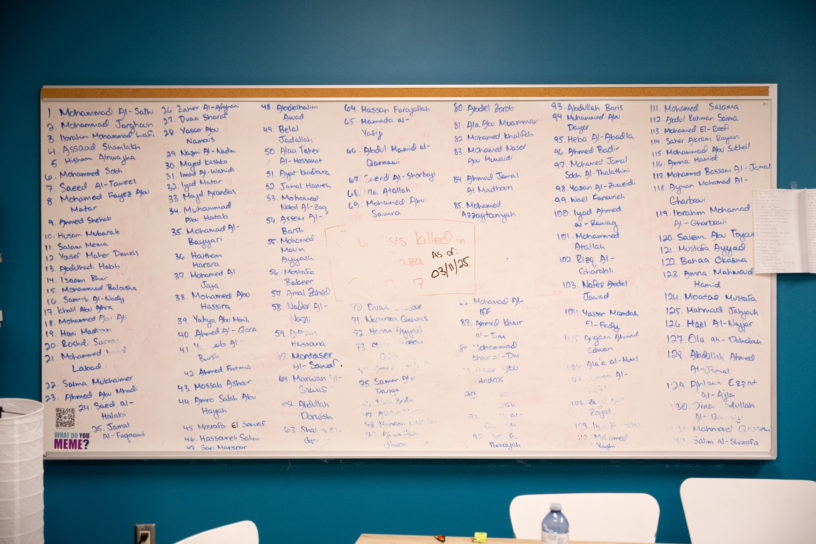
At some point during the Winter 2024 semester, however, the whiteboard was transformed into a memorial.
One by one, the names of journalists killed in Gaza were added in blue ink, until the board filled at 132 with Salim al-Sharafa, a presenter and journalist for Al-Aqsa TV, a son and a colleague, who was killed by Israel in 2024. So a blank piece of paper was taped beside the whiteboard, where the names of the journalists killed continued to be written down. And then another piece of paper was taped on—then a third, a fourth and a fifth. The names of 272 journalists are now committed to memory in the lounge. In the three years since it was posted, it’s not been touched. It has not been erased.
“I will not talk about the numbers because all members of my society, every child, every woman or journalist they killed—we should care about their dreams,” Shamun says.
And so remembering their names and their dreams is what the journalism students do.
Every time they walk into the lounge, they are forced to pause. To bear witness. It is a sobering reminder for the journalists born out of TMU, for the work they’ll have to do when they graduate into the industry.







Leave a Reply