

By Victoria Cha
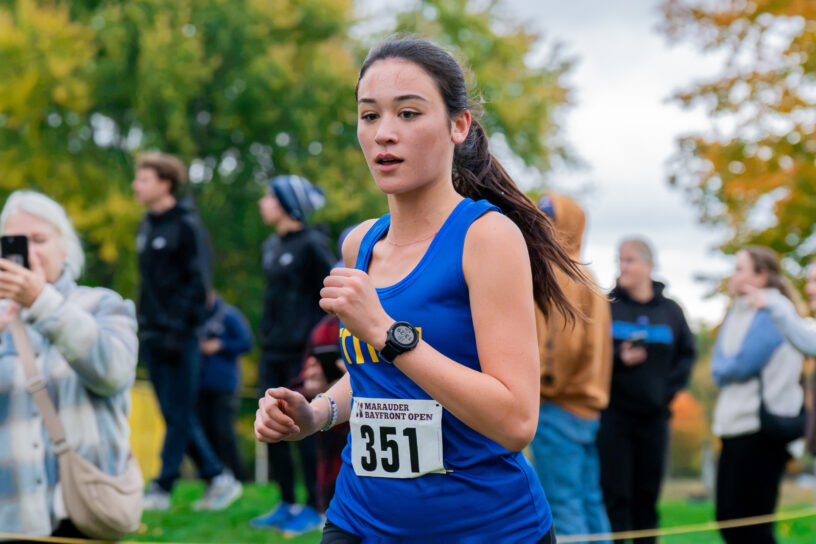
Audrey Hodowany is no stranger to commitment. When she isn’t training as a runner on the Bold cross-country team, she’s working as a research assistant on campus or as an Ontario University Athletics (OUA) ambassador. That’s not to mention attending class as a fourth-year nursing student and completing 12-hour hospital shifts in her work placement.
Hodowany handles each role with a strong sense of duty, but juggling so many responsibilities hasn’t come without strife. Hodowany has been open about her struggles with mental health, and her journey to a better headspace wouldn’t have come without a conscious commitment to caring for herself, as she does for those around her.
“Being successful or accomplished on paper doesn’t necessarily mean you’re doing well mentally,” she says. “You can be achieving all your goals and balancing multiple responsibilities, but if you’re struggling with your mental health, it can be difficult to feel fulfilled or fully present in what you’re doing.”
Hodowany moved to Toronto from Taipei, Taiwan, in 2022 to attend Toronto Metropolitan University (TMU), but she didn’t join the cross-country team until the 2025-26 season. During her first and second years at TMU, Hodowany had to discover who she was without her sport for the first time in over a decade, which she says was a challenge in itself.
“Without that consistent routine for exercise or competition, it was really hard to develop my own routine and also to feel a sense of purpose,” said Hodowany.
Having to acclimatize to a new city without her family by her side also weighed on her. Even when she found a way back to running in her third year, seeking a sense of community, she found herself facing moments that would spiral into periods of prolonged mental struggle.
“I overextended myself into things I probably don’t have time for,” she says. “There was definitely a time in the year when I was like, ‘I’m doing too much. I can’t deal with all of this. What do I do now?’”
Hodowany also mentioned the difficulties associated with non-team sports like cross-country. “There’s nowhere to hide in racing, everyone can see you there. If you come last, everyone can see you.”
When her piling responsibilities began to take a toll on her mental health, Hodowany began to realize focusing on the difficulty of her circumstances wouldn’t solve her struggles. After honest conversations with her parents, she decided her approach to school, work and running had to change.
Hodowany turned to an on-campus counsellor who works with athletes. She says this invited a new perspective—one that emphasized how she treats herself internally.
Hodowany compared self-care and performance to fueling a car. “If you’re a really nice car, you don’t pump yourself with bad gas. It’s going to run, but it’s not going to run really well,” said Hodowany. “What we put in is a big part of how we process our thoughts. You want to take care of yourself so you can process them well.”
For Hodowany, admitting she needed help—and then seeking it—allowed her to handle her demanding schedule with more clarity and autonomy.
“I would say it doesn’t necessarily get better—I handle it better,” she said. “Rather than focusing on everything that felt overwhelming or outside my control, I began focusing on what I could do to support my own well-being and take a more proactive approach to my mental health.”
Now, she navigates her mental health with more intention. When it comes to balancing her roles, she breaks tasks into individual steps, maintains a to-do list and knows when to put her wellness first.
As a captain on her team, Hodowany has been able to foster a welcoming community through this philosophy. That starts by showing up for her teammates.
“[Hodowany] is always there, always positive, always supportive of the other athletes,” said TMU head coach Charles Minor.
Hodowany said having a supportive athletic group on campus to identify with is a big help.
“It was really important for me to find a group of people who could do what we love together,” said Hodowany.
When fourth-year business technology management student Sana Ramay joined the team in September, it was clear to her that Hodowany was someone who showed immense kindness for others, and someone she would get along with.
“My first impression [of Hodowany] was she had this really welcoming energy,” she said. “I just remember immediately feeling super comfortable around her, and she seemed like someone I could genuinely talk to and be myself around.”
Ramay admires Hodowany’s attentiveness to her peers. “She notices little things, like maybe when I’m a bit quiet or something, she’ll be like, ‘Hey, how was practice?’ or ‘How’s your day been?’”
As a new runner on the team, adjusting to school and sport is a new experience for Ramay. Similar to Hodowany, having like-minded people to share the track with is crucial to her.
“The community that running has given me is just as important as the actual running,” she says.
“Having people who understand the training, competition, and balancing school makes the experience feel more rewarding,” said Ramay.
“There are many reasons why I keep showing up to run, and the friendships I’ve built along the way are an important part of that.”
That sense of belonging goes a long way in the sport, Hodowany says.
“We have a really wonderful sense of community within our team. We’re really well bonded so we cheer each other on whether we’re having a great race or not…When you look around and have all these people supporting you, a supportive coach and supportive teammates, it really helps alleviate the pressure in such a comparative sport.”
Fernanda Oneil was an international student ambassador at TMU alongside Hodowany. She said she’s constantly inspired by her friend’s dedication to her passions.
“Every single time I see her, I leave our time together [being] like, ‘Oh, I want to read something new’ or ‘there’s something new I’d like to research,’ just because she’s the kind of person that is constantly doing things, and it’s all the good things you would like to see yourself doing,” said Oneil.
Though her schedule is constantly demanding something of her, Hodowany has learned to put less pressure on herself to perform in certain ways. When it comes to running, that looks like “reimagining what competition is to me.”
Last year, Hodowany had suffered a stress fracture and was unable to compete. She set high expectations for herself and wasn’t satisfied with how her season panned out. She said focusing less on the competition factor of her sport has led her to see greater results from her races this season.
“I don’t go out there thinking I’m going to place a certain amount. I go out there honestly just to have fun, because it’s also my last year. My scores have gone up dramatically, and it’s crazy to think how much your mindset changes how you perform,” said Hodowany.
After a strong race at the McMaster Marauder Lakefront Invitational on Oct. 16, Hodowany secured a spot in the OUA Championship on Oct. 31, where she ran an eight-kilometre race in 35 minutes and ended up qualifying along with four other TMU runners for the upcoming U Sports National Championships on Nov. 14.
“I was really happy with my result, but it took everything out of me. I finished with nothing left in me,” said Hodowany.
After a four hour drive to Windsor, Ont., where the championship took place, Hodowany began her warmup and team exercises to ease the nerves. But before the race, she admitted that she felt slightly daunted by the terrain.
“There was a massive hill… I knew it was going to be tough. I kind of went into the race just being really nervous,” said Hodowany. “I wanted to walk off at 2K, but I really just pushed through it, and I ended up running faster than my previous race earlier in the year, my OUA qualifying race, which was a flat race.”
While she’s pleased with her results, for Hodowany, her biggest accomplishment was her resilience.
“Honestly, I would have been happy regardless of making or not making nationals, because the idea of wanting to quit and then not quitting is honestly a really big deal to me.”
The race was just another example of Hodowany being able to push through a difficult moment with the help of having the right mindset—one that could only be developed through past struggles and hardships.
Now that Hodowany has reached this point, she’s using what she’s learned from her own trials to advocate for mental health and inspire others as a student, athlete, teammate, friend and beyond.
“Throughout the years, you realize that mental health is ongoing rather than something’s going on, and we should just fix it,” she says.
“It’s a process. By accepting that we’re going to have down days and up days, that acceptance really helps get you through things,” said Hodowany. “If you take care of yourself and push through it, it’s going to get better.”







Leave a Reply