

By Molly Simpson
Two years after graduating in media production, 2023 Toronto Metropolitan University (TMU) alumna Camille, moved from her grandmother’s Newmarket home to an apartment just outside of downtown Toronto.
After a month of searching, she had found a position in media, working for a school board. As is often the case for early-career adults, Camille said finances are tight right now. Regardless, she’s optimistic about being at the beginning of financial independence.
At her job, she creates teaching materials for staff, covers events and works with video editing and photography—all skills she says she developed in her program at TMU. Camille said she’s content with her role and plans to stay for the foreseeable future with how the job market is.
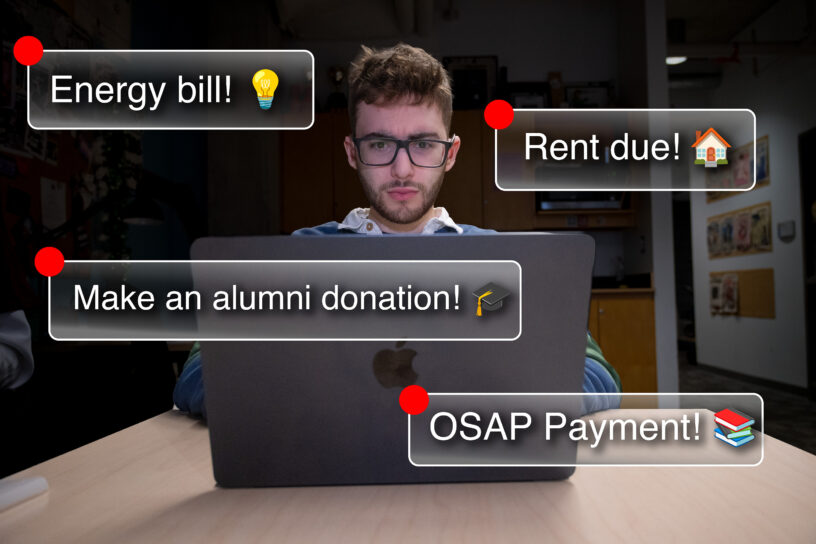
Now on her own, Camille pays around $1,600 for her less than 500 square-foot apartment. She said about half of her income goes toward rent, and the rest to utilities, groceries, gas and other bills, leaving her with little money to save.
She said she’s considering moving somewhere else with a roommate in the future. But living in the city has been worth it despite the high cost.
“It’s expensive and I’m spending more than I would like to be spending,” she says. “But moving back home is not an option for me…it feels like it would be a step backwards.”
Camille isn’t the only recent grad who’s found herself in a position like this. While venturing into the ‘real world’ has always been difficult, today’s graduates seemingly have the odds stacked against them. With the rising cost of living, housing and other expenses, many of them find themselves tightening their belts until they establish careers in their desired fields.
For fresh graduates in Toronto, these circumstances are perhaps worse. In the city, rent prices are up and many essentials cost more than they do outside the Greater Toronto Area.
According to the Canada Mortgage and Housing Corporation, the average rent for a studio apartment in October 2015 was $937. In 2025, that figure was $1,491—a 62 per cent increase in just 10 years.
According to Credit Canada, Toronto is one of the most expensive cities in the country to live in, largely due to living expenses.
For Camille, initially staying with family gave her some financial stability, yet she felt moving was necessary to live life on her own. She said while they often get along, there are a lot of “strong personalities,” in her house that could make living at home difficult, and this was one of the urging factors to move out.
Camille wanted to be independent, and have a space where she could figure out and experience her life as a Trans person, something she didn’t feel she could necessarily do at home. For privacy, The Eyeopener is not publishing her last name.
“I would rather figure it out in the space where I know that there is potentially going to be more support,” she said.
Moving into the city helped Camille with this, giving her independence and a space that’s more peaceful. “Living on my own, it’s nice because my space is mine.”
But even amid these circumstances, many fresh graduates say they are taking baby steps toward financial independence.
Alicia Dos Santos graduated from the graphic communications management program last spring. While studying, she had lived at home with her mom in Oakville, working a job at a local Starbucks.
Dos Santos now lives and works in Toronto, and feels she’s in a good place financially despite not finding a job in her industry.
Because she doesn’t have classes, her availability is open and she often works 30 hours a week. At the moment, she is working shifts at a Starbucks downtown. “I have more time in the day to work at whenever time.”
She said she now pays just under $900 in rent. Tracking her spending and income on an Excel sheet, Dos Santos said she’s been saving for the past two months. “So I’m on the up and I’m saving about half my paycheque.”
Dos Santos isn’t actively job hunting, saying she intends to wait for her industry’s peak hiring times in the spring and fall. After graduation she said she had planned to apply this fall, but didn’t. She said she no longer has a particular timeline in mind.
“I think to set a deadline for myself would not be super helpful. I think I’m just going to get it done when I get it done. And then I’d rather take the time to work on something that I’m proud of,” she said.
Some alumni don’t always end up in fields related to their degree. Wincy Li, associate director of career education at the Career, Co-op & Student Success Centre at TMU, said it has to do with the individual nuance a student brings to the table.
“Some students need to just make a living right away, get a paycheque and so they might just kind of take the first job in whatever field they happen to find a job in, and they navigate their career from there. Others might come with a little bit more experience or professional contacts and they’re able to land somewhere closer to where they want to be,” Li said.
She said sometimes students’ expectations of their early post-graduation life simply isn’t feasible, and they should be patient with themselves and their employers.
According to Statistics Canada, graduates with a bachelor’s degree or higher level of education have only experienced “modest” wage growth in recent years. They also report that this demographic’s average income is $39.18 per hour as of 2025.
The expectations of new grads versus the reality is clashing, according to a survey done by ZipRecruiter.
The survey found that 82 per cent of students soon to graduate expect to start working three months after graduating, with only 77 per cent actually accomplishing this. It also reported that on average, graduating students expect to make an average salary of $101,500 annually, but the reality is an average income of $68,400, a 33 per cent discrepancy.
Faye Dela Vega, a master of biomedical engineering student, who graduated in October is also navigating her post-graduation financial journey. Dela Vega said she worked part-time during school in retail, as well as taking on school opportunities, such as exam invigilation.
She said losing those school positions will be challenging, but she hopes things will balance out, as she’ll have more freedom to take on hours at her retail job.
In Canada, she’s only worked jobs unrelated to her degree. So, right now, she’s prioritizing building a career in her field over her finances. Dela Vega said she wants to be in research and development in the pharmaceutical or biotech industry within the next two years.
She said few people in her program have been able to get a job in the field, but finding them in Toronto is harder.
“My friend got a job in Sudbury…he relocated there because he got [a] full-time job there. But the problem is he’s far away from his friends,” illustrating the trade-offs often come with newly stepping into the job market.
Dela Vega, who is from the Philippines, lives with her mother’s friend, which allows her to keep saving while looking into roles related to her degree. She says she currently pays rent, utilities, food and other necessities.
Dos Santos said she had done something similar, living at home with her mom, which she acknowledged has provided her with a cushion if she accidentally overspends on something else from time to time.
“I think things would be much different if I had moved out for first-year and been on my own, because I definitely would not have had as much savings and I probably would have been a lot more restricted with my spending,” Dos Santos said.
Camille said that while finances can be tight, she’s not willing to neglect her social life. “There’s no real choice…This might be technically irresponsible if you look at it purely on paper, but I’m not going to spend my life being a hermit.”
She said budgeting for social activities requires some forethought and a “balancing act.” If she gets paid one week, she has to consider when her rent will be due.
“I have to be choosy with what I’m going to do…what am I willing to be worried about?” This can look like staying in with friends and watching a movie, Camille said.
Stepping out of graduation into an industry can be daunting and challenging. But Li wants students to remember that they are equipped and capable as they head into the job hunt.
“Know that you have skills and experience, even if you think you don’t, because in many ways, your school life, your academic life is preparing you for your career,” said Li.
“Think about all of the group projects, think about all assignments, the research that you have to do, all of these different things are actually building your skills, right? And those are worth something.”







Leave a Reply