

By Zanoah Plummer
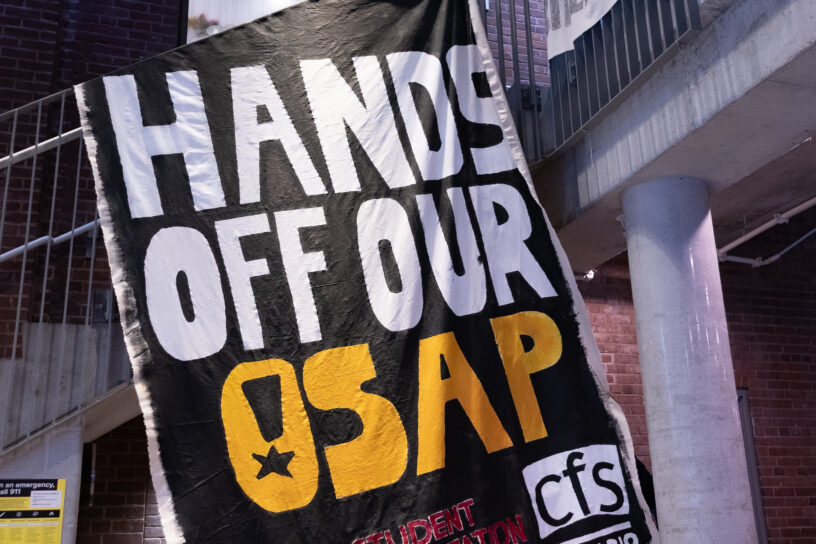
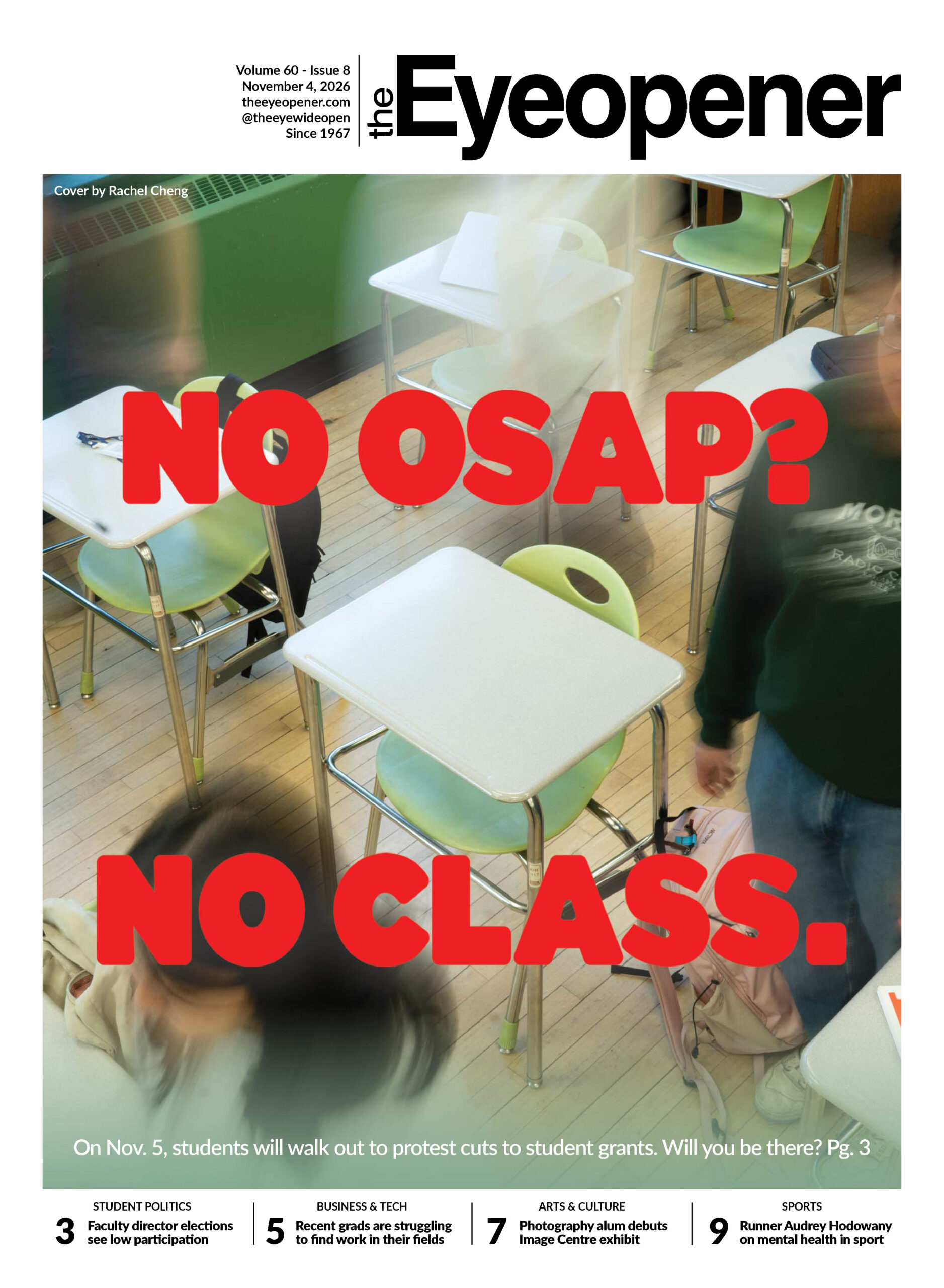
Students, professors and unions are preparing for a Nov. 5 walkout in protest of recent changes to the Ontario Student Assistance Program (OSAP) and Bill 33.
The date was selected by the Canadian Federation of Students Ontario (CFS-O), who intend for the action to be province-wide and span across several college and university campuses.
The Toronto Metropolitan Students’ Union (TMSU), the Toronto Metropolitan Association of Part Time Students (TMAPS) and the Toronto Metropolitan Graduate Students’ Union (TMGSU) have all endorsed the walkout.
The unions, in collaboration with the Student Mobilization Committee (SMC), are leading the contingent of Toronto Metropolitan University (TMU) students who are walking out. Participating students will leave class at 1 p.m. and gather near Lake Devo.
The walkout is largely in response to major changes to OSAP that reduced the maximum amount of funding the program provides through grants from 85 per cent to 25 per cent, as previously reported by The Eyeopener. The changes came into action this fall and many are already feeling the effects.
In an email to The Eyeopener, CFS–O explained the purpose of the action: “Our demands are clear: grants, not loans; an end to tuition hikes; and hands off admissions, research security plans and students’ fees.”
“We are calling for meaningful and consistent public investment in colleges and universities rather than policies that shift the burden of underfunding onto students,” it read.
TMAPS president Rose Finlay told The Eye the walkout was a “sister union effort” with the TMSU and TMGSU.
“We will all be meeting at Lake Devo and lunch will be provided, as well as just some more general information about the walkout and why we’re walking out and what our demands are to the province.”
Finlay said a petition will also be available for students to sign at the walkout.
Amnesty for the Nov. 5 walkout is not a university-wide policy and it is up to professors to decide whether or not to grant participating students amnesty.
However, the unions have created an email template students can send to their professors asking for amnesty.
TMU president Mohamed Lachemi told The Eye it will be up to students’ judgement whether or not to miss classes for the walkout.
“TMU respects our students’ right to demonstrate on matters that are important to them. Faculty and contract lecturers are aware of the walkout and invited to offer flexibility, if possible, for students who choose to participate in activities on Nov. 5, ” said Lachemi.
“This is up to the discretion of the instructors, and may not be possible for all courses.”
Some professors have chosen to grant amnesty for all students in their classes.
Thomas Hart, a philosophy professor, said he will make his class asynchronous in order to support participants.
“I think it’s important as an instructor, as a professor, as a teacher, to make sure that the students have the freedom to be able to stand up for what they count as important issues in their lives. And this one certainly is.”
Hart said during his undergraduate at the University of Ottawa, similar legislation resulted in students protesting against funding cuts to education. Hart said he participated in the action and called cuts to education a “perennial thing.”
“It felt like an existential threat, because it looked like the goal was to sort of make universities inaccessible in order to restrict, as much as possible, the number of people that were going to be there,” said Hart.
Megan Morgan is vice-president of equity at the TMSU. She said professors should encourage students to participate in the walkout.
“If this is taken into effect, they will have less students to teach. And I feel like it is important that they should encourage students to advocate for themselves and advocate for their tomorrow.”
Morgan said safety will be emphasized in the protest and the unions have ensured trained volunteers will be present in case students are uncomfortable with a possible police presence at the protest.
“We are being trained to have de-escalation tactics, just in case it gets a little bit too rowdy. We’re making sure that it’s a safe environment,” said Morgan.
Paige Garvey, a third-year nursing student, said her professors have not discussed granting amnesty to students walking out. Though, she said she can “see the importance of the walkout.”
“I would hope that [the government] actually see the effect it has on post-secondary students,” she said. “I hope they’ll make a change.”
Trudy Kuropatwa, the chair of the SMC, said the planning for the walkout started well before orientation week.
“We’ve been doing active outreach, talking to students daily on campus, one-on-one, in-class talks, connecting, again, to our student unions here at TMU and trying to, you know, light a fire under some of our democratic organizations so that when we do the walkout, it will be successful, that it will be large.”
“We want to be acting ahead of legislation like this that affects students, that affects workers across the board, and to win back those grants and to win back loans.”
Finlay said she hopes that the walkout will “better educate the student body.”
“I think we provide some really good educational input in this area and just looking forward to gathering with our membership body, educating and even strategizing.”
Finlay is also eyeing the actions or escalations that may follow the walkout.
“When we’re in these spaces, we’re collectively bringing together a larger community who can all kind of brainstorm what would be a good next step: a proposal for further protest or lobbying or whatever that looks like,” she said.








Leave a Reply