

By Damola Omole, Shumaila Mubarak, Vihaan Bhatnagar
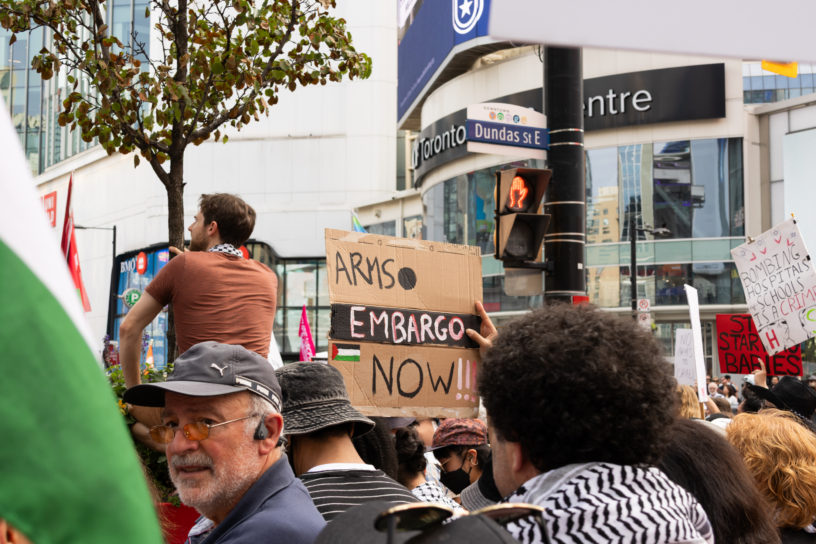
Toronto Metropolitan University (TMU) students marched down Yonge Street with several pro-Palestine advocacy groups on Aug. 16, demanding a full two-way arms embargo from the Canadian government on Israel.
The protest was organized by the Palestinian Youth Movement (PYM) with various student groups participating, including TMU’s own Students for Justice in Palestine (SJP), according to an Instagram post made on the organization’s account.
Shortly after 2:30 p.m., TMU students gathered on campus to demand the university for a full disclosure and divestment from companies complicit in the genocide in Palestine.
In a 2024 report from Amnesty International, Israel’s military offensive against Palestine was classified as a genocide, citing “during the nine-month period under review, prohibited acts under Articles II (a), (b) and (c) of the Genocide Convention.”
At the protest, SJP criticized TMU’s continued refusal to divest from Israeli companies.
“We’re here because TMU is complicit in the genocide of Palestinians, and they will refuse to divest from Israel and any companies that are complicit in the occupation and the genocide,” an SJP member said at the campus protest.
Earlier this year, in January, a Freedom of Information request was filed by TMU’s law students, which revealed TMU’s investments in companies like Alphabet, Oracle and Omers—firms that directly fund Israel’s military and technology being used in the genocide against Palestinians.
SJP further emphasized at the protest that despite two years of constant student pressure, TMU’s administration refuses to respond to their requests and calls regarding divestments.
“Our administration should treat us like humans. They should treat Palestinians like humans and it’s disgusting that after almost two years of the genocide, we still have to sit here and beg them to treat us properly,” said an SJP speaker during a speech.
The Eyeopener reached out to the university but didn’t receive comment in time for publication.
After protesting on campus the students eventually joined thousands of other protestors at Sanfoka Square. They then marched to the intersection of Bloor and Yonge streets, where the Israeli consulate is located.
This larger demonstration came less than three weeks after a July 29 report published on the “Arms Embargo Now” website, exposing Canada’s military exports to Israel, despite Prime Minister Mark Carney claiming—during April’s federal election—that “Canada does…have restrictions, probably from January 2024, on arms exports or permits for arms exports to Israel.”
The findings, uncovered by four non-governmental organizations: World Beyond War, the Palestinian Youth Movement (PYM), Canadians for Justice and Peace in the Middle East and Independent Jewish Voices, showed extensive track records of weapons, ammunition and vehicle components being strategically and systematically shipped out of warehouses in various Canadian cities including Calgary, Vancouver, the Greater Toronto Area and Waterloo.
Yara Shoufani, a spokesperson for PYM, told The Eyeopener she believes Canada should not be sending any military cargo or components to a country if there is a possibility that those components could be used to commit war crimes.
“What we’ve seen clearly is that Canada is unable to substantiate its claims that these components are not being used in the genocide in Gaza,” she said.
There is data uncovered by Arms Embargo Now and reported by CBC News that suggest that arms are still flowing from Canada to Israel. CBC News has confronted Global Affairs Canada (GAC) about the data but have not received any response.
GAC spokesperson Charlotte MacLeods told CBC News that “the government would not discuss individual deals.”
“There is as yet no explanation from the government of Canada for the discrepancy between data showing arms transfers occurred and continue to occur, and the government’s denials that it is happening,” as reported in the CBC article.
The Arms Embargo Now report also attaches Canadian-made components such as the “Nexeya Modular Product Tester” to vehicles such as the F-35 fighter, used in Israeli airstrikes.
Military cargo was loaded on commercial passenger flights to Frankfurt, Paris, New York, Abu Dhabi and New Delhi, the report reads.
Canada can’t have its condemnations and eat its genocide cake too
The protest paused at the intersection of Yonge and Carlton Streets, where award winning journalist and a co-founder of Canadian Journalists For Justice in Palestine (CJJP), Samira Mohyeddin spoke on the lack of representation of Palestinian journalists in the media.
“If you care about what’s happening in Gaza, then you need to bring Palestinian journalist voices to the front,” she said at the protest. “We don’t need Western journalists to tell our stories. We are capable of telling them ourselves.”
Mohyeddin also condemned Israel killing approximately 200 journalists as well as Canada’s response to those killings.
Benjamin Netanyahu, prime minister of Israel, is currently wanted by the International Criminal Court for war crimes, including using starvation as a method of warfare, intentionally directing an attack against a civilian population and crimes against humanity as defined by the International Criminal Court.
The United Nations has said Israel’s warfare methods in Gaza are consistent with genocide.
As of Aug. 17, at least 61,944 people have been killed, according to Al Jazeera. This figure includes at least 18,430 children.
On Aug. 10, Al Jazeera journalists Anas al-Sharif, Mohammed Qreiqeh, Ibrahim Zaher and Mohammed Noufal were killed in what Al Jazeera described as a deliberate Israeli airstrike.
Many at the protest held signs bearing the faces and names of the recently killed journalists.
Mohyeddin said she and ten other journalists founded CJJP out of frustration and wanting to “save” journalism in Canada.
When asked about her initial reaction to the killing of Al Jazeera journalists, she said, “it was devastating but not surprising.” She said Israel has “been working its way through a…list of journalists” it put out in the aftermath of Hamas’ attack on Oct. 7, 2023.
Mohyeddin also expressed dissatisfaction over the coverage of the killing of the Al Jazeera journalists in the Canadian media.
“I see something has shifted with the killing of these five journalists but I feel like [Canadian media is] not having the reckoning…they really should be having in terms of their coverage,” she said.
Mohyeddin, who worked at the CBC for nearly a decade, recalls Palestinian journalists being treated differently at the company, even before Oct. 7.
“At the heart of that, I really believe, is the fact that we don’t see Palestinians, A.) as journalists and B.) as colleagues,” said Mohyeddin. “Canada can’t have its condemnations and eat its genocide cake too.”
The protest also included other speeches from community organizers and an announcement for an upcoming peaceful hunger strike to pressure the Canadian government to end arms supplies to Israel.
The protest closed with one of the organizers reminding everyone of the ongoing violence in Gaza and a call to sustain public pressure.
“We know that our fight is not over. We know that people are continuing to be killed in Gaza every single day. So do not stop showing up. Continue showing up every single day for the people of Gaza,” said one of the organizers in their closing remarks.









Leave a Reply