

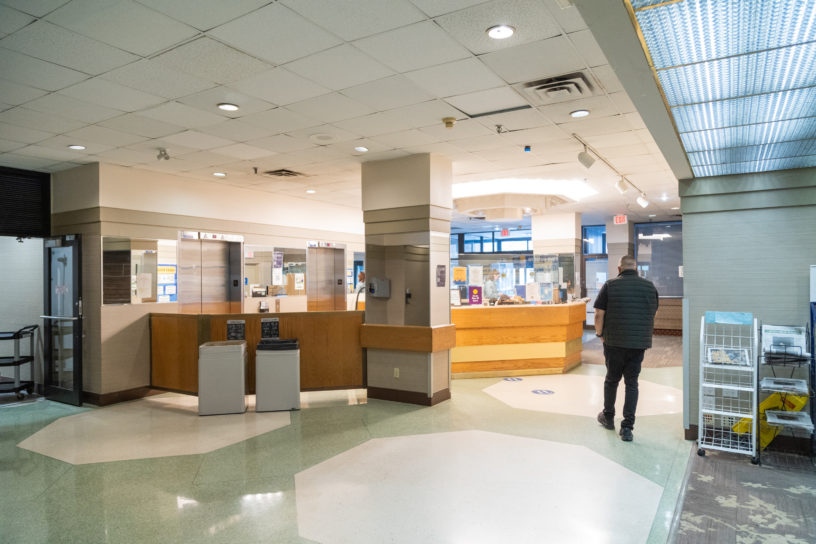
By Amira Benjamin, Vihaan Bhatnagar and Shaaranki Kulenthirarasa
The alleged mishandling of a student’s allergic reaction by staff at the International Living Centre (ILC) is raising concerns about how medical emergencies are dealt with in Toronto Metropolitan University (TMU)’s residence buildings.
Jess*, a first-year student at TMU with a soy allergy, said ILC staff delayed calling 911 on March 20 after she went into anaphylactic shock.
On the day of the incident, Jess said she asked the dining room staff if the food had soy in it. After staff repeatedly told her the food did not contain soy and that it was safe for her to eat, Jess had an allergic reaction. She said she had to go back three times before the staff confirmed the food had soybeans in it.
“They [went and] check[ed], and then [came] back and [said], ‘Oh, yes, that has soybeans in it, do not eat it,’ after I had already eaten it and had an allergic reaction,” she said.
Jess said she informed the dining hall of her allergies multiple times and requested them to label products that contained it.
However, she said they failed to accommodate this request.
“I had actually asked them why they don’t have the restaurant standard allergen sheet where the common ones are at least listed…and they said that it’s too much work,” she said. In an email statment to The Eyeopener, Housing & Residence Life stated that they cannot comment on speciifc incidents but “we are committed to the health, safety and wellbeing of our students, faculty and staff.”
Jess said she usually uses over-the-counter medication to manage her allergies reactions, but she had run out by the day of the incident.
According to the Government of Canada’s website on food labelling, “Health Canada developed amendments to the Regulations to enhance labelling requirements for specific priority allergens.” This includes soybeans.
However, these requirements apply to prepackaged foods, but do not apply the same way to food served in dining halls and restaurants.
When Jess had her allergic reaction, she said she requested the staff to call 911. But they contacted TMU security instead to make the call.
Housing & Residence life also stated that “TMU Community Safety and Security’s protocol is to notify 911 immediately in the event of an emergency on campus, and that we also encourage our students, faculty and staff to do the same.”
When security arrived, she said she was expected to explain everything that happened while she was in anaphylactic shock.
Jess said despite her lips turning visibly red and her describing swelling inside her mouth and throat, security did not call 911 immediately. Instead they started monitoring her heart rate.
When her heart rate stated showing inconsistencies, that’s when Jess claims they called 911.
The Eyeopener reached out to the univiersty for comment but did not recivce a response in time for publication
After returning to the ILC following treatment at the Toronto General Hospital, Jess said she was unable to re-enter her residence using her ID card and had to wait 30-40 minutes before getting access.
“It was really confusing, because I was tired,…I was going around all day. I still had the probes on me from the hospital,” she said.
“…After I had already eaten it and had an allergic reaction”
Jess said after explaining her situation, the front desk staff needed to call management, who weren’t answering their phone calls. It was only when her Residence Advisor (RA) contacted them that she was granted access again.
This is not the first time residence staff’s actions during a medical emergency have been under scrutiny. In [2024], front desk attendants at Pitman Hall refused to let first responders through with the responders eventually forcing their way to the elevator, as previously reported by The Eye.
The student who called 911 was told by security they should have been called instead of first responders because they are trained in the exact same way as paramedics, a fact she later learned was untrue.
In an emailed statement to The Eye in 2025, the university said that “some of TMU’s full-time front-line crew members also have advanced medical knowledge, including: Emergency Medical Responder (EMR) training.”
EMR’s are equipped to provide some out-of-hospital care in medical emergencies, however EMR’s cannot replace the role of Emergency Medical Technicians (EMTs) or Paramedics. The university did not share how many TMU Security staff members are trained as EMR’s.
“If I see someone getting a heart attack, I’m not calling security, I’m calling 911”
Alex Fontanin, a first-year accounting and finance student at TMU who lives in Pitman Hall, had a medical emergency after taking too many laxatives, causing him “the worst pain of [his] life” and leading him to vomit multiple times.
Fontanin called 911 and asked for paramedics, who had no issue coming through the security desk at Pitman Hall and coming up to his room.
He said he did not know that he should have called security first.
“I don’t understand why that’s a rule. I feel like that shouldn’t be a rule, honestly. If I see someone getting a heart attack, I’m not calling security, I’m calling 911,” he said.
Fontanin spent the night in an emergency room and after returning to Pitman Hall the next morning found his residence keycard had been temporarily disabled. However, it only took a brief explanation that he was alright with the residence staff for his keycard to start working again.
“I was kind of annoyed, not going to lie, because I hadn’t slept the whole night, and I just want[ed] to go to my bed…I [was] like, ‘Why are you blocking my res ID?’” he said.
Jess said some of her friends have faced similar issues of their residence ID being temporarily disabled after coming back from the hospital.
Students not only report facing issues during a medical emergency while living in residence but also during their recovery phase.
Josephine Millard, a third-year performance: dance student at TMU who has lived in Pitman Hall for the past three years, had to get surgery after she started feeling pain that was later determined to be appendicitis.
She said due to not being able to walk properly, she needed her partner to help with her recovery.
Despite Millard’s partner being given a note signed by residence management allowing her to go up without needing Millard to get her, there were still challenges.
“I know that they have to be careful about who they sign in, but having said that she would show them the note signed by housing residents and the staff would be like, ‘We just don’t know if she can come up.’ Meanwhile, I’d be waiting for my bed for my medication,” she said.
Millard said there were times when she would be taking a nap and front desk representatives would call her to confirm whether her partner was actually a guest.
“I feel like it’s kind of on the people at Housing & Residence Life to communicate with their staff,” she said.
*This student has chosen to remain anonymous. The Eye has verified this source.







Leave a Reply