

By Mishael Taruc
A Toronto Metropolitan University (TMU) graduate student and startup CEO is developing a medical device to assist in clearing airways and mobilizing mucus for patients with respiratory issues in long-term care.
Ali Abedinpour, a master of engineering innovation and entrepreneurship student and founder of Atabazh Medical, was only 23 years old when he watched his grandfather struggle with chronic obstructive pulmonary disease.
In his grandfather’s case, mucus had to be expelled from his lungs regularly, which being bedridden made even more difficult, Abedinpour said. Caregivers administered manual chest percussion on him at least once every two days.
To perform the treatment, caregivers cup their hands with their fingers close together as if trying to catch water. They then tap the patient’s chest rhythmically, creating a hollow sound to unblock airways, according to the U.S. National Institutes of Health.
“That moment stayed with me,” said Abedinpour, now 37.
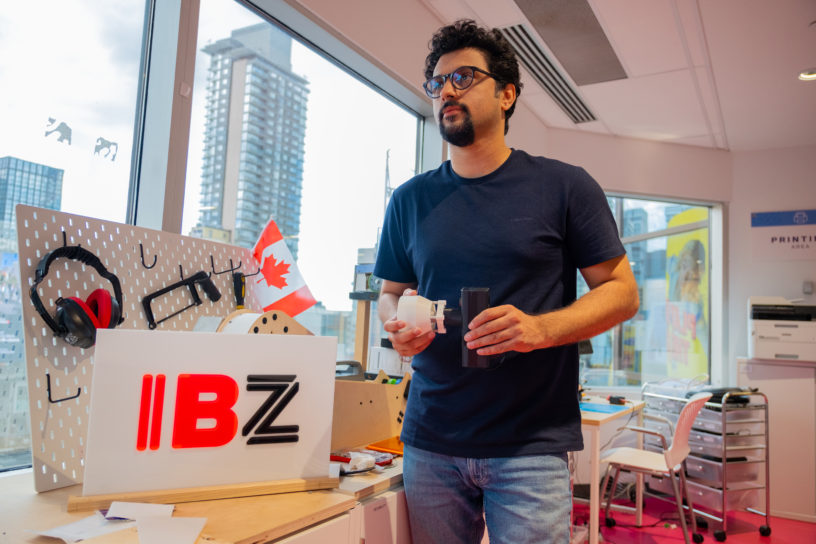
Seeing a loved one struggle inspired the idea behind Abedinpour’s Smart Lung Physio, a handheld medical device with a soft cup attachment that delivers controlled mechanical chest percussion. He said it measures the applied force and frequency, helping the user be consistent in providing the treatment.
If done manually, the effectiveness of chest percussion depends on the caregiver’s experience, Abedinpour said. “There is no consistency,” he said, so he built “something that can make this process more standardized and more measurable.”
Measurability is important because force and frequency may have to be adjusted from patient to patient, he said.
Tarek Sadek, the executive director of the Centre of Engineering Innovation & Entrepreneurship at TMU, said patients not getting the proper treatment can lead to “long-term deteriorations in their lung functions.” He has been supporting Abedinpour’s journey as his instructor and advisor.
At the moment, Abedinpour focuses on seniors. “I’m hoping in the future…it can be used at home by a simple caregiver,” said Sadek. “This also will alleviate a lot of pressure from our hospitals and nursing homes.”
Abedinpour built two versions of the device in Iran before coming to Canada in 2023 to pursue graduate studies. He said his program taught him to not only think like an engineer but also like an entrepreneur.
Abedinpour said he had to learn the nitty-gritty of building and running a startup—including speaking with stakeholders, pitching the product, seeking grants, talking with investors and testing assumptions.
Atabazh Medical was among the 27 startups exhibited in the Brampton Venture Expo on Sept. 10 where he introduced his product to investors, industry partners and fellow innovators.
He said aspiring engineer-entrepreneurs should listen to their customers before building the technology. For those who want to build medical devices, thinking about how it fits in real-world clinical workflow is necessary.
“I found that the problem is real. So that gives me more energy to continue,” he said.
Sadek’s advice for aspiring innovators with big ideas is to focus their work on a problem they want to solve.
“Don’t make the idea about the solution, make the idea about your understanding of the problem.”
The Smart Lung Physio is now in its third iteration, over a decade after the idea’s inception. Still, Abedinpour said more work has to be done before it could become commercially available.
His grandfather never got the chance to use his innovation. All the same, Abedinpour is determined to bring his product to the market.
“If I can help someone, or I can save a life…that’s everything for me. That’s why I’m living.”







Leave a Reply