

By Mishael Taruc
Toronto Metropolitan University (TMU) was among the top ranking North American universities for transportation in the 2026 Sustainable Campus Index.
The report took into account the modes of transportation used by students and employees, the sustainability of the vehicles in the university’s own fleet and efforts to lessen business air travel.
“By reducing dependence on combustion-driven transport, institutions can model sustainable transportation systems that benefit human health, improve campus operations, and reduce costs,” the report said.
Some students say this reflects their own transportation habits.
Charlotte Brooks, a second-year environmental and urban sustainability student, takes the streetcar to campus, which she says is “more sustainable than driving.”
Another second-year environmental and urban sustainability student, Methum Jayasinghe, travels from Hamilton to Toronto for an hour and a half via the GO train and TTC.
In a statement to The Eyeopener, the university said, “TMU’s downtown location was a major factor in its ranking…our institution’s location offers multiple sustainable ways to get to campus, including walking, bicycling, car sharing, ride sharing and public transit.”
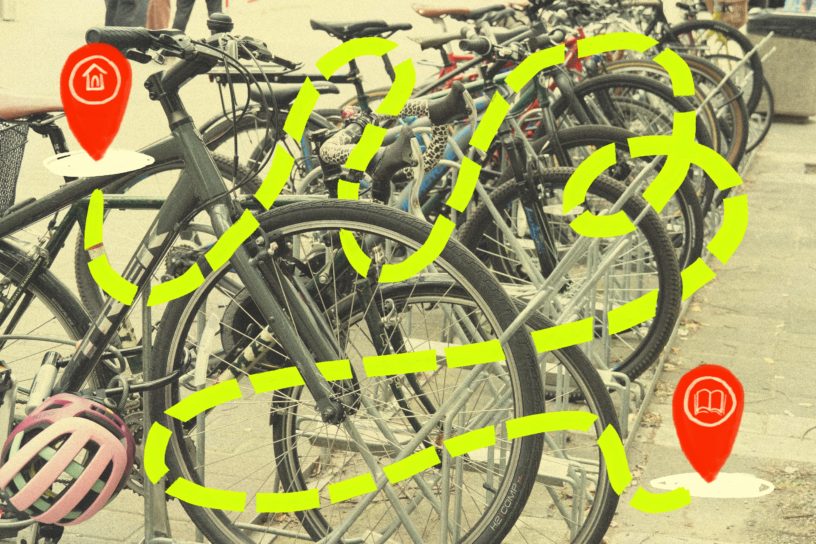
David Hunter, a master of spatial analysis student, said the most efficient way to get around the city is biking. “It’s really great to bike in the city as long as you can find the right bike routes,” they said.
A 2025 Nature Cities study found that in U.S. cities, protected bike lanes was linked to an increase in cyclist commuter mileage—52.5 per cent stronger than standard bike lanes and 281.2 per cent stronger than sharrows or lanes shared by bicycles and other vehicles.
In parts of downtown, there are gaps in infrastructures for cyclists.
When Hunter lived on Bay Street, they struggled when travelling south toward the waterfront due to the lack of protected bike lanes.
“In fact, they just spray painted a bike symbol on a path on Bay Street. And there’s no protection and cars will zip around you,” they said.
The Eye previously reported that the province began removing bike lanes in parts of Bloor Street West in Etobicoke and plans to remove those along Yonge Street, University Avenue and Queen’s Park.
Meanwhile, Jayasinghe said it would be helpful if TMU had a program providing TTC discounts since “it’s a commuter school.”
The TTC monthly pass for post-secondary students currently costs $128.15. However, this may not be the most feasible option for many students. “I don’t spend over $100 on TTC a month,” said Brooks.
Some students say there are areas beyond transportation where TMU still has work to do in the way of sustainability.
Brooks said building more student residences would improve campus sustainability. TMU has three residences with a capacity of 1,144 beds—a low figure for over 40,000 enrolled students. The new Bond Street residence, which will double the campus housing capacity, is targeted to open in 2030.
Meanwhile, third-year urban and regional planning student Gabriel Joseph Remot looked to more immediate sustainability solutions. He argued for limiting single-use plastics on campus.
Remot also pointed out that the Hub Café uses recyclable containers but he often sees that these aren’t being returned.
The Hub Café uses containers produced by Friendlier, for which students pay a refundable deposit of $0.50 with their order. After finishing the meals, students then return containers. A week or two after the return, students could request a refund or donate it to their chosen charity through the Friendlier app.
TMU aims to be a zero waste campus by 2035, and achieve a 90 per cent waste diversion rate, meaning only 10 per cent of its waste should go to the landfill and the rest is composted, recycled or reused. In 2025, TMU’s waste diversion rate is at 35.6 per cent.
“Reaching our zero-waste goal depends on students, faculty and staff actively participating—sorting waste correctly, reducing waste and making use of campus reuse programs,” the university said.
Hunter said it’s important that TMU prioritizes sustainability as it shapes “the next generation of workers.” They said planting the seed early on helps students to “start thinking about sustainability.”







Leave a Reply