

By Francesco Cautillo
It’s the evening of Nov. 4, and Toronto Metropolitan University’s (TMU) Kendo Club president Jazz Yeung is in the basement of the Podium building preparing for their annual safety meeting.
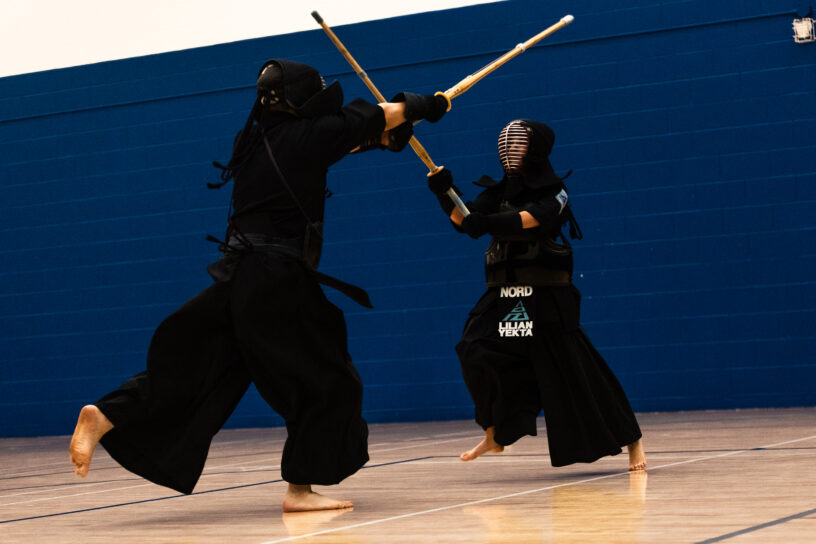
Kendo is a sword-fighting martial art deeply rooted with Japanese cultural ties. The word ‘Kendo’ translates to ‘the way of the sword’. In this competition, combatants look to strike the opponents’ head, chest, neck and wrists through the use of technically-demanding motions.
Yeung, who is a fourth-year social work student, started the sport only a year ago. They say the movements involved in the sport “might be a deterrent for some people” at first, but the sense of community and routine of Kendo itself eased their transition into the sport.
“When you do exercise and do this intense training that has a military background, you tend to form really close bonds with the people you do this with because Kendo’s hard,” said Yeung.
To balance the intensity, Yeung organizes monthly socials outside their Kerr Hall Gym dojo, making sure all club members get “a chance to really get to know each other.”
While Yeung prepares the safety seminar, their clubmate Sebastian Brawn-Czapski prepares the swords, or shinai (竹刀), with an oiling treatment.
Brawn-Czapski, a fourth-year child and youth care student, joined the Kendo club just under two years ago, around the same time as Yeung.
As someone who enjoys medieval martial arts, Brawn-Czapski was eager to explore the sport, quickly discovering the balance between the sport and the cultural traditions attached to it.
“I was not necessarily expecting this level of rituals attached to it,” said Brawn-Czapski. “It’s almost like a form of meditation.”
With that said, Brawn-Czapski used the sport to his advantage, quickly adapting to the principles of the traditional Japanese sport.
“It gives you a space to exercise with friendly people that don’t mind you being you, so long as you’re following the guidelines and the rules of the dojo.”
The TMU Kendo Club has also fostered a community of acceptance, often bringing together Queer and neurodivergent groups among other members.
Brawn-Czapski, who is neurodivergent, describes the sport as incredibly relaxing for those like him.
“We spend a significant amount of our time masking to try to be normal,” said Brawn-Czapski.
Now, he and other neurodivergent members can replace their social mask with a Kendo mask, called men (面), and other protective armor called bōgu (防具). Equipped with protection and their swords, called shinai (竹刀), members are ready to train.
Yeung said the club members often connect with their “similar hobbies outside of Kendo,” saying that “when you have stuff in common, it’s easier to talk and connect.”
Not only does the club hold themselves responsible for being welcoming to all, but they are also accountable for the crucial acts of dojo etiquette associated with Kendo.
Some of this etiquette involves bowing in, lining up in a specific fashion and making sure to bow to the dojo and any sensei that are present.
“It’s pretty fundamental [to preserve] because if we go and visit other dojos and break etiquette, then we look really bad,” said Yeung.
Both Brawn-Czapski and Yeung said that preserving Japanese culture is also an essential part of the club’s principles.
“Traditions make us whole,” said Brawn-Czapski. “We have international students here. You want to look for something that reminds you of the structure that you’re used to. So having something like that, having a space like that set up in TMU, makes us more inclusive and a space for everyone from around the globe to just come out and learn new things.”




Leave a Reply