

By Sophie Wallace
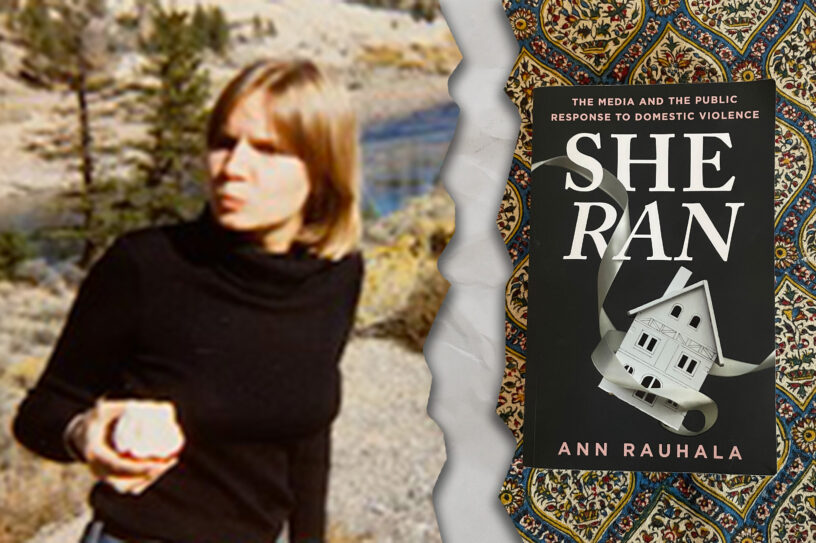
Ann Rauhala was drawn to journalism through an urge to tell stories. She came to Toronto from Sudbury, Ont. in 1973 to study. She went on to do a BAA in journalism at Toronto Metropolitan University (TMU) from 1977 to 1979.
When she was 21, Rauhala’s best friend was murdered in a brutal case of intimate partner violence (IPV). The loss has stayed with her throughout her long career as a foreign editor for The Globe and Mail, a television news documentary filmmaker at CBC and a professor of journalism at TMU.
Nearly 50 years later, Rauhala decided to write about it. The result, She Ran: The Media and the Public Response to Domestic Violence, published Oct. 2026.
She Ran is a beautiful, intimate and hard-hitting examination of the people and the grief IPV leaves behind, and what it will take to move closer to eradicating this violence from our society.
This interview has been edited for length and clarity.
As journalists, we’re taught that we have to remove ourselves from the story, even if we are activists at heart. How did you strike the balance between memoir and investigative journalism?
I was also taught to keep myself out of the story. It mystifies me a great deal that there are still journalism instructors in Canada promoting this idea of objectivity. No one I ever taught was told that objectivity was the goal.
This wasn’t a completely fact-based reporting project. This was my life’s work, and I wanted to step up and say what really went on.
I think an important key to addressing this enormous social injustice that we seem to be so poor at recognizing is to have a sort of Me Too moment on this front.
I invite every woman, but particularly those who have really won a lot of life’s lotteries, to step forward and say, believe it or not, I was abused. And I’m seeing that happen now.
How could I call on other women to do that, if I’m not willing to say, you know, I had a boyfriend who I thought was going to hurt me one day, and I decided to leave?
In the book, you touch on the idea that there’s no such thing as the perfect victim. It’s so easy for people to think that IPV is only something that happens to other people. What are some misconceptions that contribute to IPV being so pervasive?
Well, first of all, this attitude that somehow certain socioeconomic or ethnic groups are more predisposed to this kind of violence—it just isn’t true. IPV is absolutely everywhere.
And I speak from now personal experience, because since the book was released, I’m having strangers, or friends of friends, disclosing to me the violence they endured, at least twice a week.
I think another issue and another problem is our own sense of, “oh, this is a private matter.” That is such a falsehood, because we know that this kind of violence brewing in privacy can erupt into a deadly mess that affects all kinds of people who are completely uninvolved.
In She Ran, you don’t try to neatly solve anything, and you touch on the idea of ambiguous grief, which I think will resonate with a lot of people who have lost people in this way. Could you talk us through the emotional process of writing the book?
My discovery of ambiguous loss and the thinking behind it was revelatory. I was finally seeing my grief with some kind of perspective. And it seemed so familiar, and yet so novel at the same time.
Understanding the framework of ambiguous loss informed the journalistic choices that I made. There were parts of the book that were incredibly easy to write. The first 25,000 words were just sort of hands on the keyboard, it was very easy to figure out where to go and what to do. And then I was kind of stumped.
Then, as a journalist doing a big project, you’re thinking, okay, well, who should I interview? Who else’s opinion matters here?
You know, there were plenty of reports and plenty of experts I could go to. But what nobody else could do was find a way to go through those steps of ambiguous loss, in a way that was really meaningful.
Then I saw this angry man on television, at a news conference, saying, ‘this should never have happened to my daughter.’ And he was right to be that angry. But it was like, oh, this is what I want. This is what I would have loved to have heard back when my friend was murdered.
These wonderful people were stepping forward in a way that I had not been able to step forward. And it was time to step forward.
A lot has changed in the past 50 years. But where do you think newsrooms still have gaps in how they report on IPV?
First, let me be hopeful. There have been incredible improvements. I don’t think it’s any accident that a lot more decision-makers are women now.
We went to journalism school and medical school and law school and became social workers and doctors and lawyers and advocates of all kinds. And we were not willing to step away. We did what we could.
The only reason women’s shelters have existed since the mid-1970s, or the reason special domestic violence units exist at police services, is because the women of that generation and their allies pushed for that. But I think it’s time we could start pushing a lot further. There’s a lot more to be done.
A clear opportunity, to me, is exploring coercive control. This is the sort of intimate bullying, controlling, criticising, verbal abuse and psychological abuse. It is less visible, and less understood.
If we have police officers who aren’t trained to see it and understand its impact, if we have judges who can’t see it and don’t understand it, we’re not going to make much progress. So, I would really love to see young journalists look closely at coercive control.
Intimate partner abuse is a spectrum. And it can start as simply as a guy who’s stalking his girlfriend on a phone. And it can end with a woman and her children murdered. If we decide to make it a priority, we could actually save people’s lives.
Finally, what do you want people to know about your friend?
She was an intelligent, warm, kind, young woman who clearly had a big future ahead of her. And I and dozens of others were deprived of having the opportunity of having her go along our decades together.
She would certainly have been influential in any community she lived in, and she always had an instinct to stand up to bullies, and to look out for the underdog. In her short life she demonstrated that.
She was alive, and she was lively and funny and energetic and had her little insecurities and could laugh at herself.
Those close to her lost a lot, but we all lose a lot when someone like that leaves us for no reason other than the unattended mental health struggles of a young man who believed that he loved her.
So, we should never have lost her and I don’t want anyone like her to go missing the way she did anymore.






Leave a Reply