

By Daniel Opasinis
Disclaimer: This article is not meant to serve as legal advice. Please seek your own legal counsel when needed, as the laws surrounding these situations vary greatly depending on the circumstance.
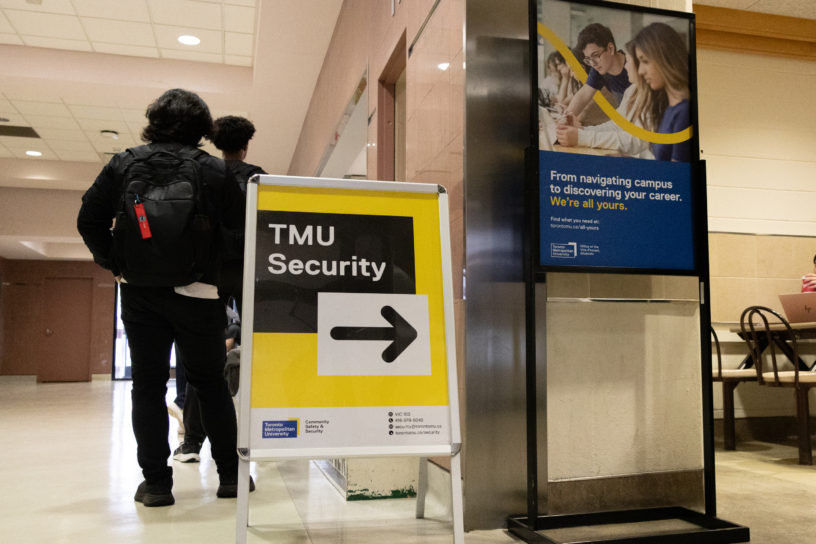
Toronto Metropolitan University (TMU) security personnel can be seen across campus adorned in yellow, black or blue polos under their “GardaWorld” badges.
Recently, videos have surfaced of TMU Security physically restraining a student on campus after a demonstration at a Dais event Friday, as previously reported by The Eyeopener.
Student’s rights on campus have become a topic of conversation and it’s important to know where you stand. The Eye spoke to a criminal lawyer to find out what guards are allowed to do and what students should know.
The following relate to campus security guards specifically, not to be confused with campus police, whose role descriptions differ.
Can security guards put hands on you?
Yes, but they need a reason to do so.
Under section 494 of the Canadian Criminal Code, any civilian or private civilian may perform a “citizen’s arrest” on someone who has committed or is suspected of committing a crime. Since campus security are not police officers, their abilities fall under those of other regular civilians.
The use of force in circumstances like these is key, as an unnecessary use of force could lead to criminal liability, the lawyer explained.
The Trespass to Property Act allows property owners to ask individuals to leave their property if they so choose. If an individual does not follow their request, private agents—like TMU Security—can physically remove a person from property. Of course, the use of force here is still important to note, and cannot exceed what is necessary.
Outside of these situations, where there is no reasonable grounds, security putting their hands on someone is not warranted and could be assault, wrongful imprisonment or a case for other legal wrongdoings.
Can security guards detain you?
This also falls under the citizen’s arrest as security guards are able to detain an individual but only until police arrive.
Security cannot detain you for questioning or investigative purposes, as a citizen’s arrest requires a crime committed or the suspicion of a crime.
Can security guards arrest you?
The suspicion of committing a crime goes further than just a feeling. An individual conducting a citizen’s arrest—in this case security guards—must have reasonable grounds to believe the person they are arresting has committed a crime.
Reasonable grounds is more than a “hunch,” it’s enough evidence that the regular person with common sense would believe a crime was likely committed.
There are three main reasons security guards could have the right to arrest someone.
The first reason would be that they were witness to, or found out that an indictable offence was committed. In summary, an extremely serious crime like murder, assault or theft over $5,000—to name just a few.
The second reason security guards could arrest someone is with reasonable grounds to assume they are fleeing or evading arrest from lawful authorities.
The third main reason is stated in the Trespass to Property act in Ontario, which says property owners can arrest, or have private agents arrest someone who is committing a crime on or in relation to the property they own. This reason is especially common in instances with campus security, the lawyer said.
In all situations, when an arrest is made by private agents like TMU Security, the guards must immediately turn the individual over to police, who have the authority to conduct investigations.
Can security guards question you?
Security guards can ask you whatever they want, like why you are on the property, or even for a piece of identification, but this doesn’t mean you have to answer.
Other than instances under the Trespass to Property Act, where a property owner or agent could ask you to leave a property after committing a crime, you shouldn’t have any legal obligation to answer the questions of a security guard.
Any questioning done in relation to a citizen’s arrest must be supported by a legal authority, otherwise police, as they are the only ones with the ability to conduct an investigation.
The lawyer added that deciding to answer questions could impact your case, if the situation escalates to the courtroom. Deciding to answer questions from campus security guards could also complicate you in a student code of conduct issue.
Campus security are not police officers and are not required to advise you of your rights before questioning. It’s important to know that you are not required to answer questions from TMU Security and to seek legal counsel in the event of a police investigation.
How are student’s rights protected?
The Private Security and Investigative Services Act (PSISA) of Ontario requires security guards to be licensed and sets out guidelines for required training on use of force, legal authority and how to de-escilate a situation.
Violations to the PSISA may lead to a security guard receiving disciplinary action or even losing their license.
While security guards could be held criminally responsible for wrongdoings on the job, students also have the option of pursuing civil litigation—suing for damages incurred from wrongful imprisonment, assault, battery and more.
If a student suspects that discrimination took place in their encounter with campus security, it’s possible there is a claim under the Human Rights Code.
The lawyer added that since universities are often publicly funded institutions, there could even be claims under the Charter of Rights and Freedoms.
Students may also be able to file complaints to the guard’s employer, the academic institution or the Private Security and Investigative Services Branch of the PSISA.
What students could do if they feel their rights have been violated
The lawyer said that asking questions, staying calm and documenting everything is the first step to advocating for yourself. Security guards are required to carry their license with them under the PSISA and you are within your rights to ask them to present it.
If you feel that security guards used excessive force when removing you from the premises or arresting you, even under reasonable grounds, consider contacting police as you would with any other civilian assault.
Seeking legal advice can help if you have been harmed or feel your rights have been violated. Since the laws around security guards vary greatly from case to case, a lawyer could provide insight and help build a case to right those wrongs.
“One last thing, I hate to say it, but there’s a stereotype about lawyers that their answer to every question is ‘it depends’ but it’s really true and every case can be different and fact specific,” the lawyer wrote in an email to The Eye.
And again, while this article is meant to help keep you informed, it does not replace professional legal counsel. Stay safe and continue to advocate for everyone on our campus.






Leave a Reply