

By Vihaan Bhatnagar
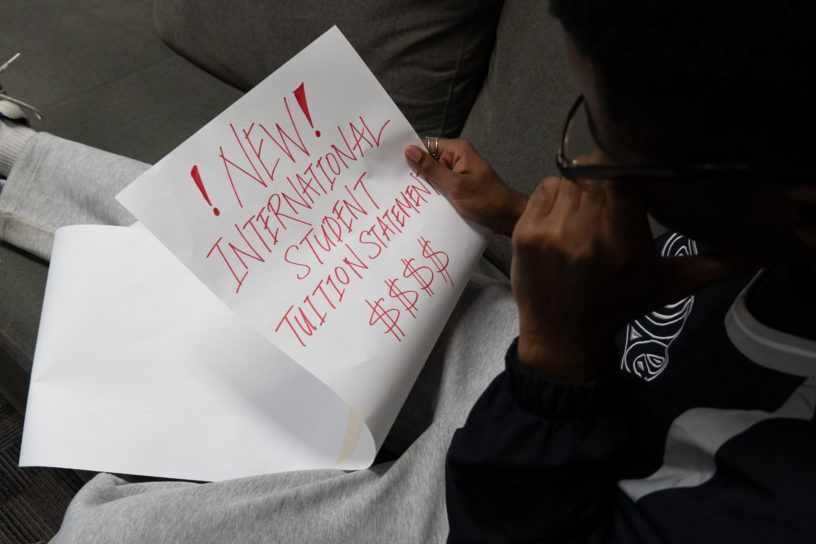
Toronto Metropolitan University (TMU) rescinded a policy that allowed international students with open work permits to pay domestic fee rates starting Fall 2025, according to an email sent by TMU ServiceHub to affected students in November 2023.
In a separate email from provost Roberta Iannacito-Provenzano sent in March 2025, she told affected students that the university gave them “advanced notice” via email on July 10, 2024. Students who were approved for an international fee rate exemption before July 10, 2024 may continue paying domestic fee rates until they complete their studies or their current work permit expires—whichever comes first.
The Eyeopener has obtained both these emails.
Many students who had gotten an offer of admission from TMU before July 10, 2024 did not have access to their TMU emails before this date, a requirement to apply for the exemption. The then-incoming students were not notified of this deadline until March 2025.
Open work permits allow the holder to work for any employer, while closed work permits are tied to a specific employer, according to the government of Canada. Under this change, only international students with closed work permits can pay domestic fee rates at TMU.
The change affects over 200 TMU students, most of whom are Iranian, forcing them to pay close to five times as much in tuition.
In an email to The Eye, TMU president Mohamed Lachemi said the decision to update the eligibility criteria was made in July 2024 to coincide with Immigration, Refugees and Citizenship Canada (IRCC) deadlines as well as to align with other universities.
“The change was communicated to prospective and current students well in advance to allow sufficient time for financial preparation,” read the email.
In September 2022, Mahsa (Jina) Amini was arrested in Iran for improper veiling. She died in ‘morality police’ custody—patrols tasked with detaining people who violate the religious laws and dress codes. Worldwide protests erupted in response, as well as inside Iran where brutal crackdowns were placed by the Islamic Republic. There were more than 550 documented deaths by early 2023, according to a 2024 report from a United Nations fact-finding mission on Iran, with the estimated number being higher.
In response, the Canadian government made it easier for Iranian citizens to stay in Canada if they were already here to study, work or spend time with family.
The government also allowed Iranians who came to Canada on a visitor visa to apply for an open work permit.
Karan Kaviani is an international student from Iran in his third-year of biomedical sciences. He came to Canada on a visitor visa in July 2023, changing it to a study visa in October 2023.
According to the university’s website, the tuition for Kaviani’s program is $7,281.38 every school year, which is the amount he currently pays. Now with the university’s policy change, he will have to start paying $36,815.24 every year after his original open work permit expires in September 2026 until he graduates in 2028.
Kaviani currently works two jobs and gets some financial assistance from his parents to afford tuition.
He tried to get assistance from the TMU Ombudsperson, who said they were in communication with the office of the registrar but students had the option to escalate the issue to the Ontario Ombudsman.
Kaviani then decided to transfer to York University (YU), which at the time still had an international fee exemption for international students with open work permits but YU didn’t accept all of his credits.
“One of the things [TMU was] telling us was you can use other alternatives…you can go to other universities that still have the policy, but…it’s not that easy,” he said.
In February 2025, after over a year of individually contacting university administration and not getting any responses, around 40 students, including Kaviani, decided to collectively go to the ServiceHub office on campus to ask for assistance. After waiting for around an hour, he said a manager came to tell them that it was out of ServiceHub’s control.
“Then he suggested [to] us or we just decided…I don’t remember…to go talk to the office of the provost because we knew they [were] the ones who mostly decided to change the policy,” said Kaviani.
Kaviani chose to go to Iannacito-Provenzano’s office in Jorgenson Hall himself. He told a secretary that he wanted to speak to Tony Conte, executive director for the office of the provost and vice president academic. Kaviani was asked to wait while the secretary went to talk to Conte.
Meanwhile, the other students were waiting downstairs in the lobby. They asked Kaviani why it was taking so long. Kaviani said he didn’t know—he was still waiting.
Growing impatient, they all decided to come upstairs.
Upon arriving at the provost’s office, they found the door to the provost’s office locked.
“They just locked the door because they thought maybe we want to protest or something. However, we didn’t do anything. We were just…talking to each other and waiting for them to [respond to us]…but then they just locked the door,” said Kaviani. “They just disappeared.”
Kaviani decided to email Iannacito-Provenzano. He said he didn’t use his own TMU email because he was afraid of retaliatory action. He instead chose to use a friend’s TMU email. His friend, Pedram Yazdani, is a domestic student and is not personally affected by the change.
Yazdani is now a first-year graduate student of economics but was a research assistant in the department of economics at the time.
He’s been a member of the Iranian Students’ Association at TMU (ISAMET) since 2019, and was vice-president in 2023-24.
It was in his tenure as vice-president that the university announced the policy change and he had been approached by many concerned students.
They tried to contact the university at the time but received no response.
Still waiting outside the Provost’s office, Yazdani said they emailed Iannacito-Provenzano, telling her they had been waiting for hours and they didn’t wish to protest—only to talk.
He got a response and was told they could speak on the upcoming Friday.
On Feb. 28, Yazdani and Kaviani met with Iannacito-Provenzano, Conte and Shari Hodges, the interim university registrar.
“They started so aggressively,” said Kaviani, adding that they were asked why they had been “spamming” the provost.
Kaviani and Yazdani responded by saying they hadn’t been spamming Iannacito-Provenzano—all the emails had been from affected students trying to talk to the university administration about the change.
Yazdani said upon learning that he was a university employee at the time, not a student, the provost told him he shouldn’t have been in the meeting and he wouldn’t be allowed to speak.
“She was like…if I knew from the beginning that you’re not a student, I wouldn’t have responded to you,” said Yazdani.
Kaviani proceeded to speak, saying he was only there to represent himself and the students affected by this change.
Kaviani told Iannacito-Provenzano he came to TMU because his tuition was low. “But if I knew that [this policy was] gonna change and I may not be able to afford it, I wouldn’t have started my studies here. I would’ve maybe chosen another school in another country,” Kaviani said he told the provost.
Kaviani said he told Iannacito-Provenzano he had gotten an offer of admission from YU as well. He chose TMU because of his personal preference—it was downtown where he lived.
YU has changed this policy recently, rescinding the exemption for new students starting in fall 2025.
The Eye contacted YU but did not receive a response in time for publication.
Kaviani said Iannacito-Provenzano told him she would put her team to work on the issue. He said she did not specify in what capacity they would be working on it.
“In the end, they were all so friendly,” said Kaviani. He said Conte gave him his card and told him to email whenever he needed anything.
In an email to The Eye, the university said, “The senior administration offices on Jorgenson Hall’s 13th floor are accessible by OneCard only, for those who work on that floor.”
“Other individuals who come to the 13th floor do so for scheduled meetings and on arrival are provided access by the receptionist, or by ringing the doorbell,” read the email.
They also said the office of the registrar responded to the emails received by the provost’s office.
In March 2025, Kaviani along with other affected students received the aforementioned email from the office of the provost. The email also said students who renew their work permit would not be eligible for the exemption.
But Kaviani had initially received an email in November 2023 saying he could continue paying domestic fee rates if he renewed his open work permit and submitted the documents to the university—which is no longer accepted.
Yazdani said he knows at least five students who transferred to YU since 2023 and at least two who returned to Iran due to being unable to pay the international tuition rates.
Kaviani, along with Arman Naderi, a fifth-year computer science student at TMU, have contacted the Ontario Ombudsman in hopes of resolving the issue. Naderi said he was told the university can reverse the decision by the end of October 2025.
The Eye contacted the Ontario Ombudsman, who said they can neither confirm nor deny whether a formal investigation is ongoing.
Kaviani, Naderi and Yazdani all said they don’t know any students who have obtained a closed work permit.








Leave a Reply