

By Ava Whelpley and Daniel Opasinis
Disclaimer: One source interviewed in this story has previously contributed to The Eyeopener while another has taught Eyeopener staff. This story explores themes of journalism and reporting.
An Eyeopener staff attended ‘To Clear The Sky: Mississauga Agency and Presence at the Treaty of Niagara’—an Indigenous Education and Treaties Recognition Week event—on Nov. 5 in hopes of covering the week of events on campus for the upcoming paper.
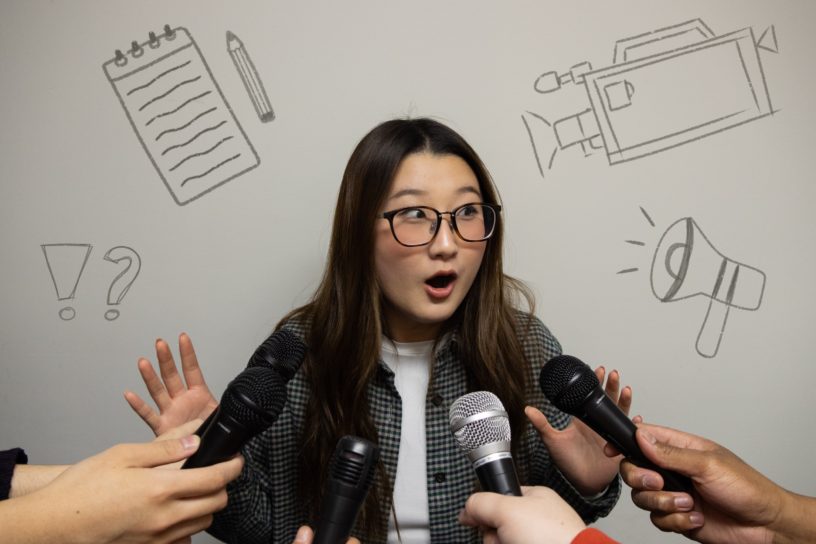
After the event, our staff member was hoping to conduct interviews with some of the attendees but didn’t get the chance—they quickly approached her instead, with cameras in their hands, identifying themselves as journalism students. They were on the hunt for sources for a class assignment.
The overwhelming presence of School of Journalism students at Indigenous-led events at Toronto Metropolitan University (TMU) isn’t new. In fact, the historic conflicting relationships between Indigenous peoples and journalists remains alive at the university, said Brian Norton, the program manager for Gdoo-maawnjidimi Mompii Indigenous Student Services (GMISS).
According to a brief by the United Nations Educational, Scientific and Cultural Organization (UNESCO)—Indigenous Peoples and the Media—while reporting on Indigenous issues has increased since 2023, harmful stereotypes persist along with the dismissal of Indigenous voices.
“Reconciliation is all about learning and understanding different points of view,” he said.
“I mean, it’s great that the School of Journalism has prioritized Indigenous voices and Indigenous stories, but I think that the whole concept wasn’t completely thought through,” Norton said.
While Norton does not work for TMU’s Indigenous Education Council—a TMU Indigenous branch whose mandate is to improve Indigenous curriculum across university programs—he said he’s heard of attempts to introduce more comprehensive Indigenous reporting techniques within the School of Journalism.
Shari Okeke, assistant professor in journalism at The Creative School said that the lived experience of students is an important factor in their ability to cover communities with care.
“I approach it by telling them that it is too early in their journalism education to be covering Indigenous communities,” she said. “So I do not want any of my students causing harm and my effort to prevent harm is by essentially saying that they cannot.”
Okeke stressed the importance of stepping into Indigenous spaces as a person before being a journalist. “If it’s your first time there, you shouldn’t be reporting on it,” she said, specifically in reference to powwow’s or events like Treaties Recognition Week.
While first-year journalism students are often sent out on assignments around campus, the students at the Nov. 5 event were taking videos, which Okeke explained would never be required of her students.
Norton echoed the importance of spending time with Indigenous peoples and making real connections.
“I think it requires a bit of foresight on students’ part, knowing that they are going to have to do reporting on Indigenous stories at some point, I think maybe that should be delayed until later years,” he said. “Maybe third or fourth year, because we can use those first and second years to actually inform a journalist and how they can build contacts, build relationships.”
Fourth-year journalism student, Sarah Bauly, said she believes more research should be done in first year. Not just on how to respectfully approach Indigenous people with the goal of getting a quote but on the complex history of First Nations, Inuit and Métis people in Canada.
“I feel like it can be done in a less harmful way,” she said. “Professor Okeke has done a great job in doing that.”
“My approach is more we need to start learning about some of the experiences, lived experiences, of these communities a little bit as a start. And so I like to introduce them to people,” Okeke said.
As part of her first year class—Introduction to Journalism (JRN 103)—Okeke said she introduces students to guest speakers, some being Indigenous, not to ask questions but to simply hear their stories.
“I encourage people to take the time, because you’re reporting on a group of people, on a nation, and if you get that story wrong, you’re gonna get roasted for it,” Norton said.
The Truth and Reconciliation Commission (TRC) outlines 94 calls to action encouraging the process of reconciliation in Canada with specific demands, as previously reported by The Eye.
TRC call to action 86 reads, “We call upon Canadian journalism programs and media schools to require education for all students on the history of Aboriginal peoples, including the history and legacy of residential schools, the United Nations Declaration on the Rights of Indigenous Peoples, Treaties and Aboriginal rights, Indigenous law, and Aboriginal–Crown relations.”
Bauly feels the Reporting on Indigenous Issues (JRN350) course should be required for journalism students rather than an elective and should be introduced much sooner. “I don’t think that conversation is happening early enough in the program,” she said.
Evan Voutsinas, a second-year journalism student said that if people at the Nov. 5 event were upset by the presence of journalists, “it’s on the journalists.”
“Honestly, media can be a really ugly thing when it comes to First Nations reporting, and we’ve known that, that was one of the first things that we learned in first year, is how to be respectful of culture,” he said.
Voutsinas remembered an assignment in first year, where students were specifically told not to attend the TMU’s annual powwow as part of their assignment. He said first-year classes on reconciliation and Indigenous reporting have stuck with him, especially when it comes to the care it takes.
“We have a responsibility to respect the events that we’re going to…You can’t just run up to somebody with a mic in their face and expect them to interview [with] you if they’re running an event,” he said. “That’s not something that we were taught and we were actually pushed away from doing that in our first year. So if anybody’s doing that, then I guess it’s just a lack of consideration from what our program has already taught us.”




Leave a Reply