

By Shaaranki Kulenthirarasa
The Toronto Metropolitan Students’ Union (TMSU) announced last week they will be reducing annual base funding for student groups* from $1,500 to $600 per year, an approximate 60 per cent reduction. The course union base funding decreased from only $1,300 per year to $600 per year, a roughly 46 per cent reduction.**
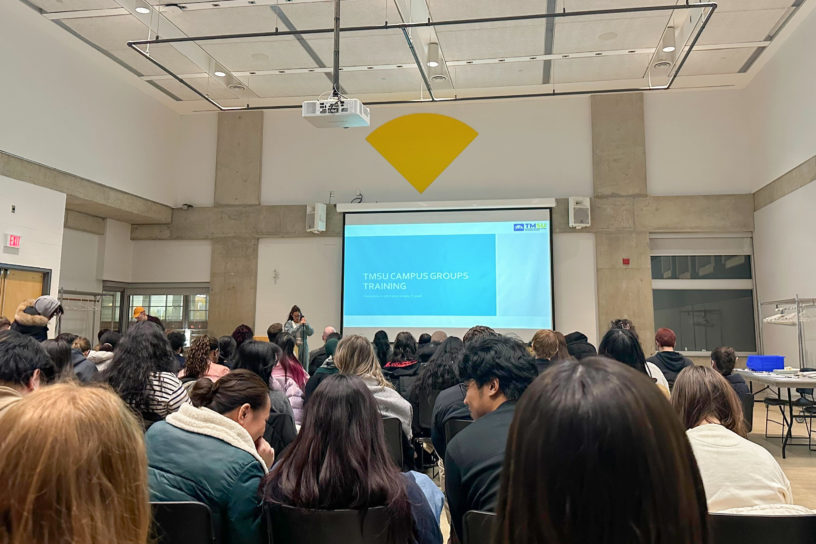
The announcement was made at campus groups training sessions on Jan. 28 and 30.
The changes were passed in an omnibus motion—all at once—at the Semi-Annual General Meeting on Dec. 2, 2025 and came into effect on Jan. 1.
The TMSU held the mandatory campus groups training event to discuss changes to policies that would apply to student groups and course unions. All campus groups had to attend one of the two training sessions with a minimum of two executive members from each group required to attend.
According to the TMSU’s website, there are 139 campus groups under them.
Many students say they left the training sessions with questions still unanswered, including Batool Qasim, fourth-year professional communication student at Toronto Metropolitan University (TMU).
“There are clear demarcations of what base funding is, what event funding is and what exceptional circumstances mean, but these policies don’t make sense in many ways,” she said.
Qasim says many questions regarding funding for the 2025-26 school year remain unanswered.
“Many student groups have been left in the dark because we have submitted requisitions that have not been answered and the TMSU changed their policies overnight without informing students that these policies will be changing,” she said.
The following is a rundown of the changes announced in the training sessions:
Funding
Base funding application, which can be used as operational costs for a campus group, will run from Feb. 2 to Feb. 11 . Student groups and course unions must now apply for base funding and can receive a maximum of $600 per school year.
Examples of expenses that are eligible under base funding include promotional materials such as banners and promotional items such as water bottles and website fees.
Event funding is provided to host social, academic, cultural, recreational and athletic events.
Campus groups can apply for up to $6,000 in event funding per-year with each event costing a maximum of $3,000.
Co-hosting events will not increase the maximum amount that can be spent.
Due to the delays in funding for the 2025-26 school year, campus groups can apply for $6,000 in funding just for this winter term.
Application for event funding opened Jan. 28 and will close Feb. 9. Groups can still apply for event funding for events held in January.
Course unions must request orientation week funding, and this should be sent in early August moving forward.
Exceptional circumstance funding is for unexpected events such as the requirement of urgent IT services, accessibility or inclusion support and emergency travel costs. Exceptional circumstance fund requests under $1,000 should be submitted three weeks in advance.
Fund requests over $1,000 should be submitted four weeks in advance. If last minute circumstances arise, students should reach out to the TMSU’s Campus Groups Coordinator.
“Exceptional circumstance funding is to be applied for three weeks in advance but if something was happening three weeks in advance, it’s not an exceptional circumstance, it’s a planned event, so it makes no sense,” Qasim said.
Students must apply for funding within the time period that is specified and unused funding will not roll over to the next year. To be reimbursed, students must be itemized and should be submitted within 30 days of purchase.
In certain circumstances, the TMSU can issue vendor payments directly by cheque. Applications must be submitted as one PDF file.
Qasim’s student group, the Professional Communications Course Union (PCCU) has received funding from sources outside of the TMSU including the Society of the Creative School (SCS). However, she notes that the circumstances are not the same for all student groups.
“The money is being lowered [for base funding]. It’s 600 dollars for an entire year which is not enough for a student group that is relying only on TMSU
for funding.”
Affiliate groups—groups that belong to a third-party organization, but operate specifically on the TMU campus—are now considered student groups.
Jini Moon-Kwon, a fourth-year arts and contemporary studies student and member of HanVoice TMU, said paying for events can be difficult for groups that run large-scale events.
HanVoice TMU was one of many affiliate groups that now fall under the student group category .
“I think it might be harder for [campus groups] when [they can’t be paid] upfront for something but they can only receive reimbursement…if they don’t have money in their trust accounts, I feel like there should be a workaround around,” she said.
Application
The process to apply to become a student group has not changed. New student groups are still required to complete a cover letter, a constitutional letter, an executive signing offer list and a member sign-up list of at least 20 full-time TMU students. This application will now have to be submitted to the TMSU website and not the coordinator.
The application period for the fall term is from Sept. 10 to Oct. 5 and from April 10 to May 5 for the winter term according to the slides presented at the training—it is unclear exactly what this includes.
Existing groups have to submit a renewal application. If an existing group fails to do so, the group would be deemed inactive.
Groups cannot host events during the application renewal period.
The majority of the changes were made to the funding process. Despite the shifts, students like Rezwan Karim, a fourth year computer science student at TMU hope these changes are for the better.
“I’m pretty sure [the TMSU is] trying their best to avoid whatever happened in the past, and I do feel that if we do support this, it might turn out to be [better],” he said.
The TMSU said in an emailed statement to The Eye***, “While base funding used to be guaranteed automatically, the new policy requires all Campus Groups to provide additional information in an application form in order to access the $600.00 allocation. The Board introduced this policy to provide the opportunity for due diligence in ensuring that these funds are actually going towards the operational needs of groups, which is what base funding is intended to support.”
The statement further detailed the reasons for the change, saying it is unrelated to the Provincial Government’s funding adjustments under Bill 33. “Our budget hasn’t grown in proportion to the number of new campus groups and course unions. We want to spread the funds to as many groups as possible and realize there are many new groups each year, which is exciting. As we’ve limited what’s available for base funding, due to the increase of applications that are accepted under event funding, we believe that $600 is a good amount and now the $600 base isn’t for events, but rather for operational expenses.”
*Correction: A previous version of this article stated that both student groups and course unions will see a 60 per cent reduction of funds. The article was updated on March 3 to clarify that only student group base funding has been reduced by 60 per cent. The headline has also been updated to reflect this. The Eye regrets this error.
**Update: The previous version alluded that course unions also saw a 60 per cent deduction in funding. This article was updated on March 3 with specific details pertaining to the course union base funding reduction of 46 per cent.
***Update: A previous version of this article did not include the statement received from the TMSU regarding these changes. The statement was added on March 3. The Eye regrets not including this in the print version of the article from Feb. 4.






Leave a Reply