

By Ava Whelpley
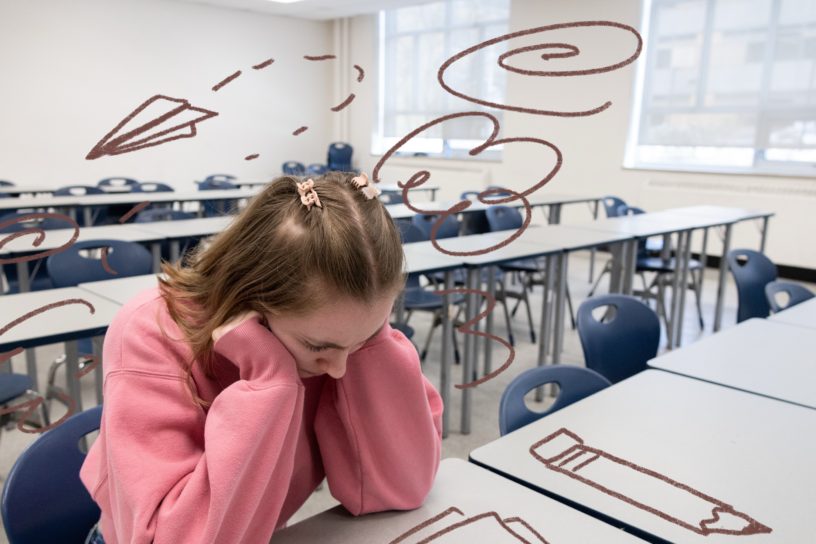
The Accommodated Test Centre (ATC) at Toronto Metropolitan University (TMU) is meant to be a refuge from the kind of distractions you’ll find in a large exam hall—pens clicking, students shuffling in and out, the irritating buzz of fluorescent light. And yet, I found myself writing my test in the middle of that same chaos.
The ATC is located in the basement of the Victoria Building but often classrooms are booked out on other floors as well to accommodate all the students. I typically write on the fifth floor in a classroom that sits about 30 students. I also once wrote an online exam in a basement room with roughly the same amount of seats.
The classrooms are usually half full so that everyone is spaced out. Students will come in and out of the room at different times to write their exams so there is always a lot of commotion around.
I have utilized the ATC multiple times throughout my first two years at TMU to write all sorts of exams and tests and never once have I had an experience free from distractions. While I applaud the simplicity of the test booking process, that’s about as far as I would go handing out roses.
A majority of the reason I avoid standard lecture halls is because of the anxiety I experience surrounding test-taking. Something as simple as a noisy environment is enough to make it worse, not to mention feeling ill-prepared and overthinking my future grade.
Morgan Grotewiel, associate professor and department chair of psychology at the University of Webster, said test anxiety is a real struggle for many students.
“People with anxiety can experience increased arousal in response to any type of stressor, including an exam. So this is going to look like increased heart rate, maybe muscle tension and sweating,” Grotewiel said. “This impairs working memory because the body’s resources are being used to respond to that threat, and this can trigger a blinking or freezing response while taking a test.”
For Molly*, a sport media student at TMU, relying on the ATC staff to set up her exam and accommodations is always a gamble.
“I showed up one time, and they literally looked at me and said, ‘we don’t have your test,’” she explained.
Molly recalled another occasion where the invigilators at the ATC failed to provide the password for her online test and she had to personally seek out the professor to retrieve it.
In an email statement to The Eyeopener, a TMU spokesperson said all invigilators are put through “a comprehensive onboarding process” and that each ATC room is carefully reviewed and assigned based on
students’ needs.
Emma Lorez, a fourth-year occupational health and safety student at TMU, said the sign-in process in the basement at the ATC can be “a little chaotic.”
“There will be a lot of people down there in this small little hallway that gets really hot. [I] almost wish that I could start my test 15 minutes before most people so that I didn’t have to be in that chaos of everybody getting signed in,” she said.
When you make it past and finally get to the correct seat with your specific accommodations, the stress and distractions continue.
Without fail, every experience I have had at the ATC has involved the invigilators talking to each other during my exam. While often it is done in hush voices, it is enough to pull my focus and cause frustration.
Lorez had similar experiences with the invigilators at the ATC before she told her facilitator and they moved her to a private room to write her exam.
“They were talking the whole time,” Lorez said. “So [eventually] I said something. I said, ‘Hey, can you please be quiet?’ They’re like, ‘Oh yeah, sorry, sorry.’ And then they kept going.”
Personally, I have not yet called them out for their unprofessional behaviour, hoping a lot of side-eying and glaring would be enough but it has yet to be effective.
Aside from the chatter, the invigilators do not seem properly equipped to deal with complications surrounding accommodations.
“Students who have concerns while writing in the Test Centre are encouraged to speak with Test Centre staff directly, and to also submit feedback through the annual Benchmark Survey,” the TMU spokesperson said to The Eye.
Molly explained a situation in which the CD player provided by the ATC died mid-exam. She uses the CD player to play pre-approved, unopened CDs to assist her focus during the test-taking process.
When Molly had told the invigilators that her CD player died they looked at her in confusion. She then explained that she could not complete the exam without her music, as per her accommodation. They looked at her as if they did not know what to do.
“It’s a lot of: ‘give me a second,’ ‘I’ll be back,’ ‘I have to ask.’ They seem like very simple things, and that’s got to be frustrating for them as well. And those moments take up time,” she said.
I also struggle with the spaces the ATC provides me with. Prior to my experience at the ATC I was studying at the University of Toronto (U of T), where I wrote exams in their test centre. One time, I wrote an exam comprising multiple sections including multiple choice, short answer and essay questions. It took me longer than 3 hours to complete but I remember feeling comfortable the whole time.
A major difference was how calm and quiet U of T’s test centre was. In my specific room, there were barriers between each desk so that I could not see anyone around me while taking the exam and I did not notice people coming in and out. Because of these borders, I also could not see the invigilators watching me and I was provided with a digital clock to keep track of time. Also, the area to take a break had couches and low lighting that was very relaxing. Ultimately, the entire experience made it much easier for me to regulate my anxiety.
“You definitely don’t want people coming in and out and don’t want the proctors talking to each other. You want good lighting, comfortable furniture in the room, maybe some white noise for background, but no other noise,” Grotewiel said.
Lorez also wrote at another post-secondary test centre before studying at TMU. She outlined all the elements that made the test centre comforting.
“There were lots of waiting rooms…there was no overhead light. I remember it had nice pot lights that [omitted] warm [light which] makes you feel relaxed.”
Many factors go into creating an accommodating environment for students with disabilities and—in my experience—the ATC has yet to achieve that.
Additionally, the ATC has failed to properly equip invigilators with the necessary tools to support students with their accommodations.
“Sometimes it’s hard when you go in and your accommodation or your disability feels like an inconvenience,” Molly explained.
Often it feels that the invigilators do not want to be there, which causes me to feel like a burden. But we need to be there, we need a space where we can feel supported and be exposed to less distractions.
“Accommodations are about leveling the playing field for students. They’re not about giving them some type of advantage,” said Grotewiel.
*This source has requested to remain anonymous due to the nature of the topic. The Eye has verified this source.




Leave a Reply