

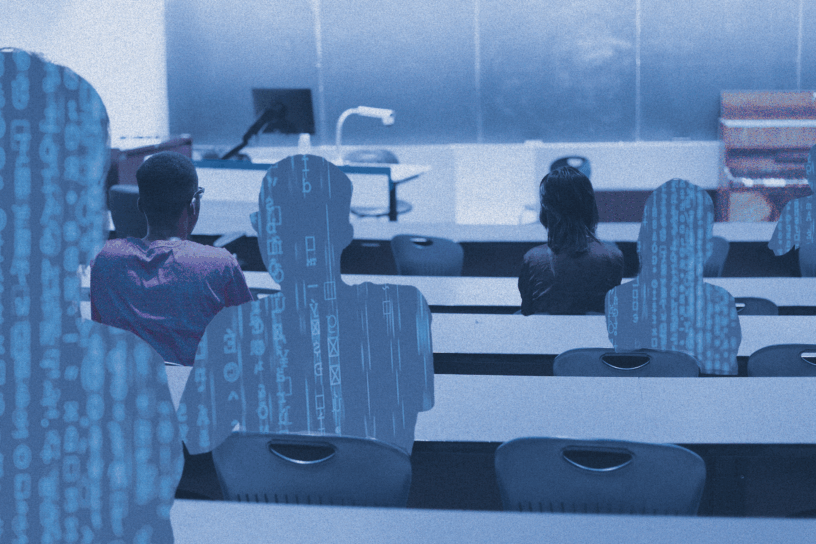
Artificial intelligence crashed onto the academic scene with little warning. Now professors are having to update their ways to win their students back from the clutches of chatbots
By Simran Sidhu
IT WAS ONE of those evenings in April for Jordan Le Roux. Finals season was at its peak, and as a teaching assistant (TA) for several classes in Toronto Metropolitan University (TMU)’s history department, dozens of assignments were sitting in her inbox waiting to be marked.
Sitting on the couch, with a cup of tea within arm’s reach, she scanned essay after essay, highlighting sentences, leaving notes and coming up with a grade to submit to professors for final review.
Le Roux clicked onto an assignment from a student she recognized. She knew them to be articulate in class and passionate about the field. The essay, she thought, would be enlightening. But as Le Roux read through the paper, she noticed paragraph after paragraph that followed the same narrative structure. It was as if there was something less-than-human about the words she was reading. And having graded hundreds of assignments at that point, Le Roux knew why: artificial intelligence (AI) had played a role in its production.
“I wasn’t angry, but just confused at what I read,” Le Roux says. In her one year as a TA, she estimates she marked over 700 assignments, big and small—and roughly estimates that around 50 per cent contained some kind of AI contribution, ranging from finding sources to writing entire paragraphs. It’s alarming, she says, what the AI boom in academia is doing to students.
“I am sad that people—really bright, really smart people—are depriving themselves of that chance to do that learning.”
WITHIN THE SPAN of a few very short years, generative AI has transformed from a minor curiosity into a permanent fixture of modern academia. From the early phase of generating extra fingers, AI has rapidly evolved to the point where even the most seasoned scholars struggle to distinguish human prose from machine outputs. The statistics paint a bleak picture.
A 2025 survey by accounting firm KPMG found that 73 per cent of Canadian students are using AI to do their schoolwork in some way, shape or form. Twenty-five per cent of them admitted to using AI every single day, or at least, for every single assignment they’re given. That figure is up 10 per cent from the year before.
Forty-five per cent of students even went as far as saying that using AI is their “first instinct” when their professors hand them an assignment. It’s a boom being felt coast to coast—and, arguably, around the world—since platforms like ChatGPT came onto the scene in 2022. Since then, software like Claude, Gemini, Microsoft’s Copilot, Perplexity and dozens of smaller start-ups have become bookmarked tabs on Canadian students’ browsers, accessed more frequently than even Google by some.
Universities and academic settings, in some sense, feel light-years behind the rapid emergence of artificial intelligence platforms. Administrators have had to work quickly to put together guidelines for AI-usage on their campuses, including TMU, which tells its students: “Unless explicitly stated by the instructor, students should assume that using AI to complete assessments is prohibited.” TMU’s Senate’s policy on academic integrity has evolved to consider fabricated work, anything produced by AI, as well.
Professors, many who have had decades teaching at the university, once used to worry about students cheating with analogue methods—still putting in the work to find the formulas, for example, but refusing to memorize them. Now, they worry about whether students care at all about the coursework, when at the press of a button, a bot can take care of their degree.
FOR GRAHAME LYNCH, an associate professor and interim chair for the School of Fashion, the current alarm around AI feels deeply familiar within the history of the art he teaches. When Lynch talks about artificial intelligence, he does not begin with ChatGPT or Gemini—he begins with the camera.
“When photography was invented, people declared it the death of painting,” Lynch says, with a chuckle. “Yet painting did not die, it evolved.” With tools like a camera, the artist still does the thinking. They still drive the creative direction by making intentional choices. But with AI, the software transitions from an assistive tool into a substitute for thought. When the algorithm itself handles the entire creative process, the relationship between the student and their work is disrupted. So the emergence of AI, Lynch thinks, may change how people think of creative work.
Lynch believes the current AI disruption may stem from a pressure on students to present refined and perfect final products, often leading them to entirely skip over the messiness of the creative process. To counteract this, in his courses he emphasizes physicality and methods that document the developmental journey, focusing on reflection, highlighting the step-by-step decision-making process and embracing mistakes. In his interdisciplinary image making course, he brings students back to physical, tactile mediums like handcutting collages, cyanotypes and cutting negative images. Mediums where AI could provide little help, because his students are taught to embrace and adapt to the imperfections of making the wrong cut.
ONE OF THE most attractive—and perhaps most advertised—academic uses for AI is generating written work. The KPMG survey found that 36 per cent of Canadian students regularly use AI to generate their essays and reports. And in TMU’s English department, where reading and writing is their bread and butter, the faculty are more than aware.
For Jason Boyd, an associate professor and former director of TMU’s Centre for Digital Humanities, reading and evaluating student prose is second nature after years on the job.
Sat at his desk one day, Boyd was sifting through his students’ submissions. When he opened an assignment for a liberal studies course on crime fiction, he couldn’t help but notice there was something fundamentally off.
The text displayed on his laptop was littered with factual errors, nonsensical claims and odd structural contradictions. There was no human voice, just a mechanical sequence of sentences that made very little sense in the context of the assignment.
Boyd knew immediately what he was looking at was a student who had pasted the assignment prompt into ChatGPT, copied the output without rereading a single word, and submitted it.
“My reaction was sort of a combination of ‘how dumb do they think I am?’ and somewhat amused because some of these outputs are just completely absurd,” Boyd says. “My sense was these were people who had done absolutely nothing—hadn’t come to class, hadn’t read the text. It wasn’t a case of a student under extraordinary pressure and using a tool out of desperation. It was people who had no investment whatsoever in the course, and strangely thought they could get a passing grade.”
Generative AI can organize data and draft outlines, but it cannot care for or understand the material
Discovering these AI submissions was not merely about catching students cheating, but opened a window into a deeper, troubling trend across campus. To Boyd, the threat of AI is something much more sly than automated essay generation. What keeps him awake at night is the slow, deliberate erosion of reading.
“Students basically just run a book through Gemini and say, ‘Just give me a summary of it.’ But we are interested in literature beyond plot summary,” Boyd says. “We’re interested in the actual text, the actual language.”
To Boyd, an algorithmic plot summary doesn’t just risk skipped pages or getting things wrong, but AI replaces the original author’s voice, nuance and intent.
“My real concern is that we’ve already lost them because they’re not even reading the texts they’re supposed to be writing essays on,” Boyd says.
This detachment leaves many educators facing a profound pedagogical hurdle.
Boyd has experienced incidents in which students not only feed readings into chatbots for plot summaries, but have those same chatbots complete their assignments, essentially passing the entire academic process into the hands of a bot. At that point, Boyd is no longer necessarily teaching people—his classroom materials, instead, are training AI algorithms.
Where once, students might’ve skimmed a passage or two to forge an essay on an entire novel, AI makes it so that they don’t even have to touch the book. Now, Boyd and his colleagues have to do something professors a few years ago didn’t—convince students to do anything at all.
“How do I make them understand that reading is important, actually reading the literature is important, reading the text is important?”
The challenge for professors nowadays is no longer detecting who used generative AI to do an assignment—this far into the AI boom, catching students in the act isn’t going to do much. Now, the job is convincing a generation that is raised on the instant gratification of generative platforms that the slow, tedious process of fighting with complex prose is where intellectual growth occurs.
Canadian students who use AI are admitting it themselves: nearly 50 per cent of those surveyed by KPMG say their critical thinking skills have deteriorated since they committed themselves to an algorithmic aid.
To Boyd, outsourcing the act of writing to an emotionless algorithm isn’t just a problem with academic misconduct, but it may be a hurdle to the development of critical thinking.
“Writing is a form of thinking,” Boyd stresses. “It’s a form of interpersonal communication. Anything that comes out of Gemini or ChatGPT has no intent behind it. It’s just a statistical word pairing.”
FOR ÉMILIE QUENNEVILLE, a final-year public health student at TMU, her first formal encounter with artificial intelligence in a university setting was not her attempting to shortcut her studying, but instead an assignment from one of her professors.
In a course focused on pollution and waste management, the professor tasked the class with prompting a chatbot to answer complex queries. Students were then required to cross-reference the accuracy of these outputs against peer-reviewed scientific studies. The results were very telling.
Rather than unveiling a flawless repository of human knowledge, the exercise exposed the limitations of artificial intelligence. She remembers being frustrated by what it got wrong, but more than that, was less than impressed by the technology that claims to do all.
“I find chatting with it quite frustrating, actually. It was very biased in its wording, and the results weren’t accurate. It wasn’t coming from scientific sources,” she says.
The assignment, as worrisome as the findings were, was another professor’s attempt to confront their students with the reality of AI in academia—that often, it can be embarrassingly off the mark.
Boyd is no longer necessarily teaching people—his classroom materials, instead, are training AI algorithms
But Quenneville wasn’t in need of any convincing. Being a mature student, she has been exposed to higher education settings before the mainstream surge of AI and maintains a conscious, grounded distance from artificial intelligence as study aids. Her skepticism is rooted in a recognition of what is sacrificed when students allow AI to do the intellectual heavy lifting.
However, it is difficult to dismiss all together the convenience of artificial intelligence, especially in competitive academic settings. When assignment deadlines loom, and peers openly share prompts to help reduce hours of essay preparation, choosing the longer, harder path requires immense discipline. The pressure is relentless—a constant whisper in the back of every student’s mind that there is an easier, faster way that might just give them the edge they need to push through.
Quenneville says that her personal decision not to use AI does not mean she is unaware of its advantages.
“I worry about being left behind because I do know that some people can use AI to make their life a bit easier. It lowers the time consumed to write. But education [can] be strenuous—it is mentally taxing. When you succeed, and you know it’s based on your own merits and hard work, it’s very rewarding,” she says.
To Boyd, this tension underscores a fundamental question about how society values higher education. If university is viewed simply as a credential factory, a place to collect marks and secure a title as soon as possible, then delegating coursework to AI is an understandable outcome. But if university is considered a transformative space for cultivating independent thinking and deep literacy skills, he argues that relying on automated outputs represents a profound loss for students.
RTA School of Media assistant professor AJ Cordeiro goes further to argue that, because of AI, post-secondary institutions are being forced to reconsider what a degree validates.
“We are moving away from certifying that someone can make something, like drafting a basic essay or generating a list of shots, to certifying that they can be held responsible for it,” Cordeiro says.
THE DIVIDE IS not as simple as students who use AI and those who don’t. There’s a middle ground, where some use it to brainstorm and check their work but draw a harder line at asking it to do the thinking portion for them. That adds another variable to a professor’s evaluation, now having to determine how much AI use makes an assignment academically dishonest.
As departments across TMU adapt, many educators are searching for a solution that doesn’t lie in surveillance or band-aid prohibitions. Bans are difficult to enforce and anti-cheating software often yields false positives, creating a tense environment of suspicion instead of curiosity. In a 2023 study published by Stanford researchers, popular detection algorithms consistently misclassified non-native English writing as though it was machine-generated, flagging roughly over 61 per cent of non-native essays due to the more constrained language structures.
As previously reported by The Eyeopener, 30 per cent of all student consultations handled by the TMSU’s advocacy office between May and December 2025 were related to academic misconduct, with a significant rise driven by allegations of unauthorized AI use.
That’s because algorithmic unreliability directly impacts students within the classroom. In March 2026, The Eye detailed a case of a fourth-year student at TMU who spent months disputing an academic misconduct allegation after her instructor claimed her essay vocabulary was suspiciously advanced.
Instead, some faculty are shifting focus from catching cheating to rethinking evaluation, redesigning assignments to demand authentic human presence. Boyd said his teaching methods now put more emphasis on in-class assignments, or work that requires “precise engagement” with the fundamentals of the texts he assigns, in a way that AI cannot do.
Cordeiro has an assignment-by-assignment approach to AI-use: some allow it, if the student discloses and explains the role artificial intelligence played, while others don’t make room for AI. In media production, some software tools are beginning to embed algorithmic support, so he prepares his students to know if, when and how to use them when they enter the real world.
Univiersty of Toronto’s law faculty is even making the case for some classes to become laptop-free zones, asking students to handwrite notes so the possibility of sophisticated AI models doing the remembering for them is off the table altogether.
The path forward across higher education will not be defined by the presence of artificial intelligence, but by how intentionally students choose to draw the line between tool and thinker. Generative AI can organize data and draft outlines, but it cannot care for or understand the material.
LYNCH HAS BEGUN trying to pull his students out of the digital ecosystem entirely. He’s created assignments which focus on hands-on mediums—going back to things like old school prints and a journaling method to document the thinking process.
He’s not the only one. In-class discussions, handwritten assignments, reflective journals and physical methods are regaining central roles in course syllabi. Other professors, still, are doing what they can to educate their students on the ethical uses of AI and its applications in the real world.
The temptation to use AI will always be there, lurking in the background of another browser tab, ready to produce an answer before a student has even finished reading the question. But this convenience always comes with a choice and a sacrifice, whether to use AI as a tool or to allow it to become the thinker. So, for today’s students, the most important lesson a professor can aim to teach, might be why they should learn at all.







Leave a Reply