

By Aleeha Raza
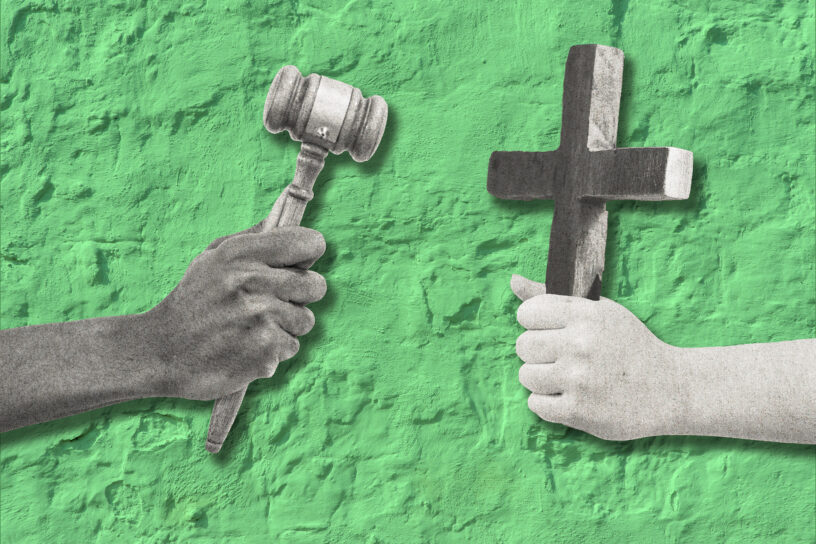
Historian and Jesuit priest, Father John Meehan, discussed how religion continues to shape international relations post-Cold War at an International Issues Discussion (IID) talk last week.
In the Nov. 11 talk, Meehan argued that religion is often viewed through the lens of conflict and extremism, but can also contribute to peace-building, climate action, migration efforts and discussions around artificial intelligence (AI).
The event was organized by IID, a student-led forum co-founded and managed by Toronto Metropolitan University history professor Arne Kislenko.
Meehan has a doctorate in history from the University of Toronto (U of T) and is the former director for the Bill Graham Centre for Contemporary Studies. He also formerly served as the president of the University of Sudbury.
Meehan’s discussion opened by reviewing the history of religion and politics in contemporary times.
“I tried last night in my talk to distinguish two types of religion, you know, the religion of the oppressor, of the powerful, that uses religion to keep other people down and maintain their power,” said Meehan in an interview with The Eyeopener.
He said there is a side of religion that isn’t often seen; the “religion of the oppressed” that uses religion to promote equality.
Meehan cited Martin Luther King Jr. and Gandhi, who both used religion to promote their causes, as examples of religion’s benefit to social justice.
He discussed how religion influenced global politics historically and how its role has evolved since the collapse of the Soviet Union and 9/11.
He pointed to Pope John Paul II, who is credited by historians with playing a part in the dissolution of the Soviet Union.
Meehan said religion has often been overlooked in discussions of international relations despite its continued influence on global politics.
Toward the end of the talk, Meehan noted how religious perspectives continue to be at the foreground of discussions on global issues, such as the advent of AI, making reference to an encyclical by Pope Leo XIV’s on the topic.
“[Pope Leo XIV] talked about a new form of slavery. Is the technology serving us or will we be serving the technology?” said Meehan.
“Basically, what he’s saying is, to what extent does this AI build up a common good? Is it in the interest of humanity or is it in the interest of a few?”
Questions fielded from attendees covered topics from colonialism, religious extremism, discrimination and interfaith dialogue.
Joao Da Silva, a fourth-year criminology student, told The Eye the discussion highlighted the importance of listening to those whose experiences differ from your own.
“Dialogue is very important to avoid war and to promote peaceful options and friendships,” he said.
Ruth Mora, a third-year psychology student, said the talk offered a thorough look at religion’s place in public life.
“I like how he emphasized that where there’s politics, there’s going to be religion and where there’s religion, there’s going to be politics,” she said.
Students also commended Meehan’s emphasis on having conversations face-to-face.
Mora said one-on-one conversations produce different outcomes than online discussions.
Ibrahim Mabsout, a third-year criminology student, shared similar thoughts. He said unlike conversations in online spaces, in-person discussion can’t be dictated by social media algorithms.
Mira Zola, a fourth-year U of T student and student leader with IID, said planning for the discussion series begins well-before the academic year.
“We spend the majority of the summer months planning, getting to know each other as a team, brainstorming different ideas,” said Zola.
She added that students are encouraged to suggest topics or speakers themselves and can do so through email or social media.
The organizers aim to feature a wide range of subjects while maintaining a non-partisan approach. The idea for Meehan’s discussion came from one of his former students.
Student leaders help organize events through promotion, hosting and facilitation, while Kislenko oversees speaker selection and event logistics.
Kislenko said the goal of IID is to encourage students to think beyond their own perspectives and engage in difficult conversations on global issues.
“We try to take people away from their little silos, where they think it’s all about them and their perspective and their experience, and get people to think about our broader world,” he said.
As the event concluded, attendees continued discussing the issues raised during the evening. Meehan’s emphasis on dialogue over debate remained a central theme.
“Debates can build a wall because you attack me, I attack you, we get defensive and build a wall between us. Whereas in a dialogue, you build a bridge,” he said.








Leave a Reply