

By Edward Lander
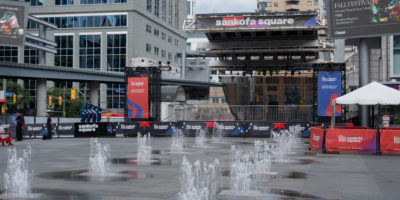
Toronto councillor and mayoral candidate Brad Bradford has spent much of his campaign criticizing the state (and name) of Sankofa Square. But last week, he turned his attention to another Toronto landmark: good old Union Station.
On Thursday, he posted to social media that the station is the picture of Toronto’s supposed decline. He claimed the facility is overrun with drug use and homelessness, promising that if elected, he’d install permanent police presence
inside in the building. He later told reporters at a press conference the move would deter “bad guys.”
And while the connection between a police presence and reducing drug use and homelessness in the station eludes me, this wasn’t the most puzzling part of the proposal. What shocked me most was just how different his description of the station was from my own experiences—and likely the experiences of commuters who use it every day.
Yes, homelessness is a real and growing issue and drug use has become more visible (in no small part because of the closure of supervised consumption sites). But Bradford seems to have little sympathy for unhoused people or those struggling with substance use, only the commuters he believes their presence represents a danger to.
As we get into the weeds of the mayoral race, the Toronto that Brad Bradford spends his time campaigning against is becoming unrecognizable from the one we actually live in.
After the shooting at Salsa on St. Clair festival in July, which saw the death of two young men, Bradford jumped at the opportunity to comment on the fear the city was feeling. He lambasted Oliva Chow and city council, claiming not enough is being done to prevent violent crime. When the chief of police assured Torontonians that violent crime is, in fact, down 26 per cent from last year, Bradford claimed city officials were “hiding behind” numbers and ignoring how residents actually feel.
Bradford has campaigned hard on ‘saving’ Toronto from a supposed Chow-induced descent into crime and chaos. But I’d question how many voters actually feel like they’re living in the city he describes.
Like three-quarters of Toronto Metropolitan University students, I take transit to campus every day. For myself and many of these students, passing through Union Station is a wholly uneventful affair. The station is clean and spacious. Probably thanks to the $824 million all three levels of government have poured into revitalizing it over the past two decades. If anything, Union Station is one of the things that makes me proud to live in Toronto.
In a July op-ed for Spacing, John Lorinc called Bradford’s approach a “city-is-on-fire routine,” and that’s exactly how it feels. But you can only yell “fire” so many times before someone looks around and realizes nothing is burning.
Editorials published in The Eyeopener reflect the opinion of the editor-in-chief.






Leave a Reply