

By Victoria Cha
While there are those who take part in the push for women in sports, there are others who make different choices—others like Sydney Sweeney and American sports betting company Novig, which released an advertisement that seemingly did the opposite.
Released on Sept. 9, the ad is a minute-long showcase of a nude Sweeney covering herself in different sports equipment as a means of promoting the gambling site. Since its release, a wave of women in sports across the industry, including those in the Toronto Metropolitan University (TMU) community, are refusing to let the matter be diminished without conversation.
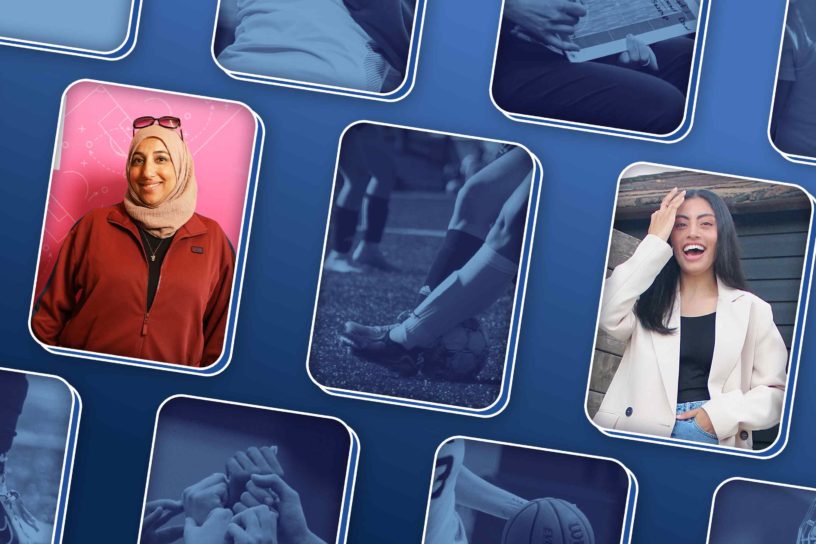
Jasmine Andrew, a third-year media production student who works in sport media for the TMU Bold and Maple Leaf Sports & Entertainment (MLSE), believes that, “[Women are] always already seen in such a sexualized way.”
The world of sport media has always been one dominated by men. In 2021, ESPN reported that women made up only 16.7 per cent of sports editors across 100 news outlets in the U.S. Not to mention the clear and ongoing athlete pay gap between the two, where RBC Wealth Management reports men make 21 times as much on average.
According to Andrew, women have been underappreciated and misrepresented from the beginning, constantly needing to “go the extra mile” to simply reach the same milestone as their male counterparts.
Though the line of progress for women in sports has never been completely linear, to many, Sweeney sexualizing herself in the name of sports has seized attention away from countless women in the industry. This has left women fending off the implications of it on their own.
“It has made my work, and the things that I’ve done to get where I am, not even seen…I think it’s just taking away from any work that I have done,” said Andrew.
For TMU sport media instructor Tasala Tahir, Sweeney had little to no consideration for the people she would be affecting through her involvement in the ad.
“If one of the youth that I work with so closely sees an ad like that, what does that tell them about themselves?”
Tahir is surrounded by young women and youth, not only as an instructor but also as a research and evaluation manager at MLSE Foundation and MLSE Launchpad. Because of this, she emphasizes the rhetoric that should be communicated rather than what the ad supports.
“We need to remind ourselves that our role in sport goes way beyond how we look. I think when you see images like that, sometimes you feel so defeated because you’re like, ‘Well, I’m trying to go against this sort of narrative, and yet it’s still happening.’”
Fellow TMU instructor and senior contributor at CBC Sports, Shireen Ahmed, echoed the frustration of Tahir and many of those online.
Ahmed adds that, “There’s a particular kind of betrayal when women do this…It’s not nice to feel like you’re being torn down by somebody who would understand and should be on your side,” said Ahmed.
On Sep. 15, Ahmed penned an opinion piece for CBC in opposition to the ad, discussing the conversations it has raised, even in the Canadian sport community.
As disappointing as it may be, Ahmed reiterates how Sweeney’s participation, sexualized and all, was an opportunity taken upon herself. “I think that’s one thing that’s a hard pill to swallow for a lot of women, that she’s choosing to do this. It wasn’t forced upon her. She chose.”
Whether Sweeney knew it or not, the ad served as a grim message from her to the women who watched it.
“Coming to terms with the fact that not all women will champion women is a very difficult thing,” said Ahmed.
Unlike what it could do for herself, Sweeney’s ignorance could not protect those who watched the ad and were not entertained by her body.
“I think this is one of those cases where she’ll be like, ‘Oh, I’m not offending anybody. I’m just doing my own thing’ which is fine, but it doesn’t mean that people won’t be offended by what [she’s] doing,” said Ahmed.
Many of those who Sweeney did offend are using this conversation to give voice to the years-long battle advocating for women in sport.
Since the ad’s release, many have gone online to share and create montages of women in sports in their respective fields, acting as a symbol to restore focus to the “real” women in sports who deserve airtime.
When asked to define what a real woman in sport is, Ahmed believed that “everybody” fits the term.
“I think it’s good that I don’t have a specific answer. It’s so broad, it’s so wide. There should not be one specific answer. The answer is so many women doing so many incredible things.”
As the online posts express, the image of a woman in sport that Sweeney painted is far from who they actually are. And while this is only the most recent instance of the fight women must bear, Sweeney’s own irrelevance to sport poses the question of whether all this attention is showing her too much generosity.
Ahmed added that “I see too many women doing too much work to let this person in whatever equipment and whatever poses and whatever script she’s reading insert herself.”
Although encouraged by the online responses to the ad, for Ahmed, who has been outspoken about marginalized communities and representation in sport for most of her career, her feelings of positivity end there.
“I don’t want this next generation of athletes to have to fight the same fights that I’m always fighting, and my colleagues and my friends and my comrades are fighting. We’re tired. I hate that this is happening,” said Ahmed. In wake of the ad, the industry must move on. However, this cannot happen until changes and different choices are made, something that Tahir emphasizes in her personal teaching philosophy, directed to the next generation of sport media students.
“You’re not teaching this person in front of you, or however many people in front of you, to be sports journalists and sports reporters or PR people…it’s not about that, it’s actually about developing the human being that ends up going to write.”
For Tahir, a student who knows how to think critically and work on who they are as a person is of paramount importance above all else.
Ahmed stresses the importance of allyship to those who must continue the fight for equal footing.
Ahmed mentioned that “It’s not even just about accountability, it’s looking towards what responsibility is and the conversations we’re having about it.”
The battle for women’s existence within the sports world has been everlasting. As time passes, so will this fight. But victory—if that’s what a woman’s right to respect must be seen as—cannot be won if narratives from people like Sweeney and those who created this ad can so easily be produced.
Despite this, the world of women’s sports will keep spinning. Women will continue to work, play and push.
What matters is not the ad itself, but the conversations that will transpire and the willingness of students to change the world that they watch through their screens.
In the ad, Sweeney asks, “Think you know sports?” She should be relieved to know these women clearly do.







Leave a Reply