

By Sophie Wallace
Rodrigo Barriuso, a graduate of Toronto Metropolitan University’s (TMU) film studies program, often hears that people haven’t seen a film like this before. “It gives me pause, you know, it’s like how am I the first person to make a film about this?” he said.
His film Neverman premiered on Sept. 10 at the Toronto International Film Festival (TIFF). “Thinking about this film in the past tense is really weird, because we literally handed it to TIFF on [Sept. 4],” said Barriuso, in an interview with The Eyeopener.
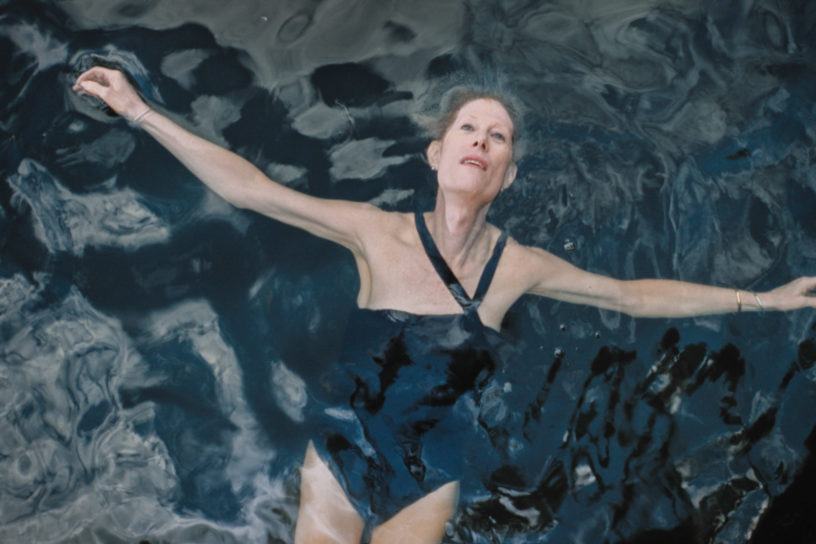
Neverman follows Lucia, played by Broadway icon Justin Vivian Bond, a 74 year-old Trans woman and gay rights activist, as she manages her early-stage Alzheimer’s diagnosis. She has no choice but to move from her peaceful lakehouse to a nursing home in Toronto which claims to be “Trans-friendly.” However, where supportive safety was promised, instead austere, intrusive staff and indifferent management attempt to slowly erode Lucia’s identity.
“The reality is that for the first time we’re seeing a generation of openly Queer people age,” said Barriuso. “This is the generation that was denied the right to marry, the right to occupy high-paying jobs…the generation that lost so many members of their chosen family to the AIDS pandemic.”
“You see a generational cohort aging without the benefits, without the pensions, without the children and the families, and entering institutions that are really ill-equipped to provide the specific care that they might need,” he said.
Despite wanting to draw attention to this critical issue, Barriuso’s feature is full of colour, moments of joy and the quiet ways Queer people show up for one another. Barriuso said he and his co-writer, Kyah Green, wanted “to challenge the notion that Queer lives are only marked by sacrifice.”
He achieves this partly through using flashbacks to Lucia’s life as an activist in the 1970s. “We wanted to portray this woman as…someone who was loved and someone who found joy and someone who experienced life and colour and exuberance,” Barriuso said.
The film follows a paper trail of Lucia’s younger self, from a newspaper clipping of Lucia on the frontline at a protest, to a typewritten flyer which reads “I AM A Queer androgyne feminist trannie pervert stonebutch tomgirl dyke and SO ARE YOU.”
The film starkly contrasts bleak scenes in the long-term care facility with snapshots of the glamour, and violence, of Toronto’s underground Queer nightlife. One painful flashback shows Lucia arrested during a police raid on the bathhouse where she works. In another, she laughs with her partner at a crowded disco. The Lucia of the present dances in a dementia haze, imagining herself still there.
Despite the casual transphobia and homophobia from the nursing home staff, Lucia finds connections in other residents. She grows close to the woman next door to her, and the two share a tender evening in a striking but moving depiction of elderly lesbians as sexual beings.
For Barriuso, this was an intentional choice. “You don’t expect to find beauty in older bodies or nursing homes or these types of interactions and I want to challenge that,” he said.
Barriuso said he hopes people take his efforts to highlight the beauty and resilience of elderly Queer people and the inadequacy of how society cares for them as a “call to action.”
“I hope it opens the door for people to think about the very little things that we can do to make people’s lives better.”







Leave a Reply