

By Molly Simpson
The Palestinian dresses and garments had been in the Textile Museum of Canada’s catalogue for years when Nina Rafique took note of them. She was studying art history and material culture and semiotics at the University of Toronto while working as the museum’s receptionist.
During her time at the museum, Rafique began researching the garments, and pursued the project for educational credit as part of her degree. Although she is no longer working at the museum whilst on a pre-master’s degree gap year, Rafique is the guest curator of “Retracing Tatreez: Palestinian Thobes through the 20th Century,” an exhibit that displays Palestinian garments from the museum collection.
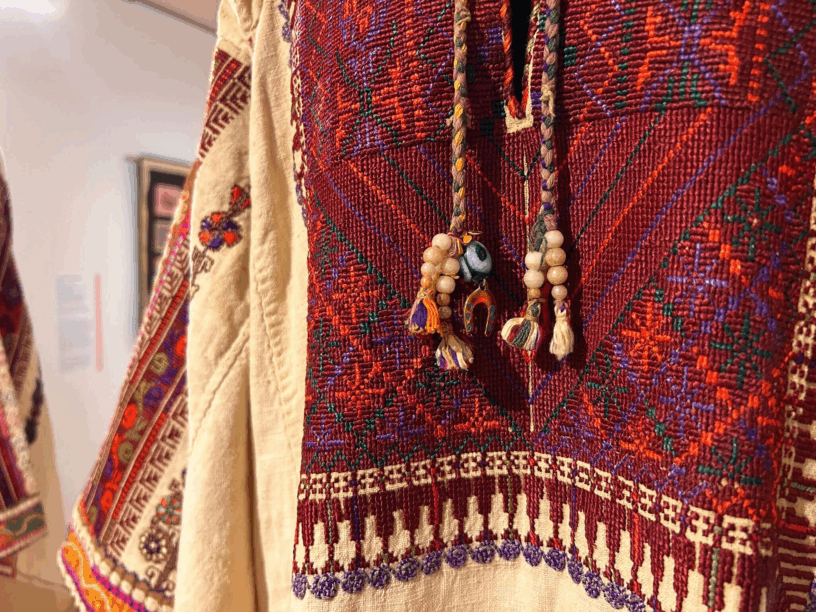
Tatreez is an embroidery form where Palestinian women and girls decorate their dress garments with “symbols of history, memory, and place,” and reflect the world around them according to the Metropolitan Museum of Art. Colours and threads, needlework used and individual interpretation all tell a story of a particular maker.
She noted a rare initial on the garment, something that she said doesn’t often appear on thobes. People didn’t assume they would be separated from these items.
Most of the items on display were made prior to the Nakba in 1948. Arabic for “catastrophe,” Nakba refers to the mass displacement of Palestinian people during the establishment of Israel, according to the exhibit description. The exhibit pieces were mainly acquired by non-Palestinian people after being “looted, left behind, or separated from their original owners,” according to the exhibit website.
The pieces came to the museum through passive acquisition, a practice where people donate their personal collections. However, the practice has since been halted by the museum due to ethical concerns.
“A lot of the time that’s coming from art collectors and people who aren’t necessarily from the cultures of the items that they’re donating. So they’re coming to the museum as beautiful objects, but objects without really additional context to where they’re from specifically, what they actually are, when they’re from, because they’re already being bought with several levels of separation from the original person who made them,” Rafique said in an interview with The Eyeopener.
In history, tatreez has made appearances as part of uprisings and resistance. During the First Intifada, a major Palestinian uprising in response to Israeli settlement between 1987 and 1993, Palestinian women embroidered tatreez into garments using colours associated with the Palestinian flag in response to restrictions on displaying the flag, according to the Metropolitan Museum of Art.
Tatreez garments are often patterned with birds, trees and flowers common to the location of the maker. The garments and thobes—the name for these Palestinian dresses—are a “documentary” of the lives of the women who sewed them, Rafique said. She said it’s possible to identify where a garment came from based on patterns and fabrics, with the exhibit organized by region. Signs saying “maker once known” sit with most accompanying placards in the exhibit.
The garments are a “documentary” of the lives of the women who sewed them.
Rafique said her favourite garment in the collection is a primarily black thobe from an area between Ramallah and Jerusalem. The thobe has red tatreez patterns and small multicoloured thread work up the front. Aside from just being beautiful, Rafique said it’s “kind of like [a] physical archive of everything that’s happened to it,” featuring different dye batches, threadwork and strange repair attempts, potentially from people who did not understand the practice, Rafique theorized.
She noted a rare initial on the garment, something that she said doesn’t often appear on thobes. She said this is because people didn’t assume they would be separated from these items.
“I don’t know this woman’s name. I don’t know anything about her, really, except where she was from. But I do have the first little bit of her initial…and it still endures on the dress, even though there have been all these other hands and all these other alterations and repairs on it since then,” she said.
Rafique was happy she was able to save the garments from “museum death,” where items enter museum collections but end up in storage rather than display. Now, Palestinian visitors who don’t have tatreez as part of their family heirlooms will be able to view them.
And when a family does still have tatreez heirlooms and practice, the exhibit has the ability to inspire.
Nazha Syriani, a fifth-year fashion student at Toronto Metropolitan University (TMU) is aiming to incorporate tatreez into a capstone project she will work on in sixth year, where she must produce five individual garments. She says she wants to reproduce the story of her grandparents in tatreez on one of these items.
Syriani tried tatreez for the first time at a workshop in Mississauga. She told The Eye she embroidered the Moon of Bethlehem, a common tatreez motif, which took her two hours.
“Palestinians are always at risk of our culture and heritage being erased,” she said. “Keeping these art forms alive and being passed down just allows us to be connected with our heritage and all the women before us, as well as showing the world that we’re not going anywhere and we are here to stay.”
The exhibit opened on Sept. 24, and will run until May 2, 2027 on the second floor of the Textile Museum of Canada.







Leave a Reply