

By Michael Elsaesser
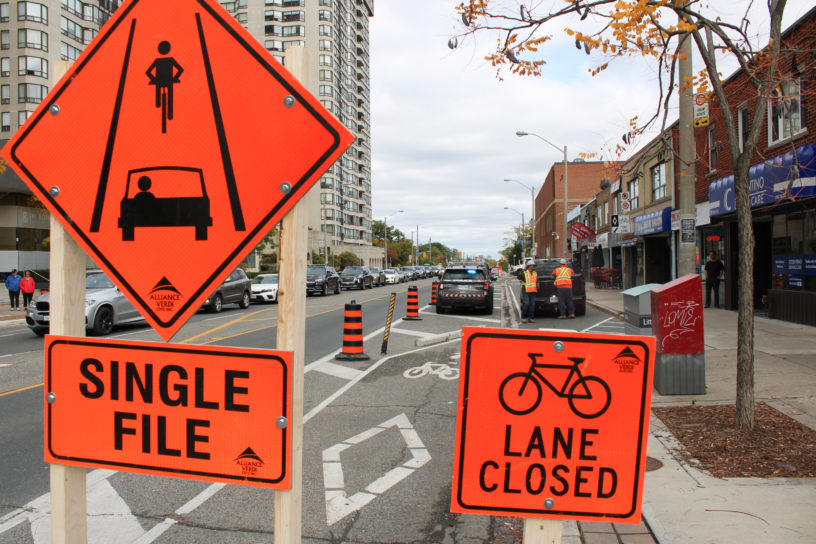
The provincial government has begun the removal of bike lanes on several busy
Toronto streets, but cyclists have been putting up a fight.
Starting with a portion of Bloor Street West in Etobicoke, crews began taking out the lanes on Oct. 14. The province says it’s removing them to reduce car traffic and make commuting around the city quicker.
The province also plans to remove bike lanes along Yonge Street, University Avenue, Queen’s Park, Queen’s Park Crescent and Avenue Road.
The removals follow the successful appeal of an April 2025 court decision that found removing the lanes would place, “people at increased risk of harm and death which engages the right to life and security of the person.”
In a September press release, the provincial government said the they’re still looking at options to keep bike lanes in areas “where they make sense and do not make gridlock worse.”
As the removals get underway, some student cyclists are speaking out against the decision.
Second-year urban and regional planning student Zachary Osborn is opposed to the removal of the lanes. He said cycling is an important mode of transportation for both students and broader Toronto communities.
“I think there’s a decent amount of students and professors that we have that do choose cycling, because it is more reliable. You know, if a distance is, say, five kilometers in the city, cycling will win every time. It is way quicker than driving, [the] TTC can be unreliable,” he said.
Osborn conducted research with the non-profit organization, 8 80 Cities, on how municipalities across Ontario have accommodated cyclists through policy and infrastructure.
“I feel like you’re really taking in the city in an active way instead of a passive way, which is really cool,” he said.
While the closest bike lane removals to the Toronto Metropolitan University (TMU) campus are several blocks away, many at the university cycle.
According to TMU’s website, the university has over 1,100 parking spaces for bikes and has said supporting cyclists is a priority in its 2020 Campus Master Plan. In that plan, TMU lists both safety and infrastructure considerations to encourage students, faculty and staff to bike to campus.
A 2021 study conducted by TMU urban and regional planning professor Raktim Mitra also found that cycling infrastructure encourages both new and regular cyclists to bike more frequently.
Osborn discussed some of the existing limitations with accessing campus by bicycle, due to the lack of protected bike lanes on surrounding streets.
“It’s unfortunate to see this narrative around removing bike lanes when streets like Dundas, or that go along TMU to the south, would be perfect for connecting students and making them feel more comfortable…now we have to work on coming up with arguments as to why we should keep what we already have, when we should be doing more,” he said.
Construction crews planned to begin removing the Bloor Street West bike lanes the night of Oct. 13, but delayed their start due to protests.
Organizers have since organized additional rallies.
Kristen Hope was one of the protestors who attended a rally. “I’m proud of us for getting over 60 people out on, like, zero notice” she said.
Irena Hrzina attended the same protest as Hope. She said she’s biked in the city for decades, but eventually had to stop because each trip on her bike “started to feel like a close call.”
“So I pulled back. The bike lanes on Bloor have made things safe again,” said Hrzina.
Reflecting on the removal of the lanes, she said: “I think it’s a shame that this is going ahead. All I can do is raise my voice and protest.”
Toronto Police Service confirmed three separate arrests at demonstrations on Oct. 14 and 15.
In an X post on Oct. 13, transportation minister Prabmeet Sarkaria commented on the protests. “Make no mistake: these bike lanes are coming out. We have a clear mandate and we will deliver.”
Mayor Olivia Chow, who is seeking re-election in the Oct. 26 municipal election, has criticized the Ontario government’s decision to remove the lanes.
“Ford must stop interfering with our city. Make no mistake: Toronto will stand up for itself,” she said in an X post on Oct. 13.
Chow’s opponent Brad Bradford, however, is in support of the removals. In an August press conference, he said he’d want to see the Bloor West bike lanes come out if elected. Work to remove the Bloor Street West bike lanes continues alongside protests.








Leave a Reply