

By Zanoah Plummer
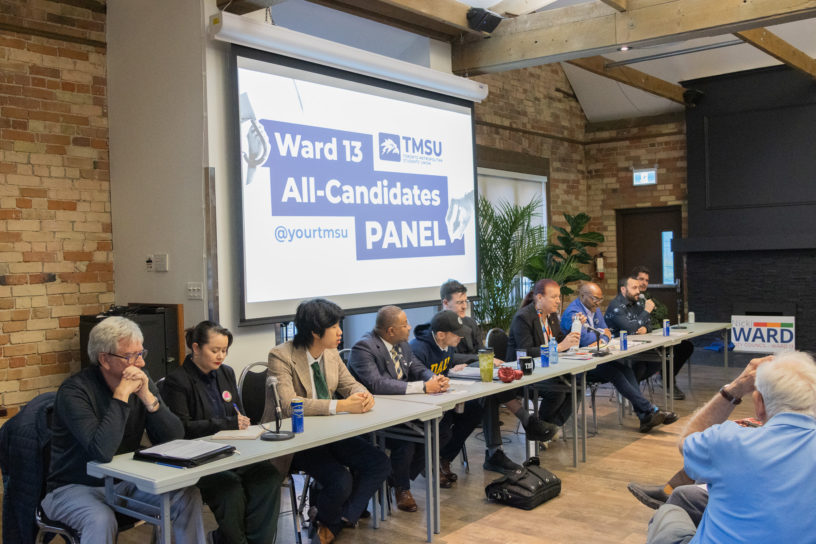
On Monday, candidates vying to be Toronto Centre’s next councillor visited campus for a panel hosted by the Toronto Metropolitan Students’ Union (TMSU). The candidates spoke to their plans for the ward ahead of the upcoming municipal election on Oct. 26.
The panel hosted 10 of the 11 candidates running for the Toronto Centre seat. Cleveland Marshall was the only candidate not present at the event.
The event was moderated by TMSU vice-president of education Teresa Baricevic and president Zain Baig. Each panelist was provided up to seven minutes to introduce themselves and their platform. Panelists were not allowed to mention other candidates’ campaign promises when speaking.
Housing affordability among key issues discussed at panel
Many candidates mentioned housing and affordability when introducing their platforms. According to a 2024 City of Toronto ward profile, 70 per cent of dwellings in Toronto Centre are rentals, compared to the citywide average of 48 per cent.
Curran Stikuts is a Toronto Metropolitan University (TMU) social work alumnus and worked in frontline and leadership roles at the 519 Community Centre for a decade. He is also being endorsed by Toronto Centre’s MPP, Kristyn Wong-Tam.
“Of course we need to expand the amount of housing we have,” said Stikuts.
“That is about looking at our programs like the multi-residential acquisition program where we buy up apartment buildings and keep them affordable, expanding the amount of money we have in those. But then also adding in the opportunities to buy up unsold condo units on the market so we can quickly bring more affordable units here right downtown onto the market.” he added.
The multi-residential acquisition program was launched by the city in 2021 and supports non-profit housing providers with the acquisition, renovation and refinancing of rental homes. The program seeks to create permanent affordable housing for current and future tenants.
Morgan Harris has served as the director of the Allan Gardens Food Bank since 2020. He said the TMSU panel was his “first outing as a candidate in a political event.”
Harris advocated for non-market housing as a solution to the rising cost of housing in the city.
The average rent in Toronto has more than doubled since 1990.
Candidates eager to address concerns around mental health and addiction
The percentage of people living in Toronto who say they have good mental health has declined from 73 per cent in 2015 to 52 per cent in 2022, according to a 2026 study by the Wellesley Institute. A May CBC story found Toronto addiction recovery centres have months-long waiting lists for beds.
Incumbent city councilor Chris Moise was elected in 2022 and is the current chair of the Toronto Board of Health. While in office, Moise created a community outreach team that involves Toronto Police and Toronto Public Health.
“In that I’ve been able to secure 16 police officers and one sergeant, as well as eight public health nurses to go preemptively into the community in the downtown core and help people before they get into crisis.” said Moise in an interview with The Eyeopener.
“And so they’ve engaged about 5,000 people in the last three and a half years providing wound care, women’s health and other health care needs. And also house referrals as well in addition to that,” he said.
If re-elected, Moise intends to continue his work with the board. He also proposed initiatives such as capping TTC fares at 10 per week, protecting tenants against demovictions and providing free breakfast to Toronto District School Board students.
Some candidates offered a different approach to addressing the needs of those struggling with mental health challenges and addiction.
Victoria Davis is a harm reduction worker and student at TMU majoring in disability studies.
She advocates for safe consumption sites in order to prevent overdoses from becoming lethal. She said many substances labeled as fentanyl are found to be something else when tested.
According to Toronto’s Drug Checking Service, 95 per cent of substances labeled as fentanyl that were tested did not meet expectations—meaning the sample tested did not contain fentanyl or was found to contain other undeclared substances.
“We need to be able to have voluntary treatment available because currently there’s about a 100-day waiting list. And if you catch someone when they’re ready to come off of the substances, then you need to catch them right at that moment because those moments are very rare and they’re very precious. Life is so, so, so precious and it’s really important that we do what we can to preserve life,” said Davis.
Candidates talk transit affordability, youth employment
Tom Cai is a mathematics and economics student at the University of Toronto. If elected, he said he will advocate for distance-based fare pricing to the TTC, capped at $3.30 at its highest. He emphasized the importance of creating job opportunities for youth amidst a rise in youth unemployment.
Walied Khogali-Ali is a founding member of the transit advocacy organization TTCriders. He said he worked to establish the first U-Pass in the greater Toronto area at the University of Toronto Mississauga campus. This pass grants students unlimited free rides on MiWay vehicles. If elected, he wants to make the TTC free for students and seniors, support rent-to-own initiatives as a pathway to home ownership and provide youth with employment opportunities.
Equity, accountability concerns raised at panel
If elected, Nicki Ward would become the first openly transgender woman to serve as a city councilor. Her campaign centres around supporting and creating cooperative housing and food initiatives to address housing and affordability issues within the city.
“I’ve been an advocate on the right side of history for 30-plus years,” she said.
“I organized the first Trans March on Yonge Street. I organized the Trans Memorial. I helped spearhead the change of the Canadian Constitution over three successive federal governments, Bill 379, 289, do you remember? And finally Bill C-16.” she said.
She continued: “We did that from the outside with no money, no support, and the opposition of some of the worst human beings you’ll ever encounter in your life. I’m not an advocate because I’m a mean-spirited person. It’s because apparently when I go to the washroom, it’s a political act.”
Norman MacLeod’s platform is Indigenous-centric. If elected, he said he would like to enforce Treaty 13.
Treaty 13, or the Toronto Purchase, is the disputed transfer of the land that later became Toronto. The treaty was not entirely honoured and parts of Toronto remain on unceded land, according to the Mississaugas of The Credit First Nation.
MacLeod said he aims to, “make life more affordable for students by introducing a vote for free TTC. I will make life more interesting for students by introducing a voting age of 16 so that the older crowd in politics can become younger.” he said.
Joe Cadeau’s campaign centres financial accountability. He would like to better manage the city’s $18 billion budget without cutting services.
If elected, Cadeau said he would like to be the link between the community and high-profile businesses in the area.
Daniel Tate is the founder of IntegrityTO, an advocacy group he said demands “accountability, transparency with our municipal government—because oftentimes, with people, it feels like decisions are made in a vacuum or in a black box.”
According to his website, if elected, Tate will audit city divisions to ensure funds are being spent effectively, introduce a zero-tolerance policy for crime and improve fare enforcement on the TTC.
Tate has a complicated history with Moise. The pair have sparred at council meetings and Tate even made a formal complaint against him after a January 2025 encounter following a council meeting, as reported by CBC in March.
An investigation by the city’s Integrity Commisioner found Moise acted in a “derogatory manner” with Tate. Moise told CBC he has “no regrets” about the incident.
Attendees given opportunity to ask questions
The event ended by opening the floor to questions from audience members.
Hamza Nasir, a third-year biomedical sciences student attended the event. He said being able to see how each candidate thinks gave him new perspectives on them.
“I wasn’t expecting it to be this interactive and this active. I essentially got to see every candidate speak and every candidate answer a question in their unique way, which I think was very nice.”
Mazen Adam, a third-year architectural science student, echoed a similar sentiment.
“Most of them shared their own solution to […] questions that we as [the] audience or the moderator asked. Some of them were scenario-based questions, so each candidate had a chance to show us how they would go through this problem or the solution for it, so that was interesting to me.”
Baig said he’s interested in hosting similar events in the future to increase student engagement with politics.
“We want students to basically see how their voices matter and how their choices can impact elections.”




Leave a Reply