

By Kaitlin Pao
Between the rush of lectures, deadlines and commuting, it’s easy to move around Toronto Metropolitan University (TMU)’s campus without noticing our surroundings. If you pause for a moment, hidden in plain sight, Indigenous artworks across campus quietly remind us of the histories, voices and traditions that deserve to be remembered.
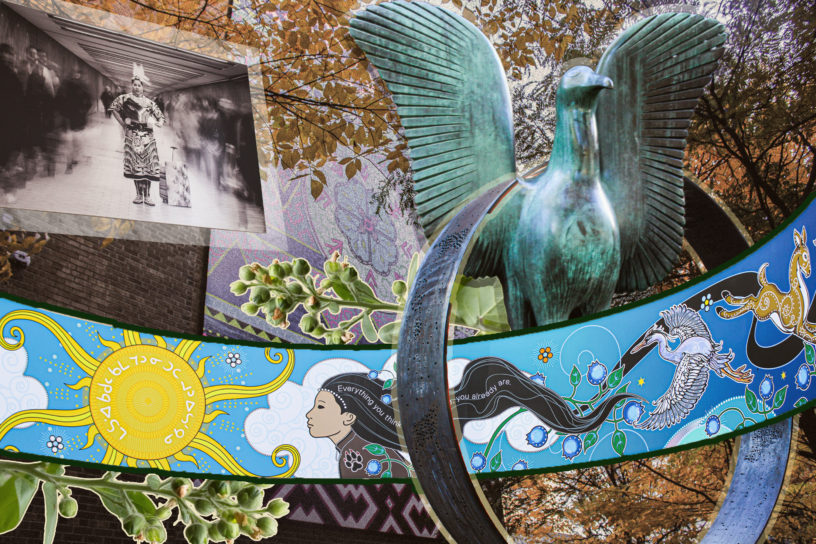
SLC “Concrete Indians” photograph installation
Located at the heart of TMU’s campus, this 10 by 15.7 foot grey-scale photograph of Tee Lyn Duke, an Anishinaabekwe dancer, hangs in the Student Learning Centre (SLC) right above the west entrance to the Library.
Done by Anishinaabe photographer Nadya Kwandibens, this photograph is featured in her “Concrete Indians” series, highlighting contemporary Indigenous identity and decolonization.
In this piece, Duke is seen in her regalia, standing in the middle of Spadina Station’s long hallway. The contrast of the cities’ dull and industrial transit systems to Duke’s cultural pieces and unshaken stance is what makes this piece powerful.
She is seen looking directly into the camera, displaying strength. This stylistic choice has been historically used in the art scene to invoke discomfort and convey a message. The morphed faces of her fellow commuters’ glances do not trouble her. This piece is a beautiful testament to Indigenous pride and the refusal to be erased.
RAC “Everything you think you need to be, you already are” installation
Shining below a skylight at the northern rotunda of TMU’s Recreation and Athletic Centre (RAC), lies Anishinaabe artist Caroline Brown’s inspiring panoramic installation.
The piece features the quote “Everything you think you need to be, you already are” by Joanne Okimawininew Dallaire, Elder and senior advisor of Indigenous Relations and Reconciliation at TMU.
With the words weaving throughout the work, flowing through the subject’s hair and translated in Cree, this piece is a reminder of self-acceptance and balance, encouraging students to celebrate who they are.
Through Indigenous cultural symbols like the Wolf Clan Paw Print, natural elements from sunrise to moonrise and bilingual text in Cree and English, the piece connects identity, nature and movement.
Installed in a space of energy and renewal, the work offers an affirmation of belonging and highlights the strength of Indigenous presence on campus.
Gould and Victoria Streets, the “Ring” sculpture
Running from class to class, you are sure to encounter the infamous “Ring” sculpture that lies east of the Gould Street and Nelson Mandela Walk intersection.
This large steel ring was designed by Matthew Hickey and Jacqueline Daniel from Two Row Architect, an Indigenous-owned architectural firm, based in the Six Nations of the Grand River First Nation.
The sculpture pays homage to the land’s history as part of the Dish With One Spoon Territory. It features imagery representing the seven grandparent teachings—humility, courage, honesty, wisdom, truth, respect and love—along with the lunar moon phases and the constellation Pleiades.
This piece’s presence serves as a reminder of the Indigenous territory on which the university stands, elevating Indigenous presence, and inviting the campus community to engage with Indigenous culture, teachings and relationships to the land.
Kerr Hall Quad Bird of Spring sculpture
Sitting on the west side of TMU’s Kerr Hall Quad is Inuit artist Abraham Etungat’s seven-foot-tall bird sculpture.
This large-scale bronze sculpture was not always this size. “Bird of spring” is one of four copies of a small soapstone carving by Etungat.
Originally, Welcoming the Bird of Spring (1986) was a carving that depicts our familiar bird—however, it is standing beside a human figure.
With both beings being connected through this shared piece of stone, it acts as a representation of the land. The bird and human are represented at the same height, mimicking each other’s form, reaching upwards. This concept depicts the relationship between differing forms—human and bird—unified through composition and tradition.
Today, the enlarged Bird of Spring invites those passing through the Quad to take the place of the missing human figure—a reminder that our relationship with the land and all living beings continues. Standing before it, one becomes part of Etungat’s vision: grounded in respect, lifted by connection.
Kerr Hall Paisajes de Nosotros (Landscapes of Us) mural
Lastly, a hard-to-miss piece is the Paisajes de Nosotros (Landscapes of Us) mural on the west-facing wall of Kerr Hall, at Gould Street and Nelson Mandela Walk.
The mural was created by Inuk artist Niap (Nancy Saunders), Peruvian Shipibo-Konibo artist Olinda Reshinjabe Silvano and curated by Gerald McMaster.
The large piece blends Arctic and Amazonian cultures through colour, pattern and the use of geometry, capturing cultural ties and the Earth’s elements.
Embodying the ice, northern lights and Inuit cosmologies, the piece acts as a tribute to the North while connecting to the Amazon through notable ancient kené—designs that symbolize plant songs of the Shipibo-Konibo peoples.
The work’s message is one of connection, respect and global Indigenous unity, reminding passersbys that all life is interwoven across regions, cultures and the shared land we stand on.







Leave a Reply