

By Eliza Nwaesei
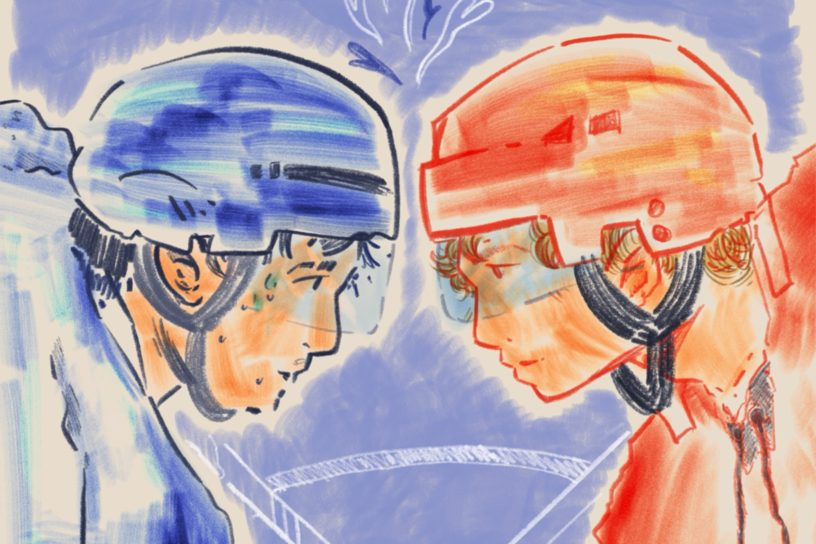
What started as a modest Crave original, filmed in just 37 days, Heated Rivalry has quickly become one of the most talked about series in recent television. The show is an adaptation of Rachel Reid’s novel of the same name—the third book in her Game Changers male-on-male (M/M) romance series. Produced into six episodes, the show was written and directed by Jacob Tierney and generated buzz well beyond expectations for a small budget Canadian production.
More than just a Canadian success story, Heated Rivalry has emerged as a pop culture moment at the intersection of hockey and 2SLGBTQ+ visibility in sports. The series follows a decade-long, secret relationship between rival professional hockey players Shane Hollander and Ilya Rozanov, exploring identity, masculinity and intimacy within a sport that has a deep history of homophobia.
As discussion around the series spreads both online and offline, various Toronto community members who are all connected to sports and the 2SLGBTQ+ community have much to say about homophobia in hockey, what Heated Rivalry got right, why it resonated with such a large audience and whether it has sparked real change in the sport.
“This is everything I’ve ever wanted so I was really in on it from the very beginning”
Aron Szocs, a member of the 2SLGBTQ+ community, grew up in the Toronto area and was exposed to sports at a young age. He became a hockey fan in 2022, eventually started playing and later became a big Professional Women’s Hockey League supporter.
Szocs recalled being interested in Heated Rivalry early on, when it was announced that the book would be adapted into a series, as he was already familiar with Rachel Reid’s M/M hockey romances and Jacob Tierney, through Letterkenny and Shoresy.
“TikTok really dragged me in and I was right there for the first episode,” said Szocs. “Then every week, right at midnight on the episode release, I was watching.”
He immediately fell in love with it and enjoyed the social media buzz around the show and how the weekly releases built anticipation and a strong sense of community among viewers. “I guess you could say it was love at first sight,” said Szocs. “I’m so happy it became popular. It’s a Canadian show made by Jacob Tierney and it’s about gay hockey players. This is everything I’ve ever wanted so I was really in on it from the very beginning.”
“The story in which it’s trying to tell feels very real to the story we’ve lived as queer people”
Reflecting on the accuracy of Heated Rivalry’s demonstration of a queer relationship, Dylan Lafave — a third-year professional music student at Toronto Metropolitan University (TMU)—responded, from his perspective as a gay man, that he believed it was pretty accurate. He pointed to the contrast between the lack of acceptance and support from Ilya’s family and Shane’s accepting family as reflective of the reality many queer people faced at a point in time, when being openly gay felt unsafe or impossible.
“The story in which it’s trying to tell feels very real to the story that we’ve lived as queer people,” said Lafave, reflecting on the hardships his community went through and still goes through today.
Lafave, who played hockey for 16 years, is familiar with hockey culture and its faults.
“Anytime I, for example, would do anything remotely feminine, there were always comments. It’s one of the only settings that I’ve been in my life where it’s like that,” said Lafave. “Something like this show is really bringing it into conversation.”
Sarah Hergel, a second-year TMU sport media student and also a member of the 2SLGBTQ+ community, was caught up in the social media storm surrounding Heated Rivalry and understands the draw and appreciates the issues it is bringing to the forefront.
“Anytime I, for example, would do anything remotely feminine, there were always comments”
She echoed concerns about hockey culture, noting how homophobic it can be.
“I don’t think it is talked about enough,” said Hergel. “There’s so many stories that are coming out from hockey and how toxic the environment can be if you have no connection to hockey, you don’t know…This show is addressing that there is an issue and [with] it becoming more mainstream, people are like ‘Oh, wait, this is real’.”
Despite initiatives such as Pride Nights and specially-designed Pride-themed jerseys, Szocs said progress in professional hockey has been limited. He pointed to fan pushback as a major reason Pride jerseys and tape were disallowed for National Hockey League (NHL) players to wear during games in 2023, highlighting how even small steps toward inclusion met resistance. As a gay man and a fan of a hypermasculine sport, he has heard statements from athletes and learned things about them that have been hurtful to his community.
“It’s unlike a lot of portrayals of queer relationships that we get to see”
Baptiste Segers, a photographer for the Toronto Gay Hockey Association (TGHA) as well as a member of the league, spoke about his experiences within the TGHA. Although he is a straight man, he has found a welcoming community with the TGHA and has become more aware of the stereotypes and exclusion that exists outside of it.
“I went to the Leafs’ Instagram on the Pride Nights, the TGHA was invited there, and Ben Baby, our commissioner, did an interview,” said Segers. “I read just out of curiosity, the comments for that specific video. I was pretty much disgusted and that’s where you see that we have a long way to go.”
With homophobia being part of hockey culture, that backdrop is perhaps why Heated Rivalry has resonated with fans, particularly within the 2SLGBTQ+ community.
“This show, the relationship is so exciting to watch because they grow so much together,” said Hergel. “I was talking to someone the other day and they went, ‘I was expecting something bad to happen, but it’s a happy storyline’.”
Like Hergel, Szocs was pleased with the show’s conclusion. “It’s unlike a lot of portrayals of queer relationships that we get to see because a lot of times they end in tragedy and it’s always miserable,” said Szocs. “There is always a silver lining in [Heated Rivalry] that is still happy even though if you really think about the situation they’re in, they could make it very sad.”
“It’s hard to welcome people when it’s just systematic down to the core”
Despite the show’s success, ongoing conversation and resonance with audiences, a question still remains: Has Heated Rivalry led to real progress in hockey culture or is it simply a moment of temporary visibility?
The answers were similar but each offered different perspectives. Szocs said it is too early to see if the show is having any significant impact on professional sports. He believes it is exposing new people to new ideas and bringing the realization to others that there may be some closeted athletes struggling.
“I think temporary visibility is a necessary step if you want to work towards change,” says Szocs. “There is never going to be long-term change with the snap of a finger.”
He pointed to actor Hudson Williams—who plays Shane Hollander—shared that closeted athletes had reached out to him after the show aired, suggesting that even if professional players are not engaging openly with the series, they are seeing themselves reflected on screen.
Segers and Lafave expressed similar sentiments, that the show is raising awareness to the issues and normalizing 2SLGBTQ+ representation in hockey. Both hope that professional leagues like the NHL capitalize on this moment, leading to progress and an uphill trajectory for inclusion.
“It’s helping start the conver sation,” said Hergel. “It’s helping open people’s eyes, but it’s like the pie crust. We don’t have the filling so we can’t make the whole pie.”
Just earlier this week, the Ottawa Senators sold Shane Hollander and Ilya Rozanov jerseys at the Canadian Tire Centre, with all proceeds going to Ottawa Pride Hockey.
What comes next remains uncertain. While Heated Rivalry has drawn in new audiences and sparked conversation, these four individuals, all united by the show, question whether professional leagues, including the NHL, are ready to build on this momentum in a meaningful way.
“This show is probably the biggest draw for new fans, and they have no relationship to the [NHL] at all,” said Szocs, pointing out the show’s league was referred to as Major League Hockey. “It’s hard to welcome people when it’s just systematic down to the core. Everything about the league and the people who run it, it’s accessible to a very limited group of people.”
Lafave added that he is unsure whether a show like Heated Rivalry would encourage players to come out or scare them away even more.
“It’s peaking right now and then it will go down, but it will not go as low as it was before”
While some doubt remains about the show having a positive impact, it does not erase the probability of progress.
“You have to start somewhere,” said Segers. “It’s peaking right now and then it will go down, but it will not go as low as it was before, so that is the first step.”
For many viewers, Heated Rivalry may only be the beginning but it has opened the door for conversations that could eventually reshape the culture of hockey.





Leave a Reply