

By Ella Miller
Prior to her super graphic ultra modern victory in the season six finale of Canada’s Drag Race, Van Goth sat down with The Eyeopener to talk about her run on the show. This included a moment in the season’s fifth episode where she came out as HIV-positive in a powerful testimony.
Van Goth—who is a 2019 graduate from Toronto Metropolitan University’s (TMU) fashion design program—talked about more than the virus itself, but also the legal minefield many HIV-positive Canadians face. Canadian law dictates that those with HIV are responsible for informing sexual partners of their statuses in any situation that poses a “realistic possibility of transmission.”
In instances where they don’t disclose, accused parties may be charged with sexual or aggravated assault which can carry prison sentences of up to 14 years.
HIV can be rendered undetectable—and therefore untransmittable—through medications like antiretroviral therapy which suppress the virus by reducing the viral load.
But according to the HIV Legal Network of Canada, as of 2019 over 200 Canadians had been sentenced for non-disclosure and in many of these cases, there was no chance of transmission due to condoms being used or low viral load.
2SLGBTQ+ advocates and their allies have been pushing back for years against these laws which they see as unfairly targeting the Queer community.
While this season Van Goth may have been labelled ‘the villain’ by fans (and herself #branding), the conversation she opened on HIV in Canada is certainly a heroic moment.
The theme of this issue is Love and Sex. How much of your drag is born just out of love?
In a lot of ways I feel like my drag is born from a love of myself and a love of the community. When I was 16, I snuck into Crews & Tangos when I first moved to Toronto and I saw a drag queen and I was enamored by everything: her stage presence, her connection with the audience, her vibe, her energy, her lights. That drag queen was actually [named] Xtacy Love, who is Priyanka’s [drag] mother.
Whenever I’m in a club or I’m performing I always make sure everyone feels seen and loved and represented. I feel like a lot of my drag, although it’s kind of dark and intense, I feel like I’m not like that.
Your craftsmanship and your ability to put a look together from a styling perspective, was that something that you always did or did that come out when you were at TMU for fashion?
Both things are true. I always had to have that love, because why would I have ever gone to see me for fashion in the first place if I didn’t?
Fashion to me has always been a form of language and a form of expression, and drag is no different for me. Storytelling in drag’s about showing someone something without telling them what it is verbatim or like hitting the nail on the head.
Beyond that, TMU really prepared me for Drag Race, because fashion is also all about taking a critique and being able to apply [it]. I loved how brutally honest some of my professors at TMU were, and it really helped me prepare for not only the real world, but also what Drag Race was like.
One of the most impactful moments of your run on Drag Race was when you talked about being HIV-positive and how Canada’s legal system treats people with HIV. What were you thinking at that moment?
You can barely even see in the edit but while we were preparing to talk about the topic—because I knew it was coming, I knew that was my runway, I knew that’s what I planned—I’m shaking, I do my makeup, I’m like shaking.
It just was a lot of weight I was carrying around. It [was] so fresh. It had only been a year prior to filming Drag Race. I spent a lot of that year, honestly, just trying to forget about it.
I really don’t remember any of it. I truly probably blacked out and just started crying. But something I was really proud of on the whole rewatch when I watched it with everyone else. In my confessional specifically, I can just see myself talk in a way that I don’t think I’ve ever really talked before, which is really honest and open and raw. I mean, it was hard to watch because I was like, ‘damn, I don’t think I’ve ever spoken like that in my life.’
I want to talk about your episode five look in particular. The makeup was something that I noticed first because it was so, so striking.
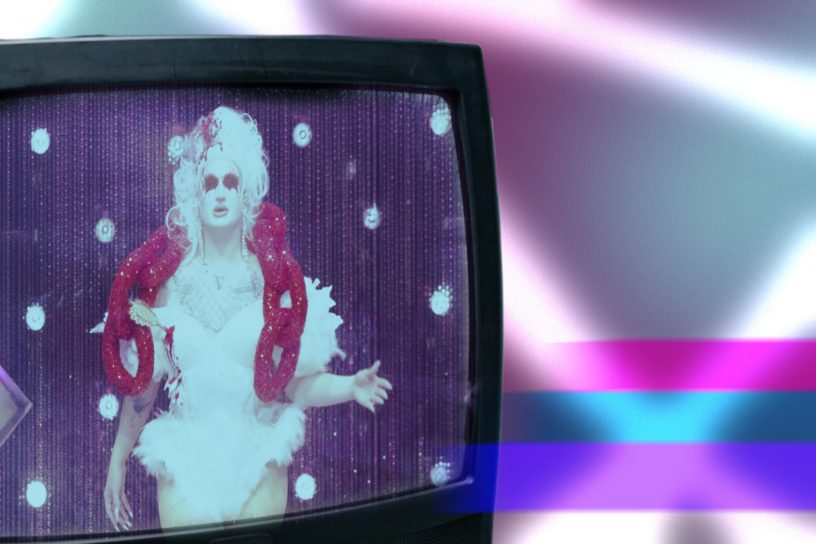
I wanted a strong contrast. White represents a time of innocence and angelic, doves. The “pierced through the heart” was definitely a layer of: one, it’s a blood thing, HIV is in your blood and the heart is the centre of your blood; also like, love, sex, heart—all those kinds of things.
I had almost gouged-out eyes, because my idea was like, justice is supposed to be blind and then in this scenario, it doesn’t feel that way. The chains were also in kind of a shape when I threw them down, like the red AIDS ribbon.
This was all because of your runway category, Perp Walk to Remember. When I heard the category I was like ‘that is such a weird category.’
We were literally like, ‘this has nothing to do with cops, right?’ Like, we’re not gonna get arrested on stage.
I love that it was kind of a mix of different people’s perspectives because obviously I went a serious route, PM went a serious route, Eboni went a historical route. I think that there were fun ways that we could interpret it. And some people went a silly route, like Sami was silly, Velma was silly. Maya was silly.
That was like the fun of Drag Race, because you can kind of make it what you want it to be. Some of us were going like, yeah, ‘what is a perp and what makes a perp, and why are these people perps?’ versus people who went ‘this is silly and campy and fun.’
We’ve seen other people come out as HIV-positive on Drag Race, but they’ve never talked about it in the way that you did.
When I found out I was HIV-positive one of the first things the public health nurse said to me was, ‘okay here’s a contact that you can talk to about all the legal issues.’ And I was like, ‘what do you mean the legal issues? Like, how does that have anything to do with the law?’
It caused a lot of interesting debate when I said it on the show, because a lot of people are saying, oh, I wasn’t completely correct or I was wrong. I think the issue I’m getting at is that the law is nuanced. To me, law should be right or wrong. Why am I putting my [fate in] a judge or a jury or group of people who I don’t know, who have their own preconceived notions, stigmas,…when I’m undetectable and there’s truly no chance of transmission.
It’s crazy to believe that someone can actually sexually assault somebody, but me not telling them something that will in no way affect them would give me a harsher punishment than somebody who deliberately sexually assaults somebody.
[There’s] so many times even beyond that where somebody’s status will be used in a court of law in an unrelated case to truly alienate the jury, alienate the judge and alienate people from that person who is the defendant or whatever. Why is my health status ever used in the court of law?
That talk I had on Drag Race caused a lot of conversation in a great way, because I think it is a longer conversation than what a one hour reality TV show about drag will allow us to get into. But it opens the door.
This interview was edited for length and clarity.









Leave a Reply