

By Hannah Thompson
Disclaimer: Zoha Naghar and Mercedes Gaztambide are TMU journalism alumni. Naghar has previously contributed to The Eyeopener.
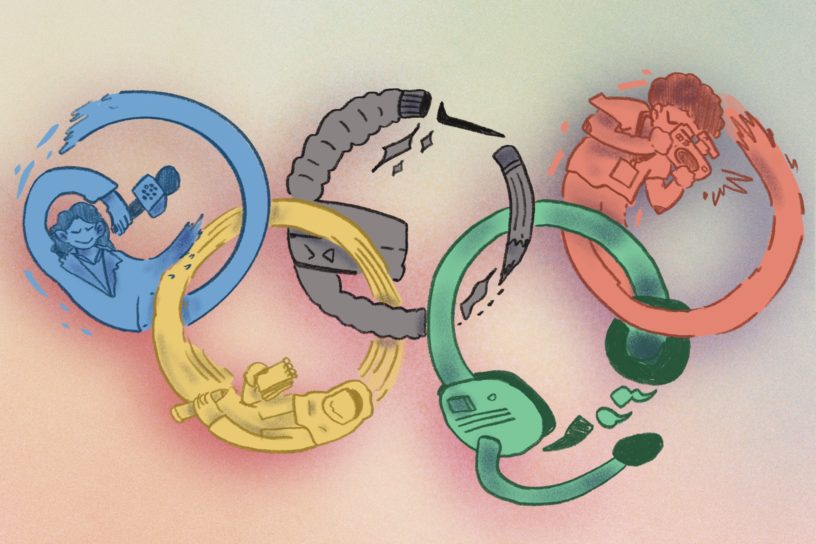
Since early February, the 2026 Winter Olympic Games have been underway in Milan and Cortina d’Ampezzo. Fans across the world have been glued to screens, cheering for every medal, watching closely for every crash, every incredible moment. But for the Toronto Metropolitan University (TMU) community, the games are more than something to watch. They provide an opportunity to create, produce and bring millions of Canadians together in real time.
At 2 a.m. in a downtown Toronto media office, everyone is watching the same screen.
A medal result is seconds away. The graphic is built. The caption is written. A finger hovers over “post.”
The moment it’s official, it goes live.
For TMU students and alumni, part of Canada’s Olympic coverage is happening thousands of kilometres away in production rooms and, in one case, high in the Italian Alps.
“It’s a 2 a.m. start,” said Ishaan Thandi, a fourth-year sport media student.
As a shotlister with CBC, Thandi monitors multiple live event feeds, tagging every crash, podium finish and reaction shot producers might need later. On any given shift, he flips between snowboarding, skiing, curling or hockey, marking the moments that will eventually become highlight packages and social clips.
The job started with a cold email.
After asking classmates how they landed Olympic roles, Thandi reached out directly to a hiring manager. That email turned into an interview and a shift schedule that runs while most of campus is asleep.
“Just being in the office when Canada has won gold medals has been unreal,” he said.
Balancing overnight shifts with classes hasn’t been easy. But the experience feels bigger than the exhaustion.
“A lot of what goes on in sport media is networking,” he said. “Meeting people and getting your name out there is huge. You learn as much from your peers as you do from the work itself.”
Across the office, Zoha Naghar’s day begins later but ends with just as much pressure.
Naghar, a 2025 journalism graduate, is the lead evening social producer for CBC’s Olympic coverage. After 3 p.m., she oversees what goes out across national social accounts, coordinating with writers, video editors and other producers to ensure Canada’s Olympic moments reach audiences in real time.
“There’s not a single hour in this office that someone isn’t putting something out,” she said.
On potential medal days, the atmosphere shifts. Everyone has a laptop open. Graphics are prepped before results are confirmed. Once the moment happens, there’s no delay.
“When you say it out loud—that you’re working for the official Canadian broadcaster—you’re like, ‘Oh my God, I’m on that team,’” she said.
The scale is national. The margin for error is small. A typo isn’t just a typo anymore.
“Everything I push out from here is being seen by millions of Canadians,” said Naghar.
Still, she says the work doesn’t feel foreign.
“I felt like I belonged here,” she said. “Because I learned all of this for the past four years.”
Thousands of kilometres away, 2022 journalism alumna Mercedes Gaztambide was sent to Livigno, one of the Alpine hubs of the Games.
As a producer in CBC’s content production unit, she works directly with athletes affiliated with major sponsors, producing digital and broadcast content between competitions and interviews.
Her days move quickly, prepping questions, coordinating deliverables, assisting on broadcast segments, often all within the same stretch of time. She is constantly shifting between creative tasks and technical ones, making sure each moment is captured accurately and compellingly.
She credits TMU’s journalism “story days” for preparing her. Though no longer part of the program curriculum, story days required journalism students to produce same-day articles about current events.
“They really throw you into the fire,” she said. “At first, it feels intense. But it forces you to get comfortable being uncomfortable. It teaches you how to make quick decisions and trust your instincts, skills you need every day in this job.”
One moment in particular stays with her.
Gaztambide watched Canadian freestyle skier Megan Oldham win gold in the women’s freeski big air final. She stood in the crowd as the national anthem played.
The next day, she interviewed her.
“To see her smile and to see her holding that gold medal…it represented not just her as an athlete, but our entire country,” Gaztambide said.
She remembers watching Oldham interact with young girls near the podium, medal still around her neck.
“There was something that really struck me about how young girls can be inspired by athletes like her.”
Within 24 hours, she saw the full arc, from competition to podium to personal interview, and captured it for audiences back home.
From overnight shifts in Toronto to mountaintop interviews in Italy, TMU students and alumni are shaping how Canadians experience the Olympics. The Games may happen in Italy but for the school’s student—past and present —community, every medal, every highlight, every athlete moment is built, produced and shared. It is a reminder that the Olympics are as much about those behind the scenes as those on the podium.






Leave a Reply