

By Victoria Cha

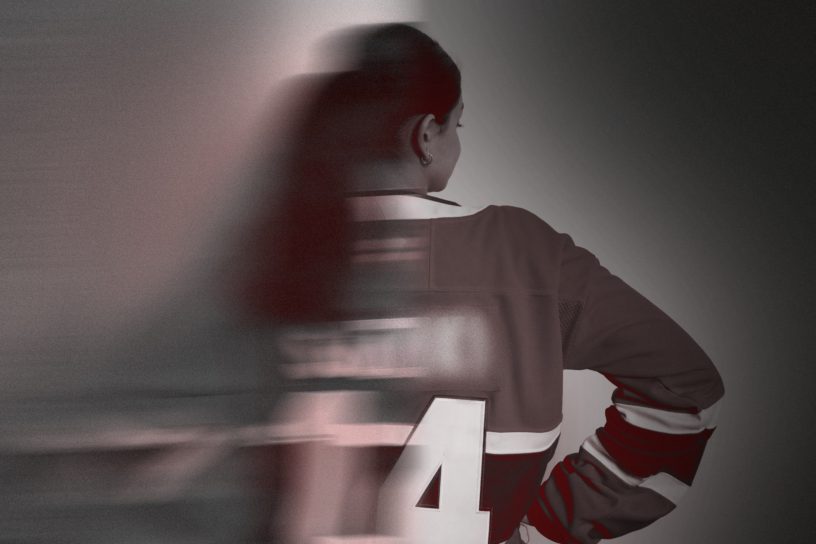
“Hockey is for everyone” is a term that floats around the NHL on certain occasions—a declaration that the league seeks inclusion and respect for all. But as the world of hockey continues to spin and I continue to try existing within the space, my doubts on the validity of this phrase grow larger.
Another phrase I frequently encounter seems to ring more true: “I love hockey but hockey doesn’t love me back.”
Time and time again, hockey reveals itself for what it is—a monoculture tailored to a very specific identity. Every couple of months, we are shown a new instance of how the sport is unwilling to give marginalized communities a place to thrive without harm.
A joint initiative amongst the NHL, AHL and East Coast Hockey League, Hockey is For Everyone aims to, “make the sport a more inclusive and safe environment for all players and fans.”
But that doesn’t seem to be the case. Not when discrimination is a continuous occurrence and players so freely make or support remarks that create a stark divide between who belongs and who doesn’t.
In a December 2025 episode of their podcast, NHL-playing brothers Matthew and Brady Tkachuk exchanged remarks about women hockey fans. In a broader discussion about people outside of the NHL using hockey terminology, Matthew said, “[There’s] nothing worse than when girls call a player by their nickname. That’s just fucking weird to me.”
But what is so weird, so foreign about a woman who simply knows as much as any other dedicated hockey fan? It seems women can never do anything right. Even when we can “name five players” to prove our validity as sports fans, it’s still not enough. We still get laughed at.
More recently, after their Feb. 22 gold medal win at the 2026 Winter Olympic Games, the U.S. men’s hockey team took a call with President Donald Trump who invited them to the White House. Following this, Trump joked, “I must tell you, we’re going to have to bring the women’s team, you do know that.”
Despite being the first of the two U.S. hockey teams to win gold during the Games, the women were not only an afterthought but something to mock.
Yet the locker room burst into immediate laughter. Not a single person in that room—not the fathers of young girls or husbands to strong wives—seemed to have an issue with the belittling of women.
It’s not just women who are pushed out.
Amidst the popularity of Heated Rivalry, a “noticeable spike” in anti-2SLGBTQ+ hate has been seen in school-affiliated hockey programs in Boston. This was something the Lawyers for Civil Rights Boston mentioned in a March 3 open letter addressed to Massachusetts Attorney General Andrea Joy Campbell.
The letter explained that increased homophobia may be, “a backlash to the growing visibility and popularity of the television series Heated Rivalry—and the resulting attention, commentary, and social media discourse it has generated around gay hockey players.”
As conversations that confront hockey’s monoculture become more prevalent, members of the sport only get more angry that its borders are threatening to widen. But what is the issue with diversifying the community?
In 2020, former NHLer and equality advocate Akim Aliu, who is Nigerian-Ukrainian, wrote in The Players’ Tribune, “the NHL’s title for their annual diversity campaign, ‘Hockey is For Everyone,’ makes me crack up. Because, right now, hockey is not for everyone.”
Aliu’s words carry just as much truth today as they did six years ago. Ill treatment in the hockey world, from those who are safe within its borders, has only continued.
In January, Minnesota Frost forward Britta Curl-Salemme posted a video to her Instagram in collaboration with FIERCE Athlete, an anti-trans organization that, as per its website, “is here to help you realize who you were created to be, by God, as a true and authentic female athlete.” This was one of multiple instances Curl-Salemme received criticism for engaging with and promoting racist and transphobic commentary.
Women’s hockey is seen as much more inclusive than men’s hockey—the 2025-26 PWHL season saw 30 queer players hit the ice, while the NHL has never had an openly gay player compete. But that doesn’t mean the space is immune to discrimination.
Shortly after the U.S. men’s team locker room celebration went public, Ellen Hughes was asked to share her thoughts. Hughes is a former U.S. women’s hockey team member and a player development coach for the current team.
She is also the mother of Jack and Quinn Hughes, both of whom were players on the men’s team in that locker room. In defense of their team, she said, “they care about humanity. They care about unity and they care about the country.”
But if they cared about unity, why did they laugh? And why is their behaviour, that so profoundly degrades women, so excusable?
Hockey grants acceptance only to those it was designed for. Research from the Sociology of Sport Journal explains that hockey is, “a white cis-male-dominated sphere that attempts to socialize young boys and men into traditional hegemonic masculine ideals.”
While these individuals can lavish in the privilege and power the sport gives them, everyone else is left having to accept being treated like an outsider, simply for not fitting the status quo.
Addressing the criticism he received regarding his reaction to Trump’s locker room “joke,” Jack Hughes said, “people are so negative out there and they are just trying to find a reason to put people down and make something out of almost nothing.”
Almost nothing?
For many, hockey, and this culture that excludes and discriminates them with little to no remorse, means everything. The “harmless” and “comedic” comments made by those who belong tell those who don’t they will always be different. Othered.
The lack of change within this culture begs the question: how can marginalized fans remain in the hockey community when they’re not welcome to begin with?
Right now, it’s up to them to create their own space in hockey. But when so many, especially those in power, make it clear they are unwanted, these marginalized groups not only have to navigate a fight for space but also their own sense of power to do so.
For now, we’re going to keep pushing the door open. We must. We know what real unity looks like, and we will keep fighting for it even when others don’t want us to.








Leave a Reply