

By Nadine Alsaghir
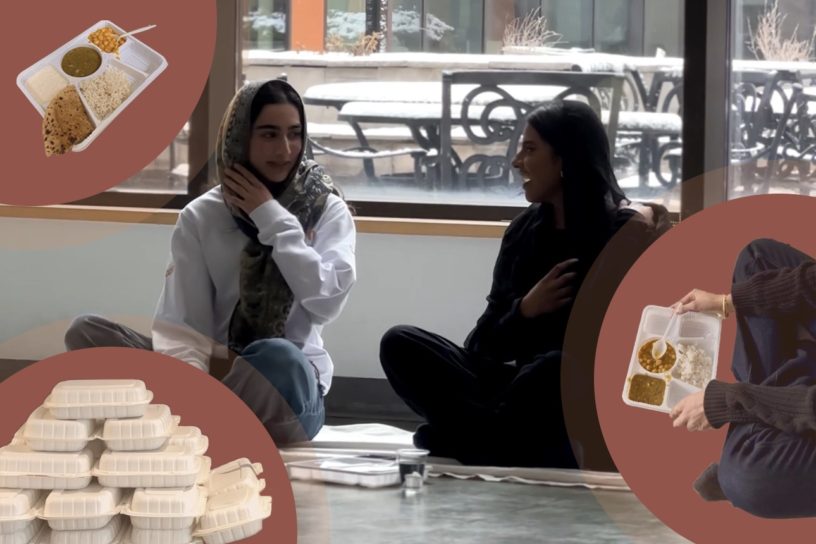
On March 17, the Sikh Student Association held Langar at Toronto Metropolitan University (TMU), offering a traditional communal meal to students while teaching Sikh principles of equality, service and shared learning.
Langar is a cultural event that aims to bring people together to experience Sikhism’s core values—sharing food and fostering understanding and inclusion, according to the Parliament of the World’s Religions. Students removed their shoes and wore head coverings before entering the room where floor decals marked places to sit.
Sunit Janjua, a fifth-year accounting and finance student at TMU and president of the Sikh Student Association said the way attendees sit on the floor conveys the event’s message. “That symbolizes equality because regardless of your race, culture, ethnicity, everyone’s equal,” she said.
Janjua said bringing this to campus helps emphasize Sikhism’s core principle of learning.
“Everyone is on their own pace…it’s good because everyone’s students here, everyone’s learning different things and we’re all on our different learning paths,” she said.
Sikhism is a monotheistic religion that originated in the Punjab region of South Asia in the 15th century, founded by Guru Nanak. Janjua explained that historically in Punjab, India, kings and emperors would sit beside servants in Langar to reinforce the principle of equality.
Participants in the event could take unlimited servings of rotis (bread), dal (lentils), sabzi (vegetables) and kheer (rice pudding). Event volunteers would check on the guests to pour preferred dishes and refill plates.
During the event, Paath, a Sikh prayer, played in the background. Angadjot Mann, a first-year business management student, emphasized that the Paath playing in the background was a touch of authenticity from the Gurdwara—a Sikh holy temple.
For first-time attendees, Langar offered a unique cultural experience. Jonah Roukema, a fourth-year mechanical engineering student, said he was surprised by the depth of the tradition as someone who isn’t Sikh.
“We didn’t realize it was a whole [thing], like putting on a head covering and stuff, but it was definitely a fun surprise,” he said.
He added that participating in serving the meal taught him about giving back to the community. “I think people can get sucked into individualism a lot and just kind of protecting [themselves],” Roukema said.
Mann said the event highlighted important human values.
“I think this is a really important part of being human…it kind of also gives you that self-fulfilment, kind of helping people, serving them food,” he said.
Mann said it was inspiring to see students his age participating in Seva, bringing energy and engagement to the event. Seva in Sikhism means selfless service done without expecting anything in return.
“You go to the Gurdwara, it’s mostly older people, 25, 30, but it’s really nice seeing the younger generation getting on it as well,” Mann said.
Organizing the event requires careful planning. Janjua said the food is prepared in a Gurdwara in Scarborough and transported to campus. Leftovers are donated to local people experiencing homelessness, reflecting the Sikh commitment to helping those in need.
Attendees hope that future events like Langar will continue to bring students together, offering opportunities to learn about different cultures and give back to the community.
Roukema said he appreciates living in a multicultural city like Toronto, “It’s so awesome to be able to experience all different parts of the world within one small area, so I definitely would go to any other event like this.”









Leave a Reply