

By Aditi Roy
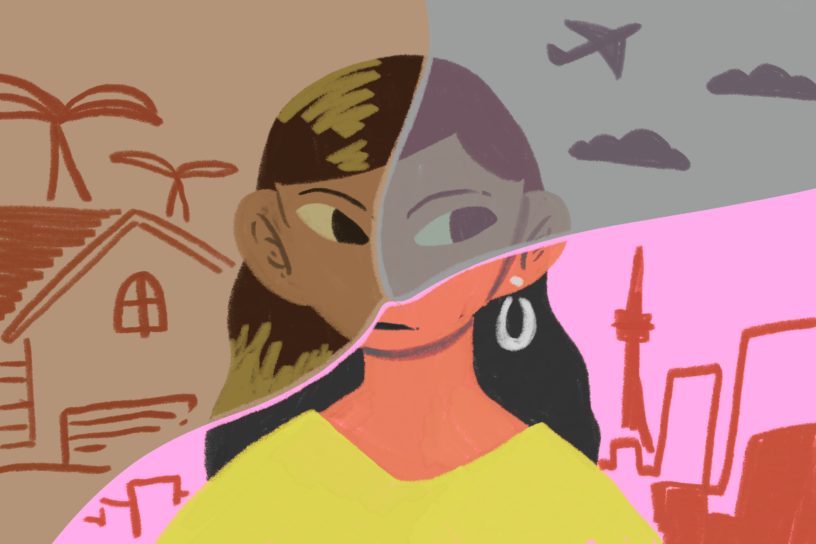
Third-culture kids (TCK) are people who have grown up across multiple countries. At TMU, third-culture students are finding a new place to call home.
Masoud Kianpour is a sociologist, social psychologist and senior research fellow of multiculturalism at TMU. He defined the term as a “child who spends a significant portion of their developmental years…growing up outside their parents’ culture of origin.”
Kianpour explained that such kids tend to develop a malleable sense of identity in attempts to adapt to their changing environment. “These kids do not develop a sort of cool rootedness in either their home culture or their parents’ culture or the host culture…but instead construct a third-culture,” he said.
Elizabeth Abi Jones is a fifth-year psychology student who has lived across six different countries in her lifetime. Jones is of Gambian descent and was born in the U.S. She said she has lived in Senegal, Kenya, Tunisia and Ivory Coast—constantly having to relocate due to her
father’s work.
“I usually just tell [people] I’m American, depending on how I feel, I’ll give them the full breakdown,” said Jones.
Kianpour himself fathers a TCK son and said he understands the struggles children can have growing up in various environments. “They live in what we call cultural liminality, or in-betweenness. Many of these TCK kids feel that they do not fully belong anywhere,” he said.
For Jones, home is not bound by a location. “Home is where my family is, just because wherever I’ve gone, they’ve also been there too,” she said.
Jones’ mother has played a pivotal role in helping her find a sense of belonging. Growing up, she said she experienced being teased for not being able to speak her native language Wolof.
“Don’t ever let anybody tell you where you’re from,” Jones quoted her mother’s words in times of need.
On campus, Jones is a member of the Black Business Student Association (BBSA), choosing to identify more with her race than any of the cultures that have impacted her—a larger ground to make meaningful connections.
Jones said she feels understood at the BBSA, seeing the diversity present within the club. “It’s a group filled [with] different people, ranging from African to the Caribbean to Latin American and me personally, I’ve always been interested in other people’s cultures,” she said, a nod to her rich traveling experiences.
Hamed Bakkar is a third-year computer science student at TMU. He was born and raised in Damascus, Syria and moved to Rome, Italy at the age of 17 due to his fathers work with the United Nations.
Spending three and a half years in Rome, Bakkar noted the similarities the two cultures shared, making the experience an easier transition.
“The family culture and getting together, the restaurant culture, the cafes. I’d say something similar between Syria and Italy is definitely…[that] they love living life,” he said. Bakkar added his upbringing in Syria and time spent in Italy was in stark contrast to his university life in the fast-paced city of Toronto—where he feels life is centred more around work.
Having moved at a slightly older age, Bakkar has a different experience of living in a foreign country, recalling a lingering feeling of not belonging.
“It was definitely a little weird, because I did not speak the language…I’d say, in Italy, you definitely feel it immediately,” he said.
Kianpour explained why it is easier to navigate one’s intricate identity in such a multicultural country like Canada.
“When you say, ‘I’m a Canadian,’ no one assumes that you’re necessarily white or belong to a particular ethnic racial background,” he said.
Saanika Mahajan is a fourth-year software engineering student of Maharashtrian origin—an ethnic group in India—who was raised in the United Arab Emirates from the age of 10.
Although she spent nearly the same amount of time in both countries, Mahajan holds closer to her Indian heritage, framing her identity as being “80 per
cent Indian.”
Mahajan clung onto her Indian heritage, unable to find opportunities to integrate herself into local Emirati culture. She has fond memories of her time in Sharjah, U.A.E. and adores the local culture but she felt like an immigrant through
and through.
“They are very close knit among themselves, so they don’t really take in…other cultures that way. They let everybody coexist, but in their own groups,” she said in reference to the U.A.E.
Her childhood in Sharjah still felt very Indian, as she attended an Indian school, ate home-cooked traditional meals and immersed herself in the Indian community within the U.A.E.
“At home [in the U.A.E] we celebrated our festivals, we spoke in our native language, and we connected with people around even in U.A.E.—we found a little community,” she said.
Mahajan’s experience with discrimination within the country has also shaped her sense of community.
“There are salary discrepancies and the workload distribution…even being an American company, they overwork the Indians, but they underpay them for the same designation,” she said in reference to her father, who has worked there for years.
Kianpour noted this is a common experience for many TCK’s. “Their belonging might become conditional or hesitant, because they always know that acceptance is something that is contingent on appearance [and] accent,” he said.
Despite such encounters Mahajan still holds pride in her Indian identity, sharing her excitement with the widespread reach of Bollywood movies and songs.
“There is a huge fan base for Bollywood in [the] U.A.E. So they host a lot of Bollywood movies. I used to go watch them, even locals like Bollywood,” she said.
For Mahajan, Canada marked the start of a fresh chapter as she attempts to “absorb” the local culture. She recounts feeling five per cent Canadian a result of her undergraduate years in the country.
“I have managed so much on my own in this country…when I went back home for a vacation and I came back here, you have no idea, when I navigated [Sankofa] Square again, I felt like home,” she said.







Leave a Reply