

By Sophie Wallace
Disclaimer: Olivia Quain has previously contributed photographs to The Eyeopener. She had no part in the production of this story.
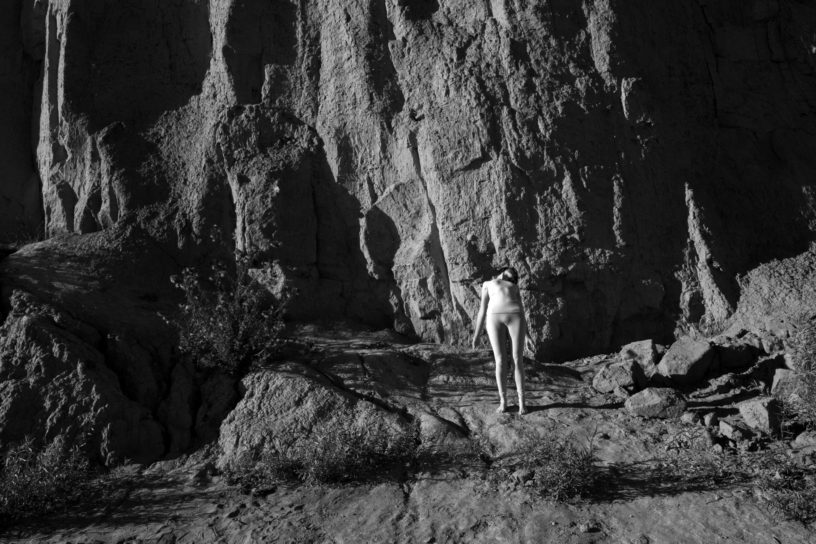
Sunlight bursts from the ground. A woman contorts herself to mirror the jagged shapes of Scarborough Bluffs. Hair and skin and rock face meld into one.
Toronto Metropolitan University (TMU) photography ’26 graduate Olivia Quain’s thesis work Turning to Stone asks a vital question: what do we make room for when we stop asking women to be beautiful?
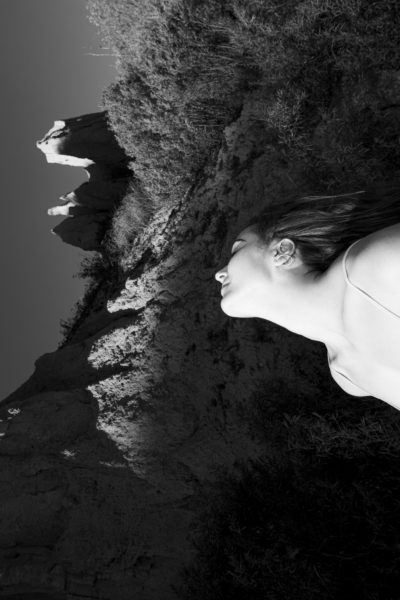
The black and white image series captures women’s bodies amongst the rocky cliffs of Ontario. In some, the figure is barely discernible, emerging as little more than a glimmer of light and texture; in others, she fills nearly the entire frame.
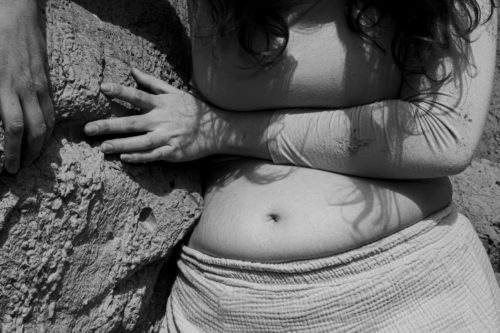
“You look at a rock. And it’s not necessarily always beautiful. Right? That doesn’t mean that it’s not interesting,” said Quain in an interview with The Eyeopener.
Quain’s curiosity about rocks started long before her thesis work began to take shape.
“I started to sort of see the rocks as really sentient, very quiet observers of time and space”
Quain went on exchange to Edinburgh, Scotland in her third year. Her maternal grandfather had traced her family’s roots on to the nearby Isle of Mull—a fitting place, she decided, for setting her exchange semester project.
After a chance meeting with a geologist on the ferry to Mull, Quain spent a spontaneous day travelling with him around the island, learning about the ancient landscape her ancestors called home.
“I had never really come face to face with my family in such a disjointed, but very intimate way,” she said. “I started to sort of see the rocks as really sentient, very quiet observers of time and space.”
Her work photographing the geology of Mull earned her the Dixie Allen Excellence in Photography Award, sponsored by the Women’s Art Association of Canada (WAAC). But back in Toronto, Quain began to observe parallels which formed the basis of her thesis project, Turning to Stone.
“I was like, ‘wow, there’s actually a lot of similarities in the roles that we appoint to rocks and roles that we appoint to women’,” she said.
“For survival reasons, [women] have to take an interest in their surroundings.”
Throughout history, Quain said women have been “kin-keeping,” and “keeping track of family members and relationships and information and interpersonal conflict.”
“When shit hits the fan … people go to the women,” she said. She feels this echoes how we can learn so much about our histories from analyzing stone.
One idea was central to Quain’s photographic exploration of this parallel. “What I wanted to shy away from was sensationalizing the female form,” she said. “I didn’t want it to be about beauty or curvature.”
Quain said her goal was to subvert stereotypical visual cliches of woman-earth photography.
“Woman and waterfall or woman and tree … it all sort of felt like it was wrapped up in this, like, big fertility analogy,” she said.
“I was like, ‘no, dude, women have been sitting here watching it all play out for millions of years’ … that’s much more interesting to me than a woman’s potential to bear children.”
“What I wanted to shy away from was sensationalizing the female form”
Quain described inviting her models to play with the space around them. “A lot of it was just me hanging out with cool women, and asking them while I’m shooting, like, ‘what are you noticing about the rock that you’re touching right now? Or, do you think you could fit your head in there?’ We’re just having fun,” she said.
“I was much less interested in flattering my models. And I think, in turn, that kind of removed the pressure from the models to look good. And of course, they look beautiful, because they are. But … that wasn’t either of our goals,” said Quain.
The rough textures and angular shapes of Quain’s high-contrast images are far from overtly feminine; Quain describes often displaying her photographs upside-down, giving them a sometimes disconcerting quality. Nonetheless, the audience is captivated.
Quain’s work will be on display at the WAAC’s Dignam Gallery, as part of the “Nature Is Her Form” exhibit, until Aug. 25.







Leave a Reply