

By Mishael Taruc
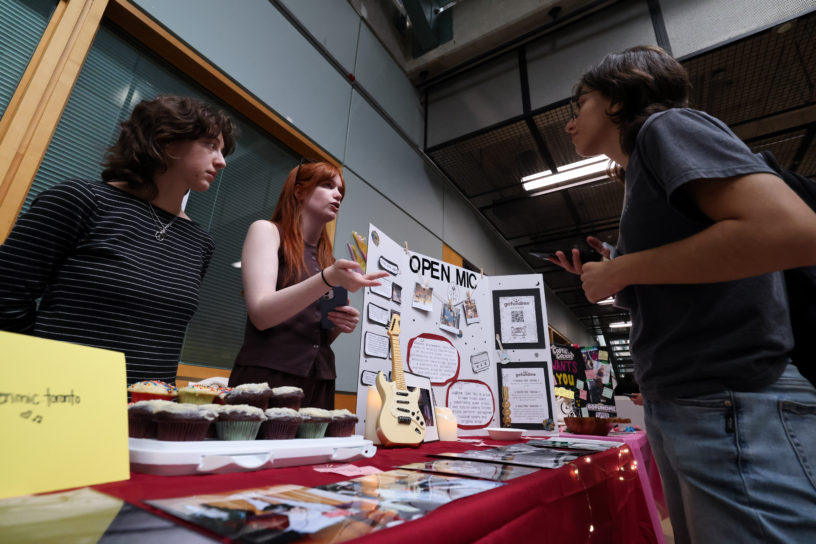
Desserts, trinkets, pre-loved clothes and live photobooths livened up the hallways of the Rogers Communications Centre on Sept. 18, as fourth-year media production students set up booths to raise funds and recruit crews for projects in the annual practicum fair.
Students in the program can opt to take a practicum course, where they work in groups to complete a production project.
Sport media and media production instructor Karen Sebesta said, “those projects can be anything from immersive experiences, live events, podcasts, music events, short films, scripted television, multi-camera live shows.”
Students engage in fundraising activities as they plan their production budget, weighing which expense to splurge on versus which to save on.
According to the Canadian Centre for Policy Alternatives (CCPA), TV and film production in Canada went down by 18.5 percent in 2023-24 and rebounded slightly in 2024-25.
Total production in the country saw a 4.6 per cent increase, brought by foreign productions. “Total Canadian feature film and television production slipped by a further 2.2 per cent,” CCPA said.
Fourth-year media production student Michael Giacobbe was the business manager for his team, which pitched an educational arts and crafts show for kids. He said producing the pilot would cost about $2,500.
To finance the project, his group launched a campaign on GoFundMe and contributed out of their own pockets, according to Giacobbe.
During the fair, Giacobbe’s group sold make-your-own bracelets and keychains, and set up a live photobooth in which they sold live drawings of patrons—in theme with the nostalgic children’s programming they’re bringing back.
Shea Hamblin, a fourth-year, media production student, served as creative director for her group and was also in charge of the budget. She said they sold shirts, pins and stickers to add to the money they raised through GoFundMe and from reaching out to their community.
Hamblin’s group is producing a horror-comedy about “two YouTubers who were cancelled. And they want to regain their virality by doing a ghost investigation video, but it kind of goes south.” She said their budget is roughly $3,600.
Sebesta said students’ production budgets vary depending on the type of project they pursue. Groups who do audio-based projects usually have no expenses because sound equipment is available at the Creative School Equipment Distribution Centre (EDC).
“The middle ground is probably between $500 and $1,000,” Sebesta said, for students who produce a documentary or a pilot for a television show. Those come with costs for a set, props or transportation.
Film projects are typically most expensive, costing anywhere from $1,000 to just under $4,000 for the most ambitious groups.
Giacobbe’s group is not pinching pennies when it comes to the honorarium for the cast. “We wanted to ensure that our child actors were being paid,” he said.
Besides art supplies, a chunk of his group’s budget is going to catering and snacks. Giacobbe said, “our snack budget’s pretty high because we have a cast of eight-year-olds and so having snacks on hand is really important.”
However, his group will be saving money on wardrobe as they opted to use clothes their cast already have. The EDC will take care of the equipment.
Giacobbe’s group is shooting in Kerr Hall, which is free. “As the business manager, it always makes me happy when there’s zeros,” he said, since they are not splurging on location costs.
The opposite is true for Hamblin’s horror-comedy project.
“We have a very specific aesthetic that we want to portray and we want to convey that to the audience, not try to fake it too much so we’re renting a house,” she said.
Their production crew would need to travel to the location but they save on transportation costs by carpooling.
According to Sebesta, students learning to plan a production budget keeps them grounded about the feasibility of their ideas.
“We want them to dream,” she said. However, she reminds her students that they “don’t need a lot of bells and whistles.”
Both Giacobbe and Hamblin advised their juniors to plan and budget their production way ahead of time.
“If things go wrong, you have time to make up,” said Hamblin.
More importantly, Giacobbe said, “don’t be afraid to make what you want…Just go for it and make it because there’ll be other people out there that will also like to see it.”





Leave a Reply