

By Keyvan Mohammadi Rad and Amira Benjamin
“The purpose of having a film collection is ultimately to project it.”
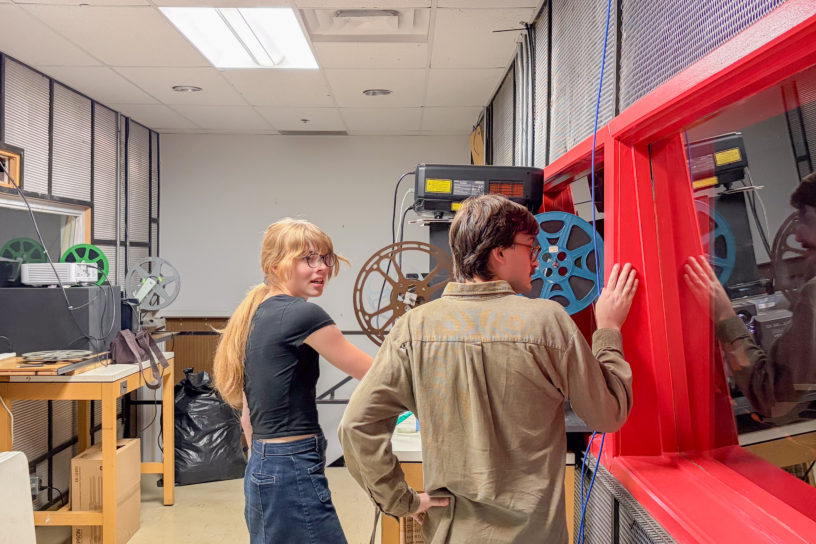
This is the belief of Ryan Shea, a second-year film and photography preservations and collections management student, and a member of the Association of Moving Image Archivists (AMIA) chapter at Toronto Metropolitan University (TMU).
“What we’re dealing with everyday is film and magnetic media, how to preserve it correctly and what kind of life it can have,” said Shea.
Throughout their first year, Shea and his “tight-knit” cohort have used the programme’s collection of 16mm films to learn preservation techniques. It includes classics like the Spanish comedy-drama Viridana (1961) and Jean-Luc Godard’s Weekend (1967), but also rare archival shorts from the National Film Board of Canada.
On Aug. 20, the students set up a public screening of one of the films for the first time. They chose the 1966 cult psychological Swedish thriller, Persona, also from their learning material.
“We’ve seen over the course of our first year so many kinds of interesting titles that we just decided we would start up projecting them for an audience,” he said.
“We have all of these films and it seems like the perfect opportunity to create these kinds of events to share these with other people. It’s almost like, ‘why not?'”
There’s been a major resurgence in analogue film projection in recent years, best exemplified by Christopher Nolan’s The Odyssey.
The film, which had a 70mm format, grossed $66 million in revenue from just the 41 screens playing it in that format worldwide—two of which were located in the Greater Toronto Area.
Paul Moore, a professor of sociology and film historian at TMU, said directors such as Nolan intend for audiences to see their films in analogue formats, which can draw in moviegoers seeking a more unique experience.
“My first film after lockdown [was] Nolan’s Tenet [on IMAX film]. I went really far out of my way to see [it], even with social distancing,” he said.
Moore said independent Toronto cinemas, such as the Revue Cinema in the west end, are playing a big part in popularising seeing movies on film. “When you look at the Revue schedule, [you can see] whether a film is being shown on film, whether it’s being shown on 16mm, 35mm, 70mm and it draws an audience. Now that’s just one theater in a big city [like] Toronto, but it’s enough to put together an audience of 300 or 400 people almost every day.”
According to Moore, analogue film has a unique draw in the age of the exponential growth of digital technologies.
“What’s at play is knowledge or even the self-awareness in the back of your head that this image, when it’s projected on film, has been cared for by real people, has been cared for by professionals, has been put together skillfully by people who know how to craft the experience,” he said.
“Some people are certain that they can hear the difference, that it’s a more full spectrum on the screen when it’s a light through film projection as opposed to a digital projection, [the way that] some people kind of like playing LPs on record versus listening to digital music.”
Quin Bright is also a second-year film and photo preservation and collections management student and member of AMIA TMU.
“Part of what we’ve been learning [is] the experience of viewing film in [its] original format on celluloid is part of preserving it…culturally,” she said.
Zoe Xu and her sibling, Connie, attended the Persona screening.
“I like the grain [of analogue films]. I like seeing the little circles for the projectionists so that they can change the reel, like the sound of the projector,” explained Connie.
“It’s interesting to be in a darkroom with everyone and experience something that somebody worked on. [It’s] quite personal and tactile.”
Shea highlighted that the screenings are free not just to be accessible to the university community, but also so AMIA TMU members can learn outside the classroom.
“Part of the purpose…is not just for people to enjoy the films, but for us to get to learn all the ins and outs of running events and projecting film.”





Leave a Reply