

By Riddhi Dhingra
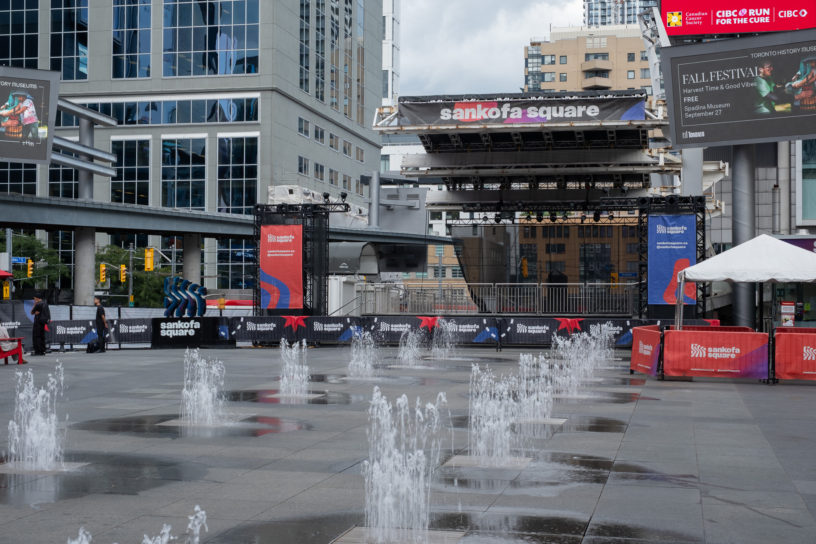
Downtown patios sizzled, Sankofa Square filled with rhythmic Ghanaian music and inside east end bars, jersey-clad fans cheered out of their seats.
Third-year media production student Mia Greenidge, whose mother’s side of the family is from Ghana, fondly recalls the Ghana vs. England match she watched at the FIFA Fan Festival at Fort York and The Bentway.
“There was holding your breath, and then the release when you see that they didn’t get a goal,” she said.
When Ghana secured victories against England and Panama, the emotions reached beyond venues and into public plazas throughout downtown Toronto, bringing pride to many people.
“It feels very cool to see a group of people represent a whole nation and a whole diaspora,” said Greenidge.
For the five weeks of the FIFA World Cup, Toronto Metropolitan University (TMU) students with roots outside of Canada felt interim unity of a city celebrating multiculturalism. But with rising political tensions, some say this looks different from their daily realities.
According to Statistics Canada, there were 1,074 racially and ethnically motivated hate crimes in Ontario in 2025, a sharp increase from the pre-pandemic average of 365 from 2016 to 2019.
Isa Nadeem is a Pakistani second-year accounting and finance student, who was raised in Saudi Arabia. He recalled the moments when he saw his favourite team score, saying “it was as euphoric as it gets.”
Nadeem commented on how the event brought together groups with historical divisions, such as Indian and Pakistani fans through love for the game.
“To be honest, it just felt united,” he said. “It’s a good thing that everyone can actually enjoy something that’s going on around the world.”
Christopher De Sousa, professor of urban and regional planning at TMU, said that events such as the World Cup brings diverse communities together.
De Sousa described Toronto as “a city of neighbourhoods,” which lays the groundwork regarding these cultural celebrations throughout established cultural enclaves.
“You have streets that are ethnically branded where communities gather, like Corso Italia where we used to have a lot of Italians, Little Portugal, Little Jamaica, Greektown on the Danforth, and Little India.”
“Because Toronto is so multicultural, people have been allowed to grow up and celebrate their ethnic roots. It honestly makes for a much better World Cup because when it comes, I become Portuguese, even though I grew up in Canada,” he said.
Standing in the crowd of thousands of fans in Sankofa Square was never just about football for a student like Greenidge. It was a rare moment of seeing public enthusiasm for diversity, he says.
After seeing “two sides of the coin,” Greenidge said the celebration during these world competitions felt almost forced.
“You can have thousands of people cheering for one country while on the other side, people are trying to limit international students or keeping closed minds to anyone from a different background,” she said.
Greenidge said Canada can sometimes feel as if it is neglected compared to the U.S or other countries.
“At the end of the day, it makes sense that the World Cup would be hosted somewhere where there are people of literally all different backgrounds,” she added.
“[In Toronto], I definitely don’t feel like I have to tone down my identity,” Greenidge said. “That is the beauty of going to school at TMU in the heart of the city. You can find your community.”
For Nadeem, living in Toronto presents very different cultural contrasts regarding social and cultural norms. “You can do anything and people usually don’t mind. In Saudi Arabia, people actually stare at you.”
Bryan Kolahzari, a third-year arts and contemporary studies student, recalls when he attempted to connect with other Persian students during the tournament.
“We were talking about Persian food, and I didn’t know a lot of it because my dad doesn’t cook,” he said. “I didn’t feel like an imposter, but I felt like I was missing out.”
Jonathan Mirkalam, an Iranian fourth-year history student, said he felt the disconnection stemming from deeper political fractures which surrounded the national teams themselves.
“We were in the World Cup, but there wasn’t really community representation,” Mirkalam said.
“Because of political stuff in Iran right now a lot of people don’t even support the team. People are split—there was no situation where we could all just come together.”





Leave a Reply