

By Michael Elsaesser
On Oct. 28, the Bank of Canada increased its benchmark interest rate from 2.25 per cent to 2.5 per cent, reversing a series of cuts that began in June 2024.
The central bank attributed the decision to high energy prices and economic growth, warning that the rising business costs could contribute to inflation.
In its Nov. 10 summary of deliberations, the bank’s Governing Council acknowledged that further rate increases could be necessary if inflation continues.
For students, the announcement has different implications depending on how they finance their studies.
The provincial government and commercial banks base their student loan interest rates off the Bank of Canada’s policy decisions.
Following the October announcement, major Canadian banks increased their prime lending rates from 4.45 to 4.70 per cent, effective Oct. 29, 2026.
Under the Ontario Student Assistance Program (OSAP), loans can consist of both federal and provincial portions, which are subject to different interest rules.
The federal portion of OSAP has remained interest-free since April 2023, protecting borrowers from Bank of Canada policy rate increases.
According to an April 2026 briefing note from Employment and Social Development Canada, the elimination of federal student loan interest is expected to save the average borrower $350 this year.
The federal government also maintained temporary increases to student grants for the 2026-2027 academic year, contrasting with Ontario’s decision to reduce the proportion of non-repayable grants.
In February, Ontario announced changes to OSAP, reducing the maximum amount of non-repayable grants from 85 to 25 per cent, effective as of September.
The remaining assistance must be provided through repayable loans, potentially increasing students’ debt after graduation.
The provincial portion of OSAP carries a variable interest rate of prime plus one percentage point, meaning Ontario student loan interest rose from 5.45 to 5.70 per cent.
For borrowers with $10,000 in outstanding provincial loans, the increase represents around $25 in additional interest annually, assuming the balance remains unchanged.
Interest on provincial loans begins accumulating after students leave full-time studies, including during the six-month period, before repayments are required. Students borrowing through private banks may face more immediate consequences, as those loan options accumulate interest while borrowers remain enrolled.
The increase follows years of fluctuating interest rates and changes in student borrowing at TMU.
According to Government of Canada figures compiled by The Eyeopener, the annual value of student loans at TMU reached $106.8 million in 2023, before declining to $95.8 million in 2024 and $88.25 million in 2025.
This is a 17.3 per cent decline in two years, although they do not state whether changes in interest rates contributed directly to the decrease.
The most recent figures also predate significant changes to the OSAP system.
Also in February, Ontario ended its domestic tuition freeze, permitting annual increases of up to two per cent for three years, followed by increases capped at the lesser of two per cent or the three-year average inflation rate.
In an emailed statement to The Eyeopener, Toronto Metropolitan Students’ Union (TMSU) vice-president education Teresa Baricevic said the changes create additional barriers for students.
“[This] makes it harder for students to afford a post-secondary education, and creates more barriers for future students to begin their studies and their post-secondary journey,” she said.
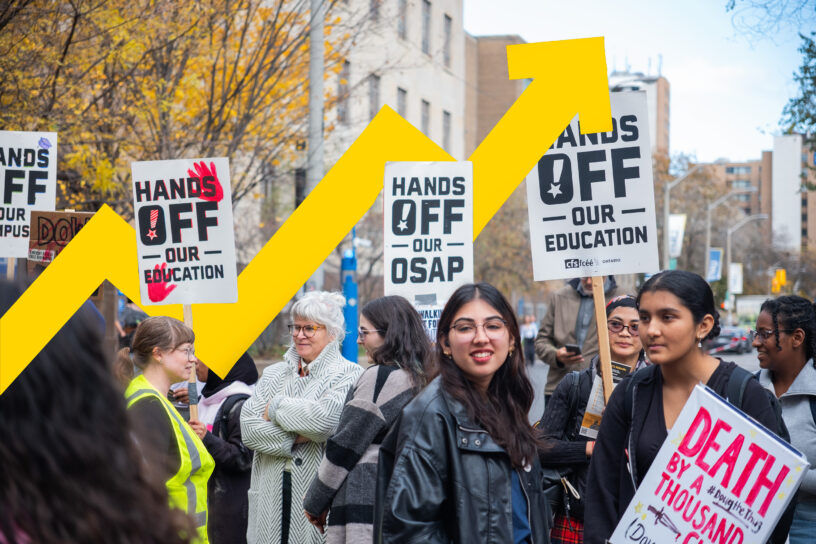
Baricevic said approximately 400 people attended the Nov. 5 campus walkout opposing the changes.
TMSU continues to organize through its Hands Off Our Education campaign alongside the Canadian Federation of Students. Baricevic said the union would continue encouraging students to attend demonstrations, lobby government officials and contact elected representatives.







Leave a Reply