
By Sophie Wallace
For millennia, humans have looked for reflections of ourselves in the natural world.
Through fireside storytelling, young children learned of how Sedna’s severed fingers became the life-sustaining creatures of the ocean. In ancient Scottish mythology, the selkie, a seductive, shape-shifting seal-person, was often blamed for unhappy marriages or disappearances at sea. In ancient Egypt, the god Hapi personified the annual flooding of the river Nile, bringing fertility to its surrounding valleys.
Throughout history, whether through song, dance, myth or handprints on a cave wall, humans have used art to try to understand our place amongst the family of things.
It is a relatively recent phenomenon, fast-tracked by European, Christian philosophies, to see ourselves as separate from nature. This paved the way for the exploitation of natural resources in the name of progress that continues today. If you are blind to the inherent value of something, it is so much easier to kill it.
Now, our world is facing an existential threat. According to the second edition of Canada’s Changing Climate Report, much of human-caused climate change is irreversible. Over the past 75 years, Canada has warmed by 2 C, and Canada’s North has warmed by 2.6 C, almost three times higher than the global warming average. Extreme heat, longer wildfire seasons, shrinking glaciers and rising sea levels are just a few of the catastrophic consequences. Scientists are describing it as the sixth mass extinction. It is the first one caused by human behaviour.
It is ridiculously easy to feel hopeless—to watch in abject horror as world leaders make decisions from their insulated towers while the rest of the world burns. It is so easy, especially when you can see what is going on all over the world at the touch of a screen, to feel completely disempowered. But these institutions thrive off our disempowerment.
It is a vital ingredient in their ability to dominate, oppress, subdue and ultimately, get away with murder.
For me, activism has always been inextricably linked with art. I remember being 18, sitting on my friend’s living room floor, listening to Erykah Badu, painting protest signs until the early hours of the morning. Community meetings always began with a poetry reading; someone always brought a guitar.
My best friend was solidified as my best friend when she introduced me to her favourite poet: Mary Oliver, whose work demands that you slow down and pay attention to the tiniest things. In her widely beloved work Wild Geese, Oliver writes, “tell me about despair, yours, and I will tell you mine.// Meanwhile the world goes on.// Meanwhile the sun and the clear pebbles of the rain// are moving across the landscapes.”
So much of the art that inspires me comes from, or tells stories of, the land. So much art about the land tells us what it means to be human.
This summer, one of the U.K.’s biggest galleries, the Tate Modern in London, exhibited a collection of works by the late Ana Mendieta. Mendieta was born in Havana, Cuba in 1948 and experimented with what has since been termed “earthwork.” One of the most influential artists of the twentieth century, Christie’s art auction house describes her body of work as a “groundbreaking exploration of feminine archetypes and the natural world.”
Medieta made art from sand, soil and plant matter, taking photos and videos on super-8 film whenever she trekked deep into the Cuban jungle to make her marks. She lived and breathed her work, often using her own body, decorating it or desecrating it with flowers, feathers, pig’s blood, gun powder, often leaving only a silhouette behind.
Mendieta’s life was cut cruelly short in 1985 when she fell victim to the same violence against women she sought to bring to light. A Guardian review of her latest exhibition reads, “a Mendieta who never fell from her apartment would be absolutely at the forefront of art in this century.” In some ways, this issue is a love letter to her legacy.
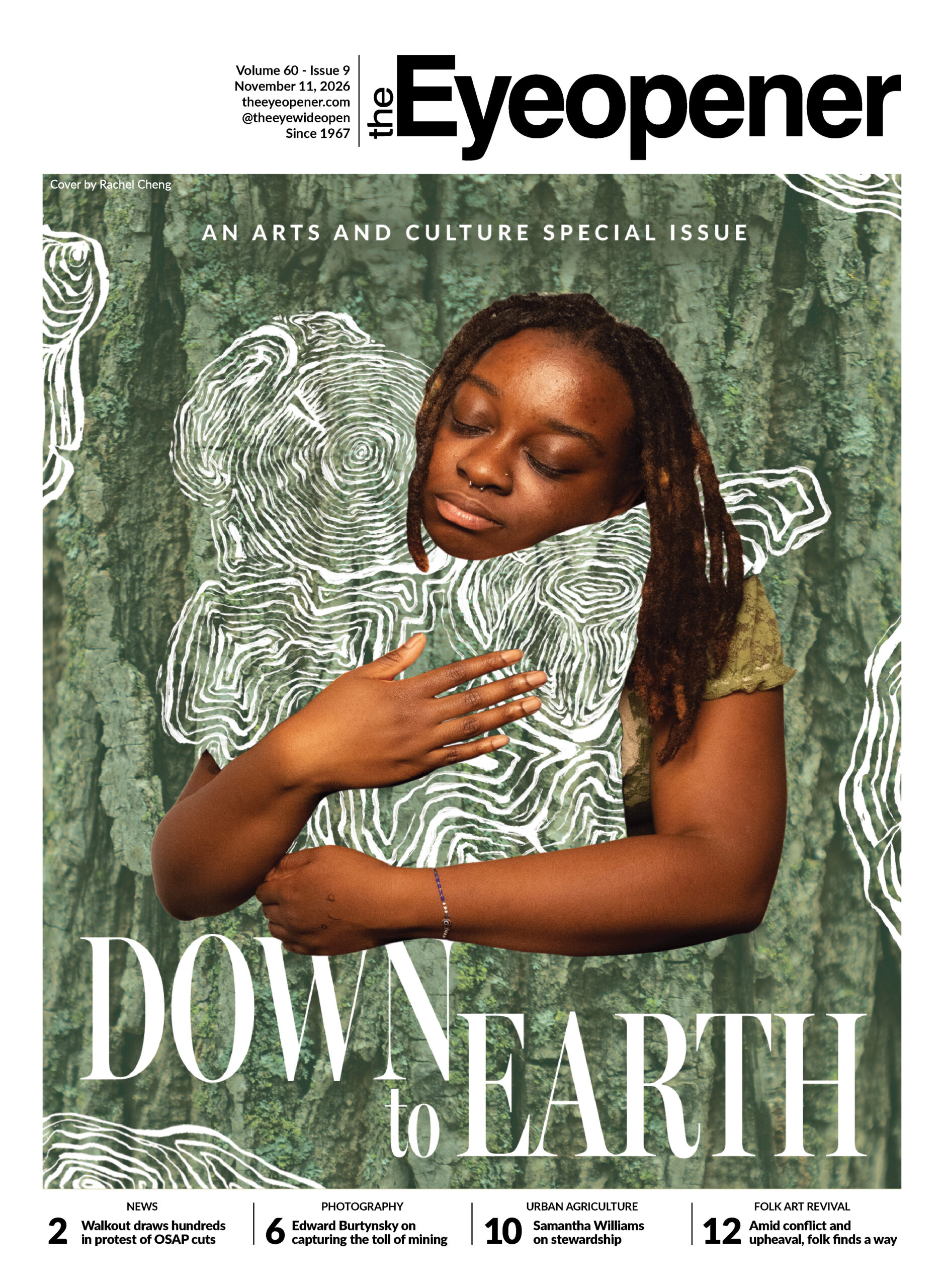
The stories in this issue chronicle the resourcefulness, resilience and creativity of our community, both on and beyond the bounds of this campus. They show how art can be a powerful force of activism in the face of our ecological crisis.
We speak to Samantha Williams of Toronto Metropolitan University’s Indigenous Foodways program at the Urban Farm, who shows us how intentional planting and harvest can bind community, create a place of emotional safety and be its own form of cultural solidarity, art and expression.
We visit the Gardiner museum, where writer Amira Benjamin speaks to the curator of After the Island: Caribbean Canadian Ceramics, and we learn how clay can tell stories of migration, family and belonging.
We learn from beadwork artists across Canada about how the rich, varied and highly technical art form has roots in law and treaty and can act as a bridge to reconnect to cultural heritage. To name a few.
As journalists, we understand too well what it does to you to be too plugged in, to care about everything, everywhere, all at once.
I have no antidote to offer you. I only know that perhaps the stories between these pages can act as a catalyst for hope.
To make art is to be moved by the world, and then to move in response. I hope the stories in this issue can be a call to action, and a movement to say:
We care, we care, we care.



Leave a Reply