

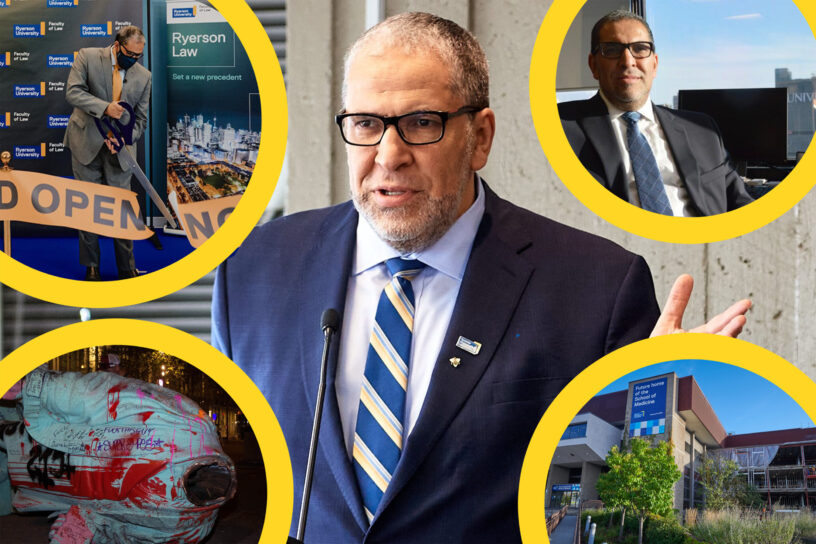
In his 10 years at the top, Mohamed Lachemi has presided over one of the most change-filled periods in TMU’s history. Before he leaves at the end of the semester, students, faculty and school leaders give an honest look at what the president is leaving behind
By Jaymes MacKinnon
TAKE THE YEARS you’ve spent on campus and double them. Quadruple them. Sextuple them, even. Kella Loschiavo likely has you beat. “I’ve been at TMU for 41 and a half years and I’ve seen many presidents,” she says. “I believe that President Lachemi will be remembered as a president who oversaw the most significant periods of transformation in the university[’s] history.”
Loschiavo is, herself, a president. She leads the Ontario Public Service Employees Union (OPSEU) Local 596, Units 1 and 2. The union represents academic and administrative support staff, research assistants and student residence workers at Toronto Metropolitan University (TMU). Reflecting on 10 years of change is a daunting task, but Loschiavo is well-prepared to do so. She describes Lachemi’s leadership style as “ambitious, strategic and focused on institutional growth and transformation.”
The growth Loschiavo refers to is undeniable: during Lachemi’s term, the COVID-19 pandemic and artificial intelligence (AI) challenged core assumptions about what a university can and should be. Under his leadership, TMU opened a law school and a medical school, changed its name and expanded its real estate portfolio. The “Rye-high” reputation that trailed the school for years has nearly been rebranded out of existence. But how the towering man in square-frame glasses will be remembered is in question.
“From a union perspective, leader[ship] must be measured by more than strategic plans and institutional achievements,” Loschiavo said. “It also must be measured by communication, transparency, meaningful consultation and the ability to listen to people affected by decisions.”
The leader at the helm of this transformation leaves a fragmented legacy. Protests over the last three years on campus, and how they were handled, have seemingly tarnished student trust in the university. There is no doubt that Lachemi made long-lasting changes to TMU’s public perception, institutional offerings and geographical footprint. However, for some, that change was perhaps achieved through gradual distancing between the office of the president and the students, faculty and staff who will live in the wake of the decisions Lachemi made long after his exit.
MOHAMED LACHEMI FACED a challenge when he assumed the presidency in 2016: the shadow of a popular predecessor. Sheldon Levy, who was president from 2005 to 2015, had an unusually positive reputation for a university administrator. Profiles of him in The Eyeopener and Toronto Life depict a humble and charismatic “dreamer” who was known to commute via motorcycle and rarely turned down a chance to chat. In a farewell feature on his legacy, The Eye’s Jonah Brunet remarked he was unable to find a single person who had “anything bad” to say about the former president.
Levy took over TMU’s top job from Claude Laujeunnesse, who attracted controversy among students when he accepted a nearly 40 per cent salary bump between 1996 and 2002. During his annual state of the university address in 2001, The Eye reported that a student yelled, “And another pay raise for you, huh, Claude?” To which Lajeunesse responded, “I hope so.” When Lajeunesse left TMU in 2005, his salary was $260,531, the equivalent of $411,440 today. Lachemi earned $471,070 in his final year as TMU’s president, nearly double that of Toronto mayor Olivia Chow.
In the middle of Levy’s second term, the Board of Governors changed university by-laws to allow presidents to serve additional terms beyond the cap of two five-year periods. Levy ultimately declined to serve a third term and Lachemi, then provost and vice-president academic, stepped in as interim president in December 2015 while the board of governors searched for the right person. In March 2016, it was officially decided he was that ‘right person’ and appointed him as the university’s ninth president and vice-chancellor.
At that point, Lachemi had been at TMU since 1998, when he joined the department of civil engineering and proceeded to climb the ranks. His interest in engineering was sparked as a teenager in Algeria after an earthquake killed 4,000 people in his small hometown. “Engineer” remained a core part of Lachemi’s professional identity through his tenure: when students protested the statue of Egerton Ryerson on Gould Street in 2017, Lachemi said, “My background is engineering, I like to build things, I don’t like to destroy things.”
Lachemi came into TMU’s top seat with a list of goals. “We have achieved almost everything on that list, along with many other new developments,” Lachemi told The Eye in a written statement. However, Lachemi remains humble about those achievements. “It’s not about me,” he said, crediting the “incredible team of people at TMU who make all of these changes possible.”
“What I have always admired is his humility, regardless of the scale of his accomplishments,” said Sri Krishnan, dean of the Faculty of Engineering and Architectural Science.
Members of Lachemi’s staff did not return The Eye’s request for an interview or comment. But his colleagues in other parts of the school will remember him in all kinds of ways, bitter and sweet.
Carl Kumaradas, vice-provost and dean of the Yeates School of Graduate and Postdoctoral Studies, remembers a time when Lachemi advised him on a home renovation project. “I’m like, ‘who knows something about concrete?’ And I said, ‘oh, Mohamed does.’ So I emailed him, can we have a chat about my basement…he gave me advice,” Kumaradas said.
His colleagues, like dean of the Chang School, Linda Koechli, have described him as a big-picture thinker. “Some of the words that come to mind when I think of him and the work that he’s done over several years [are]…openness to the innovation, the big ideas,” Koechli said.
If there is one thing Lachemi will be remembered for, it will be as the president who made the very-big-picture call to change the university’s name. After years of pressure from students highlighting Egerton Ryerson’s role in the creation of the residential school system, the change was made official in April 2022. The controversial decision was the fourth name change since TMU was founded as the Ryerson Institute of Technology in 1948. TMU was the first university in North America to “change its name to address its colonial history,” President Lachemi wrote in a Toronto Star op-ed.
“Changing the name of the school [was] pretty consistent with the direction that our school really wants to go towards—a more progressive and social justice-oriented direction in its education and mandate,” says Ian Lin, vice-president finance of the Lincoln Alexander Law Students’ Society. “I think changing the name of the school [was] definitely required in light of…truth and reconciliation.”
NOT EVERYONE IS a fan of Lachemi’s approach to solving TMU’s big problems. Sociology professor Jacqui Gingras is critical of what she sees as the “corporatization” of the university under Lachemi’s leadership. “Decisions are based on cost-effectiveness. Decisions aren’t based on what are the best learning environments, what are the best research environments for people to engage in knowledge, production, discovery, and all those kinds of things that we are really passionate about here at a university,” Gingras said.
Pamela Sugiman, a professor of sociology and former dean of the faculty of arts, echoed Gingras’ sentiment. “I think there has been a movement towards managerialism and administration…a focus on smooth-running efficiency,” Sugiman said. “Sometimes we need to push beyond that in the interest of students and faculty, and for the university as a whole.
Sugiman is currently in an active $2 million lawsuit against TMU for alleged breach of contract without prior notice, violations of Ontario’s Human Rights Code and unlawful seizure of her research funds. Incoming president Roberta Iannacito-Provenzano told Sugiman she was removed from her position as dean in July 2024. At the time, Sugiman was on bereavement leave following the death of her only child in November 2023.
The university alleges the demotion was driven by financial mismanagement. Sugiman and some of her colleagues have publicly alleged that she was fired because the university no longer saw the diversity, equity and inclusion (DEI) initiatives Sugiman had championed as economically viable.
Sugiman’s case is one of several active suits that call into question how seriously TMU takes its proclaimed DEI values; Lachemi’s term could arguably be characterized by some of them. In 2025, a group of current and former TMU law students who wrote a letter to the university in support of Palestine sued the school for defamation, seeking damages up to $10 million. The students say they intended for the letter to remain between them and the university; however, the law school publicly condemned their writing as antisemitic, leading to an “intense and widespread backlash” against the students, according to their statement of claim. An external review by a judge, now known as the Macdonald Report, found the students did not breach the student code of conduct in their letter.
Shortly after the letter was made public, Diamond & Diamond law firm launched a class action lawsuit against TMU, Queen’s University and the University of British Columbia, alleging the universities failed to protect Jewish students from antisemitism. Earlier this year, Liat Schwartz, a former child and youth care student and former president of Students Supporting Israel’s TMU chapter, launched a $1.3 million lawsuit alleging the university created a “poisoned environment” for Jewish students on campus.
Distrust between students and the university reached a fever pitch in September 2025, when a video of TMU Security physically restraining and arresting a student at a pro-Palestine demonstration went viral. The university appointed another external judge to review the incident, who concluded security was lawful in their use of force.
Some members of the TMU community, like law student Ian Lin, have been satisfied with how Lachemi handled the reviews. “We were facing a lot of acrimony from the law community and having that expert independent opinion…really brought affirmation and stability,” he said.
Others were less convinced. “People have different views on the use of external investigators,” says Sugiman. “Some people believe that decisions can be made by the leaders of the university. But there’s been a movement away from that at TMU. There’s a problem, so we’ll hire an external investigator.”
Gingras, who is a member of the group Faculty for Palestine, sees the reliance on external reviewers as an outsourcing of moral issues. “I just think it’s a moral failing, it’s a lack of moral courage, it’s a lack of moral clarity,” she said. “What does a leader do in those situations? They don’t react, they act. And this has been a long series—decades-long series—of reactions.”
It’s criticism that Lachemi has faced from the student body, too. Students for Justice in Palestine TMU, for example, has approached the president many times in-person on campus. “I just wanted to ask, what was with that incident that happened recently,” a student asked in a recorded interaction with Lachemi in an elevator last year, referring to an off-campus Students Supporting Israel event that was the subject of one of TMU’s external reviews. “Can you please stop?” Lachemi said, as the student asked him further questions.
In his statements to The Eye, Lachemi addressed these demonstrations. “Over the past few years, I have often said that we cannot adjudicate or solve foreign policy or global conflicts—this is not the role of a university nor are universities equipped to do so. Our responsibility is to serve the whole community,” Lachemi said. “I have been encouraged by the work undertaken by members of our community to foster understanding, dialogue and a sense of belonging.”
IN EVERY CONVERSATION on Lachemi’s legacy, students, faculty and staff discussed two significant accomplishments: the launching of the schools of law and medicine.
“These are significant accomplishments, and they have changed the institution,” said OPSEU president Loschiavo. “However, I would also raise another side of this transformation. From the perspective of OPSEU, we’ve asked who carries the workload associated with all of this growth.”
There is an extraordinary amount of labour needed to keep an expanding university running. CUPE 233, the union representing TMU’s custodial and maintenance workers, came into conflict with President Lachemi during a strike action in April 2023. In a press release at the time, CUPE accused Lachemi of crossing the picket line, refusing to negotiate and suggesting the president went “out of his way to insult and demean [their] members.”
Loschiavo leads a different union on campus, but she says the university has not properly consulted unions on campus during Lachemi’s term. “[Employees] want to see the university succeed, but they also want to be respected, consulted, and supported,” Loschiavo said. “The president should be meeting with all unions and hearing and consulting with all unions, but we were not consulted at all, I felt.”
Zain Baig, president of the Toronto Metropolitan Students’ Union (TMSU), praised Lachemi as an “optimistic and realistic leader.” But he echoed Loschiavo’s concerns, saying he wished the president had been more communicative with student leaders and describing the existing communication system between TMSU and the university as “kind of bureaucratic.”
“I know some executives from other student unions across Ontario and they work a lot more closely with their administration,” Baig says. “We communicate through the office of the vice-provost students…they’re very responsive and we work with them all the time. But that’s not really the president’s office, you know what I mean?”
“There’s so many ways things could have been different,” said Gingras. “I’ve communicated these things through email, [but] it becomes like, an exercise in futility to ask nicely for things to be different…But it’s an incredible feeling of helplessness.”
People outside of the school may remember Lachemi for all the things he’s done to it. People inside it, however, will remember how he did those things.
“We cannot continue to talk about innovation, excellence and community while overlooking the people who make those things possible,” Loschiavo said. “The real legacy about leadership is not simply what you build during your time in office, it’s about what you leave behind and how you leave an organization and how people remember being treated under your leadership.”
UNLIKE LEVY’S PLAIN and simple “good guy” legacy, Lachemi’s seems to be more complicated. It’s something, to his credit, that he acknowledges. “Balancing the priorities of a university comes with its unique challenges. I don’t think anything can fully prepare you for the scale and depth of this job. However, an important lesson I learned from my parents, especially my mother, is to learn from your experiences,” he said.
This is learning he’ll now pass on to his successor, Roberta Iannicito-Provenzano, who will become TMU’s first woman president in January 2027.
“I have seen firsthand her inclusive, thoughtful and committed leadership. I know she is committed to supporting the TMU community, fostering an inclusive environment and advancing academic and research excellence,” Lachemi said.
Already, there are questions about how Iannicito-Provenzano will choose to lead. By selecting a university insider, the Board of Governors has chosen continuity in leadership; those with qualms about the last 10 years will be watching her governance closely, Loschiavo included.
“President Lachemi will leave behind a university that looks very different from the one he inherited,” she says. “The question is whether the next chapter will be about building [an] even a stronger institution, while also rebuilding the relationship with the people who make that institution work.”
TMU’s incoming leader won’t have to go far for advice: unlike past presidents, Lachemi isn’t ready to leave campus just yet. “We will certainly miss him in senior academic leadership, but I am personally delighted that [Lachemi] will be returning to the Faculty where his research, teaching and academic leadership journey began,” said Dean Krishnan. “It is a wonderful homecoming.”





Leave a Reply