

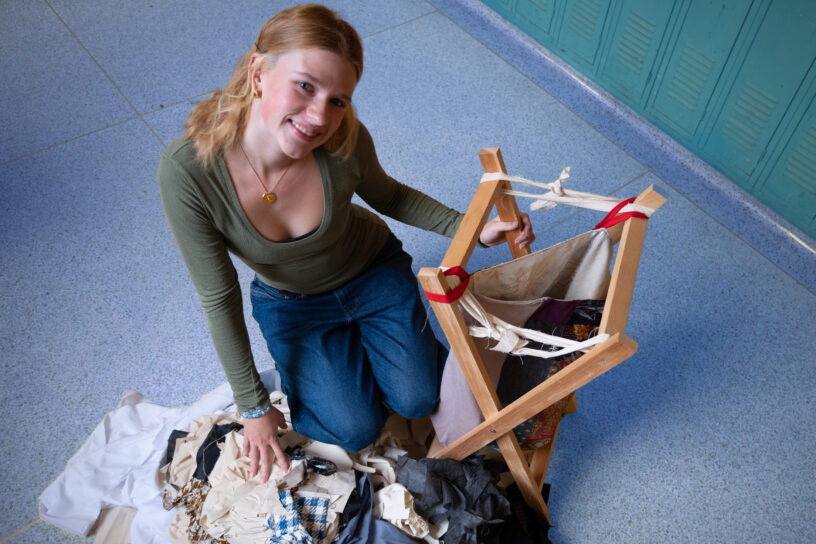
By Edward Lander
Before the Sustainable Fashion Initiative (SFI) launched in 2022, a substantial amount of fabric scraps from the School of Fashion were winding up in the landfill.
That year, the newly-formed student group installed fabric waste bins in six of the program’s Kerr Hall South classrooms. The goal was simple: to cut down on waste in an often-wasteful industry.
When fourth-year creative industries student Heli Pallop heard about the SFI in her first year at Toronto Metropolitan University (TMU), she said she was sure she wanted to get on board.
Raised by two environmental scientists, Pallop has always had a passion for sustainability and believed SFI’s work was more than worthwhile.
“It really spoke to me,” she said. “Fabric waste is insane, especially in the fashion industry—especially fast fashion, which is becoming more and more popular.”
Pallop started out as the group’s first-year representative and has worked her way up the ranks to president. She’s now responsible for leading the 12-person group and its many events, such as the annual clothing swap, which took place on Oct. 27 this year.
The event was hosted in partnership with the Black Fashion Student Association and brought together students from across campus to exchange used clothing. Students who attended were permitted to take as many clothing items as they’ve brought themselves.
Pallop said it’s one of the group’s most popular events.
“It’s always packed,” she said. “People come and see that we’re doing a clothing swap and then go back home and bring clothes back, especially if they live on campus. Sometimes people stay for hours to watch what comes in and out.”
SFI has also hosted mending workshops in previous years. These invite students to bring in damaged clothes and learn techniques for repairing them from members of the group and other students.
Fourth-year photography media arts student Kyra Campbell is the SFI’s vice-president of creatives. She said she’s been part of the group nearly as long as Pallop and joined for similar reasons.
“I’ve always been interested in the environment and helping it,” said Campbell. “We want it to last as long as we’re around.”
Campbell said with the amount of resources that go into clothing production, being able to save fabric rather than toss it goes a long way.
She noted the high water usage involved in clothing production, particularly in dense fabrics like denim. In 2015, denim brand Levi’s found that creating a single pair of jeans can use as much as 3,800 litres of water in its production—around 19 bathtubs full.
Though SFI’s events are wide-ranging, the fabric waste bins remain at the core of their work.
Pallop said the group collects fabric from the bins every week, typically filling a household-sized garbage bag. SFI then stores the scraps in a Kerr Hall storage closet, where they await use in one of their activities.
In Dec. 2025, the group used the scraps to create dog beds for the Etobicoke Humane Society.
Pallop said SFI’s work wouldn’t have been possible without the help of associate fashion professor Rachel MacHenry.
MacHenry served as the group’s faculty point person for several years. In that role, she helped SFI get its fabric waste bins installed and assisted in organizing events.
“Fashion is a hugely polluting industry, but lots of students who are training in fashion would like to see things done differently,” MacHenry said. “I think this is a great opportunity for people to take a small manageable project and work it through the system.”
MacHenry has been working with sustainability in textiles for 30 years and has taught at TMU for four. Here, she’s been very involved with the TMU’s Urban Farm, where she worked to set up a natural dye garden for use in a fashion course.
MacHenry said SFI’s work at the student level will help give them the confidence to make change when they enter the industry themselves.
“You would have the knowledge and confidence to perhaps bring up questions and try to facilitate change within that field,” she said.
Pallop said seeing fabric saved from the landfill is what keeps her going.
“Just to know our fabric scraps from TMU went to a good cause, and some dog is laying on them now, that’s a happy feeling—that’s what I want to be a part of it for.”






Leave a Reply