

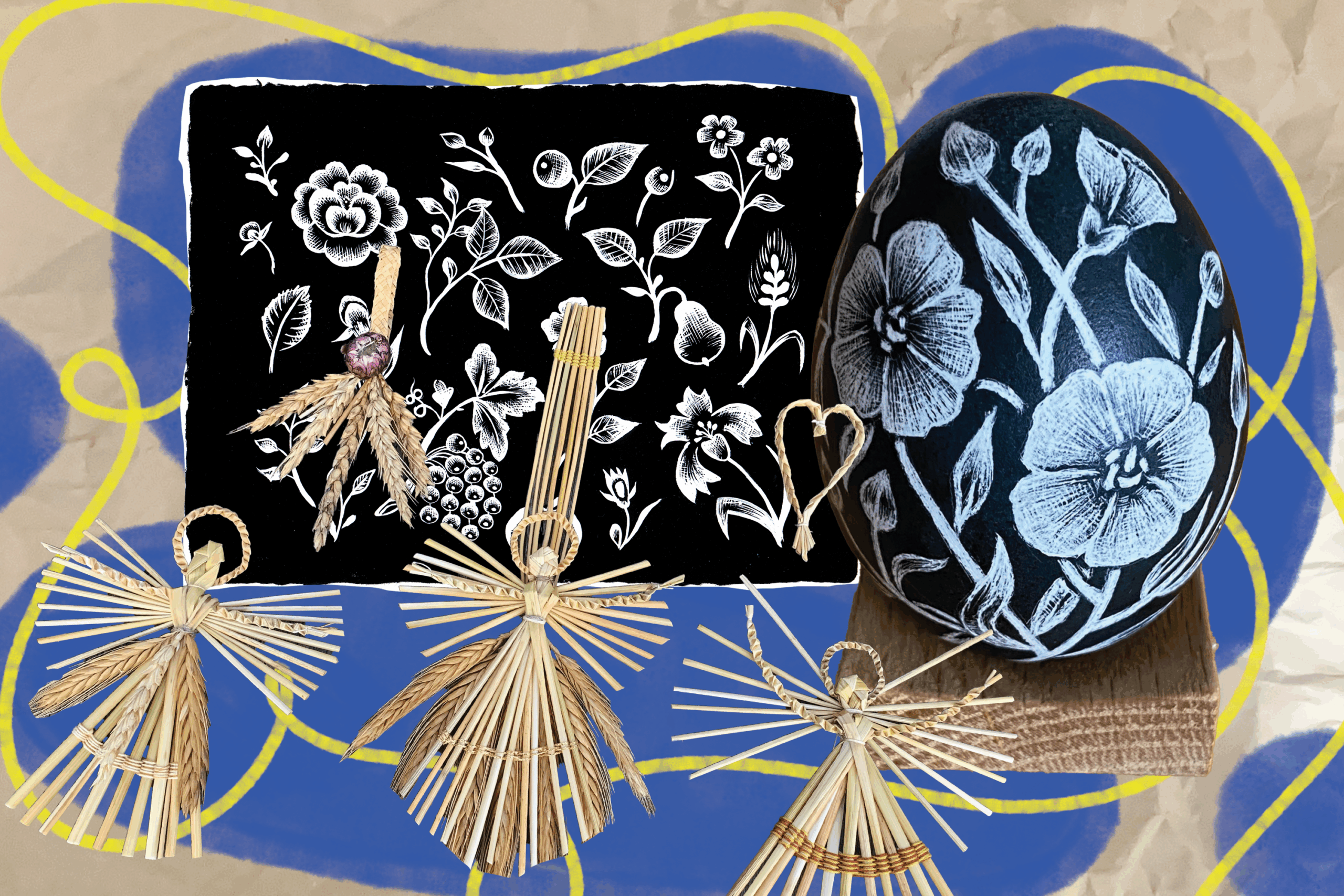
In the wake of conflict, Ukraine and its diaspora are seeing a resurgence and celebration of folk traditions
By Jaymes MacKinnon
It came naturally to Bozena Hrycyna. Summer was in bloom and she felt an urge to fill her home with the long, fresh-smelling grasses that grow around her rural Ontario homestead. By the next summer, it had become a habit: early June meant decorating her kitchen with bundles of harvested grass, creating the perfect backdrop for community dances at her farmhouse. “It was just so beautiful,” the artist and organizer said.
Several years after this impulse became a tradition for Hrycyna, she found herself reading an account by a Ukrainian ethnographer. “It was describing in the village how this was a ritual or tradition of this feast of the early summer, and I was like, oh my god, I just did that!”
Hrycyna is a co-founder of Kosa Folk Arts, a Toronto-based collective and non-profit of artists, activists and diaspora members dedicated to Ukrainian and Eastern European folk art. They facilitate educational workshops, perform and host an annual week-long summer camp with the goal of building community and preserving heritage. For Hrycyna and other artists, capturing folk art in words feels impossible. “It’s not like, intellectual…I never think of it as art,” Hrycyna said. “A lot of it feels like ritual.”
But in places like Ukraine, this intangibility can serve as protection. In the nearly five years since Russia began its full-scale invasion of Ukraine, the Russian military has frequently targeted and destroyed Ukrainian libraries, archives, monuments and museums, according to the United Nations.
Despite these attacks, Ukrainian art has gained recognition on the global stage. “The moment that culture and art is threatened, I feel like it’s highlighted and people focus on it more,” said Oksana Hawrylak, a co-founder of Kosa, who also serves as the Creative Director of the St. Volodymyr Institute, a Ukrainian cultural and education organization in Toronto.
“Since the full-scale invasion, I think that there has been a revival of kind of preserving and relearning about Ukrainian ancestral culture,” Hawrylak says. “There’s a lot more embroidered clothing that’s inspired by traditional Ukrainian embroidery…[worn] in the main cities of Ukraine, just wearing that as like, day-to-day fashion.”
The surge of culture goes far beyond clothing: theatre shows in Kyiv are sold out months in advance. Ukraine won its first Oscar in 2024 for 20 Days in Mariupol. Ukrainian folk-rap group Kalush Orchestra won Eurovision in 2022 wearing traditional clothing, including frontman Oleh Psiuk, who paired his signature pink bucket hat with a colourful кептар (keptar) in their winning performance. Ukrainian folk arts—songs, dance and crafts passed on through community—are thriving, including in Canada and Toronto’s Ukrainian communities, where diaspora members are preserving and reclaiming centuries-old traditions.
“There’s this horrible war, but there’s also so much cool stuff and good stuff happening. It’s really amazing,” Hrycyna said.
A group of four women with mixed Ukrainian heritage started Kosa in 2010, four years before Russia began annexing Crimea. The founders are members of the first generation to experience an independent Ukraine after the Soviet Union collapsed in 1991. “It was always like, we love Ukraine…We were so interested in being reconnected to Ukraine because our families had been displaced from there, pretty much all of us,” Hrycyna said.
The group formed organically, Hyrcyna says: a group of friends with a common upbringing, a shared curiosity about heritage and a draw towards the arts. Their early workshops raised money for an orphanage in Ukraine. “We were sort of inspiring each other to go deeper with it… we were just looking for sources constantly, and it formed this like, collective,” said Hrycyna.
“I don’t live where my grandmother was born. I see different plants, but I can get inspired by what’s been passed on to me or what I’ve learned about my ancestral culture and kind of make it more relevant here”
“It started from Ukrainian folk art because that’s what we knew, but we did welcome visitors,” Hawrylak said. The Kosa member teaches писанки (pysanky) making workshops—a form of intricate egg decoration traditionally made in the final week of Lent. A family from Mexico once told her the craft reminded them of making cascarones, eggs that are dyed and filled with confetti.
“A lot of these traditions are more similar than not…the only difference is that the plants are different,” Hawrylak said.
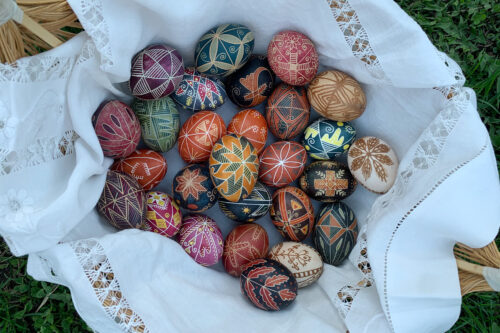
Folk art practices are often tied to seasonal cycles of the land. For the artists in Kosa, late Winter is often synonymous with making писанки (pysanky). Springtime is for веснянки (vesnianka)—songs to welcome warm weather. After the summer solstice comes the return of cold and making a дідух (didukh), a wheat sheaf for Christmas. Kosa Community Folk Choir has a tradition of carolling house to house, Коляда (Koliada), for Ukrainian Christmas and New Year.
“I don’t live where my grandmother was born. I see different plants, but I can get inspired by what’s been passed on to me or what I’ve learned about my ancestral culture and kind of make it more relevant here,” Hawrylak said.
Many of these traditions are recognized globally as forms of “intangible cultural heritage,” the term used by the United Nations Educational Scientific and Cultural Organization (UNESCO) to describe folk art. UNESCO defines it as “the practices, knowledge, and expressions that communities recognize as part of their cultural identity, along with associated objects and spaces.” In 2003, UNESCO adopted a convention to protect intangible cultural heritage. This convention recognizes that folk knowledge is important to preserve for future generations and that it is often under threat, whether by war or environmental disasters.
UNESCO maintains a list of heritage it has deemed in need of “urgent safeguarding.” صابون نابلسي (Nabulsi soap making), a Palestinian tradition of soap made from olive oil, water and lye was added to the list of culture under threat in 2024. Ukraine has seven entries, including everything from borscht to ceramics to the kobzar-lirnyk, a tradition of visually impaired, nomadic string musicians.
People often turn to folk arts during times of repression to connect with their community and make sense of their pain. The AIDS Memorial Quilt, for example, is considered the largest folk art project ever made. A group of activists led by Cleve Jones unfurled it on the National Mall in Washington on Oct. 11, 1987 with 1,920 individual panels. Today, it has over 50,000 panels.
Catherine Limbertie, the secretary of the Community Folk Art Council of Toronto, says Canada could go further in recognizing and protecting folk traditions. “Canada doesn’t want to go anywhere near the idea of intangible cultural heritage, because we just have so much,” Limbertie said. The country has not ratified UNESCO’s 2003 convention. Indigenous leaders have been some of the most vocal advocates in favour of Canada ratifying it.
“It is indeed intangible, but you need to be able to transmit it, and importantly, you also need to be able to celebrate it,” Limbertie said.
“They were not restricted by a certain preconceived notion of what a community should look like or what folk art should look like”
The question of what counts as authentic celebration can hang over artists who practice art to connect with their heritage. “There’s always a lot of conversation and questions about authenticity…people will get really existential about it,” said Hrycyna.
Which parts of tradition must be preserved? What can evolve? Part of what drew Saša Rajšić to Kosa was their creative approach to adapting Ukrainian traditions.
“That was my first time [encountering] a group that is both young and contemporary and urban, but they engage with folk traditions in a way where they don’t concern themselves with aestheticizing them” he said. “They were quite Queer and quite punk and quite progressive in a lot of ways, which again is not something that I would see in the folk cultures I came from, which would often be affiliated with a church.”
Rajšić is an artist and PhD student in social justice education at University of Toronto, who grew up in the former Yugoslavia between Croatia and Serbia. He followed Kosa’s work for years before eventually curating an exhibit of their work last year at Hart House called Future Folkways.
“They were not restricted by a certain preconceived notion of what a community should look like or what folk art should look like,” Rajšić said. “They’ve built quite a bit of legacy.”
He described the process of collaborating with Kosa to develop the exhibit as “a wonderful curatorial challenge.”
“The word archive might paint a specific picture in one’s mind with archival packages and gloves and looking at artifacts. This was nothing like this,” Rajšić said. “This was a few banners in someone’s shed in their farm, a few objects at someone’s mom’s basement…their archive was stored in various places around the city of Toronto and beyond.”
The exhibit included a display of work and a mix of craft and song workshops. Incorporating musical traditions was crucial: Ukrainian vocal polyphony is a form of traditional singing that was “quite unknown in diaspora,” according to Kosa member Hrycyna.
The singing style features multiple melodies at once. Andrea Kuzmich, an ethnomusicologist and former director of Kosa Choir, learned about the tradition through Kosa in 2013. “I’m third generation…I came from a situation where my Ukrainian-ness was very muted,” Kuzmich said. “My grandparents spoke Ukrainian, mostly. I didn’t understand.”
She said singing in Ukrainian polyphony in a group is “kind of magical.” Performing this music with other people, especially in nature, helps Kuzmich slow down and connect with “a sense of time that’s not so rushed.”
“We’re singing these hundreds-of-years old songs…if we try to put it into words, that’s just gonna, like, compress the experience,” she said. “You cannot put it into words, it has to be experienced.”
Part of why Ukrainian polyphony is less known than other cultural exports, like Ukraine’s national instrument, the bandura, is because the singing is often viewed as feminine, says Kuzmich. “It’s seen as female…the singing is gendered compared to the instruments, which is something that is [seen as] more complex.”
Existing outside the mainstream art world has its benefits, according to Rajšić. “I think for a lot of people, having access to natural materials, not having to participate in the consumerist culture to create art, not being prevented by the ideas of [the] art market, the pressures of performing with your art—so making art cheap and accessible—I think is also part of folk art,” he said.
The “folk revival” started long before the full-scale invasion, according to Bozena Hrycyna. “We’re situated in a larger story of like, a folk revival and also like, urban folk scene[s] across the world,” she said.
However, Oksana Hawrylak says the current day threats to Ukrainian culture have driven folk arts to take centre stage. “The art and design has completely elevated and it’s been now seen and recognized internationally…a lot [is] inspired by traditional craft and folk art,” Hawrylak said.
Rajšić says these practices will continue to evolve. “[It’s] an art form that is living and breathing together with the artist, meaning it’s reflective of an artist’s interests and ways of being in the world, while grounded and informed by artists and traditions that came before it,” he said.
For members of diaspora, being able to engage and adapt traditional practices helps bridge gaps between their Ukrainian heritage and Canadian upbringing. “I don’t speak Ukrainian, [but] I feel like I really can sing these songs,” said singer Andrea Kuzmich. “Ukrainians who can’t speak English can say to me, like, yeah, you can sing Ukrainian!”
For many Ukrainians, language has been both a tool of suppression and a method of resistance. “The whole question of language is one of intangible cultural heritage,” Limbertie of the Community Folk Art Council of Toronto said.
The songs that we know now are from periods back then where you weren’t even allowed to, like, speak Ukrainian or sing
Sophia Salyk’s parents and grandparents grew up fluent in both Ukrainian and Russian in Lviv, Ukraine when it was under control of the Soviet Union. Today, the Toronto Metropolitan University (TMU) student’s family exclusively speaks Ukrainian in their Toronto home, where embroidered вишиванка (vyshyvanky) decorate the walls. “Every region in Ukraine has their own patterns, designs, and things that they incorporate into it,” Salyk said. “So, even though they all come from Ukraine, you can kind of pinpoint what region it’s from…it’s a pretty massive part of our culture.”
Salyk is the president of TMU’s Ukrainian Students’ Club, a group that aims to build community for Ukrainian students on campus. “We are able to have a good presence here and just have positive experiences and just kind of really show how amazing and, like, rich our culture is,” she said. “It’s like a little bit of a break from everything, but still being, like, around our culture and our people.”
For Salyk, connecting with folk art traditions is critical during this moment in time, given “the tough times going on back home.”
“The songs that we know now are from periods back then where you weren’t even allowed to, like, speak Ukrainian or sing,” Salyk said. “Our ancestors were still continuing that art, and it wasn’t lost, and our culture wasn’t lost, so I think it’s so important that we still continue it now.”



Leave a Reply