

By Molly Simpson
Every October, disgruntled children in mittens and coats hide their costumes before heading out for trick-or-treating. It’s an age-old tradition; there may even be an image that exists in old family photo albums documenting it. But experts say this may no longer be a universal experience given an emerging climate reality.
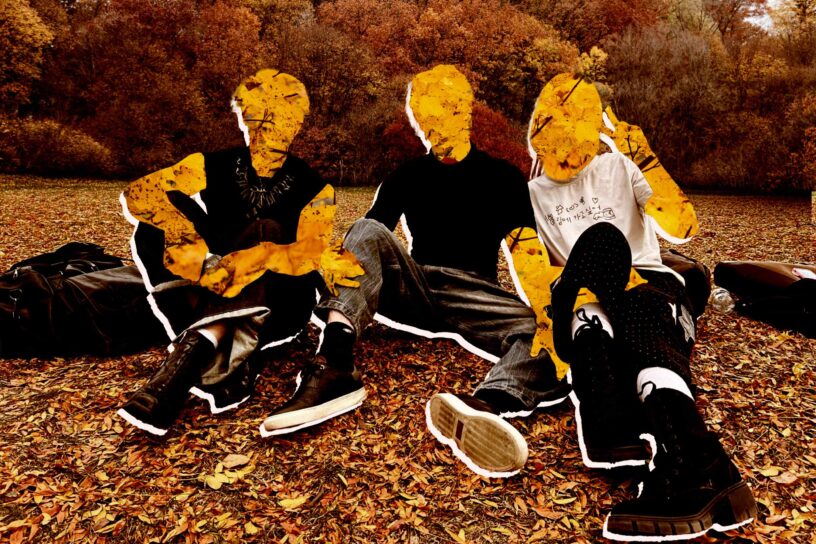
It was late October and yellow autumn leaves blanketed the ground of Kerr Hall Quad at Toronto Metropolitan University (TMU). Students were playing sports in the grass, and just a few days out from Halloween, many students had their outerwear on. But Rika Kim—a third-year child and youth care student—had her jacket on the ground, wearing short sleeves. After all, it was 23C out, feeling more like 25.
Liam Mitchell, a second-year creative industries student, accompanied Kim in the quad. Later, Roman Lodhi, a third-year computer software engineering student, completed the trio of friends. They, too, had discarded their jackets.
Kim noticed the change in autumn weather over the past several years. “I feel like everyone had a similar experience of wearing their winter jackets or having to wear leggings, and no one knows their costume because it’s so freaking cold,” she said, adding she remembered snow during the Halloween season.
Mitchell said that he still has his summer gear out and ready.
Ever Abuhammam, a fourth-year film student, said he’s pulled out a jacket only a few times this season. “I’ve subconsciously felt the need to grab my puffer and get outside and I’m like, ‘oh wait, I don’t even need this’,” he said.
Fall, as experienced today, is growing further from the fall of the past, impacting the nostalgia people feel towards their memories of the season. While the issue of fashion and wardrobe could be considered small, it’s a symptom of something larger.
The way young adults and their parents experienced fall was different, said Shel Winkley, a chief meteorologist at Climate Central, a U.S.-based nonprofit that communicates climate research.
“We know that there were times when it was big winter coats and we were fighting kids to either put it underneath their costume or above their costume. Now that’s not something that we have to do every single year,” he said.
“We also know that Halloween is the time when we start to get into the vibes of fall and [are] getting ready for the holidays. And so we’re just not getting the same kind of weather that we used to around the spookiest night of the year,” Winkley said.
It’s part of a broader pattern. The three warmest years on record have been 2023, 2024 and 2025 according to the World Meteorological Organization (WMO). A warmer fall is contributing to that too.
Rika Kim, a third-year child and youth care student, has noticed the change in autumn weather over the past several years. She said during Halloween this becomes particularly difficult. “I feel like everyone had a similar experience of wearing their winter jackets or having to wear leggings, and no one knows their costume because it’s so freaking cold,” she said.
Kim was in the Kerr Hall Quad in late October. She had a jacket with her, but it wasn’t on. Despite being just a few days out from Halloween, it was 23 C outside, feeling more like 25 C.
Liam Mitchell is a second-year creative industries student, accompanied Kim in the quad. He, too, had discarded their jackets. Mitchell said that he still has his summer gear out and ready.
Ever Abuhammam, a fourth-year film student, said he’s pulled out a jacket only a few times this season. “I’ve subconsciously felt the need to grab my puffer and get outside and I’m like, ‘oh wait, I don’t even need this’,” he said.
Alison Matthews David, a fashion professor at TMU with a PhD in fashion history, said fashion has a function.
“Fashion has to respond to the actual climate that it’s in,” said Matthews David. “We’ve created so many artificial climates that are artificially warm now, so our wardrobes kind of react to that.”
Tyler Hamilton, a meteorologist at The Weather Network, said this does not mean fall doesn’t get cold or that Halloween will be devoid of cold weather gear. “It’s not so much that fall is totally disappearing. It’s just the transition is a little bit extended.”
According to Timeanddate—an online resource for world time zones and displaying historical weather data—as of Nov. 6, Toronto has still not experienced temperatures below freezing (0 C) this year.
According to Hamilton, this has been the trend for the past 10 years. “Our first hard freeze temperature below the freezing mark in the GTA, it’s becoming more common to occur in November versus October,” he said, acknowledging this wasn’t true in the past.
Hamilton said temperatures since 2000 have been trending “consistently above the long term.” He pointed out the Halloween of 2024, which had a low of 16 C, according to Timeanddate. “That was record breaking.”
Halloween costumes aren’t the only casualty of warming temperatures in fall. While the season is known for “volatile” swings in temperature, climate change promotes extremes according to Winkley, who said this can make it difficult for people to know what to wear.
“We’re experiencing more of these above-average days than we’re experiencing average or below average days,” he said.
Winkley said 2026 is an El Niño year, which typically brings milder winters in Canada. This is a weather phenomenon occurring every two to seven years where tropical easterly winds move warm surface water westward across the Pacific Ocean, and heat the air above it, blocking cold water from rising, according to Environment Canada.
Winkley said the warmest El Niño years still haven’t trended as high as the three warmest years. He said the effect doesn’t create new heat, but redistributes heat that already exists.
Humans have warmed the planet 1.4 C to 1.5 C above the pre-industrial average, and while this warming might not seem like a lot, Winkley said it’s good to think about it like a cold.
“Even just a couple of degrees shift [in] your internal body temperature means that you’re on the couch, you’re taking a sick day, you feel unwell. So the way to look at that number is to understand that fall kind of has a fever,” he said.
According to Berkeley Earth, 2026 has a 96 per cent chance of being the warmest year on record, partly due to the “short-term influence of a record-breaking El Niño.” This would surpass 2024, which according to Copernicus, is the current record holder.
“When the El Niño wanes, we’re still going to have the warmth from climate change,” Winkley said. But the weather pattern isn’t evenly distributed. “El Niño touches parts of the planet. Climate change touches all of us.”
While it can feel like there’s not much people can do, Winkley advises talking about the shifting patterns with the people around them.
“So when…you go out for Halloween and you don’t have to put the big coat on over the costume—not to say [you] should be the Debbie downer [of] the Halloween party—but you can have those conversations and just say, ‘oh, it feels a little warm outside today’,” he said. “Because if we can talk about it, then we can get to solutions.”






Leave a Reply