

By Amira Benjamin
The first thing you notice about After the Island is the weight of the history in the room. Amid the gentle sound design and subtle hints of fragrance, you feel cloaked in an energy that is equal parts familial and warm.
One of the first set pieces is a long table, covered in small art pieces and mementos. A pile of books by the abolitionist Frederick Douglass is tied with a red ribbon and topped with a cluster of red grapes. Next to it sits a decorative plate with a beautiful illustration printed on top. The third floor feels as if it’s welcoming you home.
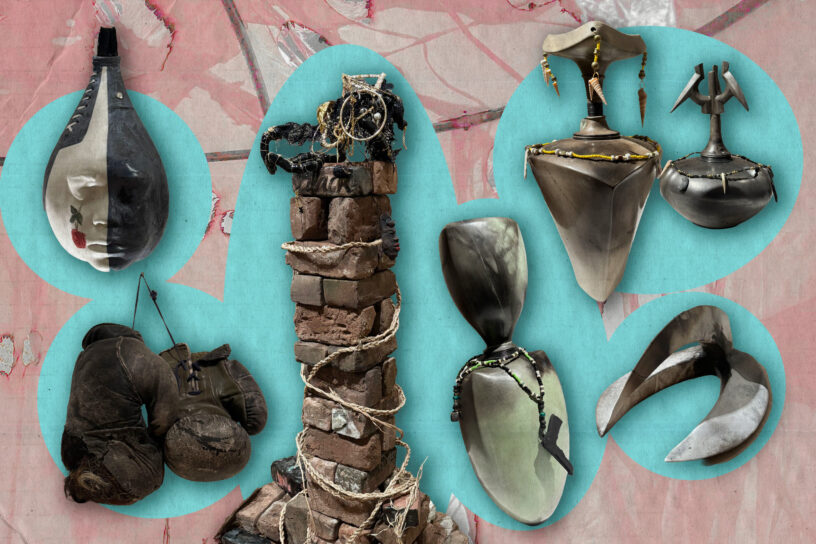
Launched on Oct. 9 and hosted at the Gardiner Museum, After the Island: Caribbean Canadian Ceramics is an exhibition exploring “a broader understanding of Caribbean ceramic practice as a dynamic field shaped by movement, exchange and cultural continuity.”
Joséphine Denis of the Black Artists’ Network in Dialogue (BAND) Gallery and Sequoia Miller, chief Gardiner Museum curator, co-curated the exhibition. Two concurrent After the Island exhibitions are being presented in both Toronto and the Museum of the African Diaspora (MoAD) in San Francisco.
“[Miller] reached out wanting to have a local partner for this exhibition who would also be, you know, an equal partner to MoAD, but who would be able to add a grounding to the context and Black arts community within Canada,” said Denis in an interview with The Eyeopener.
The exhibit features four artists: PJ Anderson, Eddy Firmin, Manuel Mathieu and Sharon Norwood.
Denis, who is the co-director and director of curatorial initiatives of BAND, said she had worked with Miller for a little over a year on the exhibition and had seen “a surge” in Caribbean ceramicists.
“At first, we weren’t necessarily looking at having a selection of just Canadian artists,” said Denis.
“We realized as we were having a long list of artists that we were considering, that we had [a] strong enough list of just Caribbean Canadian ceramicists, so we were really interested in focusing and supporting this.”
Denis explained that while ceramics is not a uniquely Caribbean medium, many Caribbean artists turn to it for a variety of reasons.
“[Ceramics] involves a lot of traditional skills, skills that are passed down in ways that, for some of them, feel quite intimate or even matriarchal. It’s one that allows them to deal with objects as sort of cultural heritage, as spatial and built-in environments, and to really delve into the sort of material cultures and ritualistic cultures that exist within the Caribbean,” she said.
Erica Whyte is a sound, sculpture and visual artist who works within the Design Fabrication Zone at Toronto Metropolitan University. A current artist-in-residence at the Canadian Clay and Glass Museum, she told The Eye she uses ceramics “to express my own culture.”
“Most recently I’ve been really interested in exploring girlhood and growing up as a second-generation Caribbean…because it feels like the two can’t exist without the other,” she said.
Whyte described these pieces as “very dainty and very girly,” and wanted the combination of sound and sculpture to feel playful while adding a Caribbean-inspired soundspace.
“I think as a young person growing up with Caribbean family…there’s always this reference to the Caribbean. You go back, you see what your family’s life is like there, and you meet family that are there, and that kind of tethering to the Caribbean is also inextricable,” described Whyte.
“I think the way my family has thought about tending to their lives and tending to their lives here, has always really resonated with me.”
Denis also said it was intentional to co-present the exhibition across North America as well. “It’s sort of a curatorial ethos and praxis to bring in different voices and contexts together as you’re speaking about a diaspora reality.”
“It was an interest in looking at Caribbean identity and movement as transnational, in looking at the region as this sort of porous space where from island to another, from nation to another, there’s a lot of exchange and similarities, while still trying to think about the distinct practices that exist through them.”
Whyte often describes her ceramics work as “earthwork” and acknowledging the work with the land.
“It very much so is a practice of, you know, working with your hands. You’re working with, very literally, dirt,” she said, “I guess that it is a material that comes from the land.”





Leave a Reply