

By Francesco Cautillo
Some of the most iconic works of photography fall under the intent of sparking resistance or capturing nature’s beauty. When it comes to the work of Canadian photographer and Toronto Metropolitan University (TMU) alumnus Edward Burtynsky, both can be true.
From Oct. 29 to Nov. 1, the Metro Toronto Convention Centre played host to Art Toronto, which features pieces from both Canadian and international artists. One of the highlights of this year’s exhibition was the world premiere of The Vault Collection presented by Toronto’s Nicholas Metivier Gallery, which unveiled two images from Burtynsky’s collection, Mining: For the Future.
The collection features images from across Burtynsky’s archive dating from 1986 to 2016, with most pieces taken on film. Now, these images can be displayed at a larger scale and continue to highlight his examination of industry, landscape and the scale of human ambition.
Featuring expansive perspectives, the images simultaneously present eye-catching landscapes while emphasizing the toll taken on these landscapes by the mining industry.
In an interview with The Eyeopener, Burtynsky discussed his own connection to mining and its impact on the environment. The artist grew up in Southern Ontario and worked in mines from a young age. He described the “danger” involved in the work and his own appreciation for “how hard it actually is to create these materials we use every day.”
Burtynsky translated his own knowledge into the work, allowing him to demonstrate his perspective via photography.
“I thought that photography was this perfect medium to be able to connect us to the places that we use the materials for wherever we go,” said Burtynsky.
In an age marked by countless environmental crises borne by climate change, the mining industry’s environmental impacts perhaps go unnoticed by many. But nevertheless, this industry chips away at the forefront of ecological damage.
World Resources Institute reports that mining-related industry has led to 1.4 million hectares of tree loss from 2001 to 2020, with the majority coming from tropical rainforests. Additionally, 260,000 hectares of that tree loss occurred in Indigenous Peoples’ and local community lands.
The two new world-premiered images were taken during the time Burtynsky spent in Western Australia.
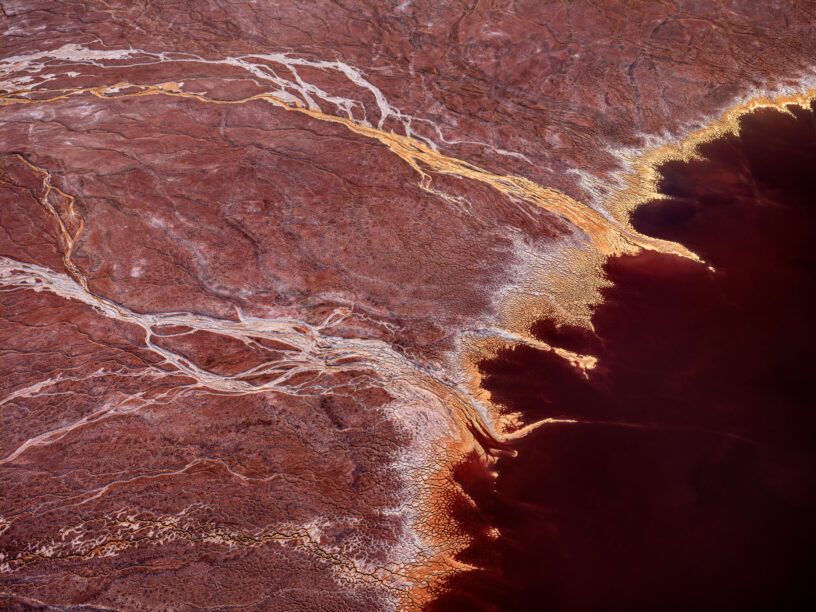
The first image, titled Murrin Murrin Tailings Pond #4, depicts a withered terrain of deep red colour, incorporating what appears to be water running through the edges and into a larger liquid body. The dark red colour of the water body almost replicates a pool of blood, as if seeing life being drawn out from the terrain.
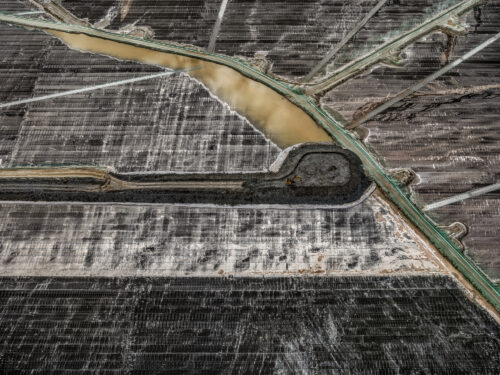
The second image, titled Tailings Storage Facility #1, features a much simpler palette of black, white and gold. This piece highlights a puzzle-shaped landscape with an excavator on a trail of gravel heading toward a golden river, akin to human kind’s natural ‘chase’ towards these consumable resources.
In the images, Burtyksnky chose to highlight the mining impacts with wide landscapes as opposed to some of his other works, which focus more closely on human-environmental interactions.
“I’m interested in the collective impact that we have on things at scale, the residual landscapes we leave in the process of doing this at a great scale,” said Burtynsky.
He offers this viewpoint through the use of both drones and helicopters.
“I do actually prefer drones, because I can be more precise with the drone,” said Burtynsky, adding “I can fix it in the air and move it little bits at a time and really get my composition downtight.”
Much of Burtynsky’s most famous work has focused on landscapes, with some of his earlier work found right on campus in The Image Centre’s permanent collection. His two installments at TMU came in 2020 and 2021, with each showcasing a different chronological stage of Burtynsky’s career through over 200 photographs of his earliest works.
Similarly, some of Burtynsky’s most famous work focuses on landscapes in Bangladesh around 26 years ago, where he displayed decommissioned ships and the world of shipbreaking.
This seldom covered practice is often seen as a form of recycling and is described by Anthropology News as the method where Bangladeshi workers cut through ships run aground on intertidal beaches with hand-held gas torches.
Burtynsky described the intensity of these terrains, saying that “it was probably one of the most dramatic landscapes I’ve seen in terms of size and danger. And something I’d never experienced before.”
More recently, his work and travels have taken him to China, where he hopes to use his eye to put a spotlight on the technological advances and environmental challenges that country faces. Burtynsky said he is interested in “telling the story of how China is really reshaping the planet.”
“Geopolitics come and go, economies go up and down, but climate change is this slow frog in the pot getting hotter, so to me, we have to get back around to having that discussion,” said Burtynsky.
“I believe that we have all the tools necessary to solve the problem right here right now. But we don’t have the political will, or the ones who are in power today are more selfish and care about keeping their profits where they want.”







Leave a Reply