

By Neve Chamberlain
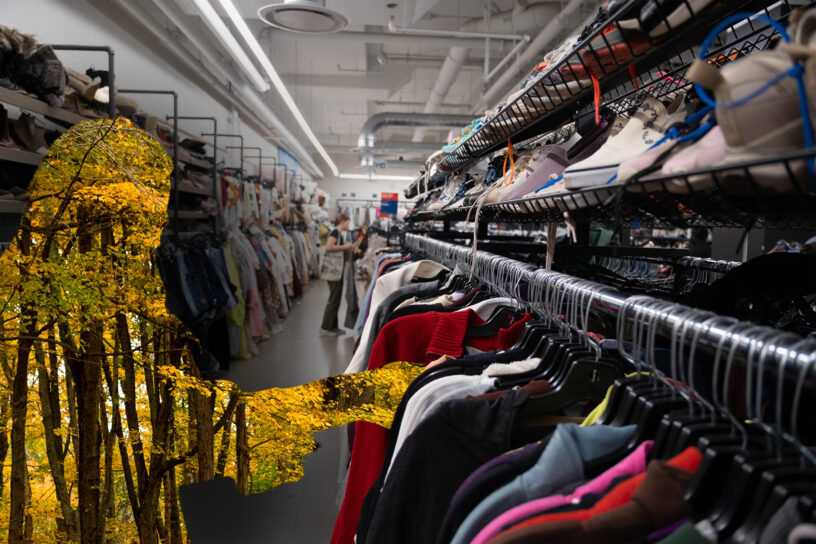
Some students at Toronto Metropolitan University (TMU) say thrifting can restore a deeper connection with your clothing. But as second-hand shopping continues to grow in popularity, it’s perhaps falling victim to the overconsumption it promises to solve.
A 2019 survey by ThredUP reveals the portion of Gen Z buying second-hand was growing 2.5 times faster than any other age group.
Zoë Frantz, a first-year master’s student at TMU’s School of Fashion, shops second-hand roughly once a week, spending around $20 to $40 per trip. Her favourite find is a double-breasted military petticoat with crested buttons and shoulder straps.
“It was a little expensive…but I didn’t care. I was like, ‘this is beautiful’. I’ve been looking for a coat like this for years,” said Frantz.
Shortly after purchasing it, a button fell off. Though, Frantz saw an opportunity to personalize the coat by choosing a new button. “Now it’s not going to be like any other [coat] that exists,” she said.
Frantz said thrifting offers affordability and a way to reconnect with clothing. “The reason a thrift store is so great is because you never know what you’re going to buy, and it really forces you to be creative,” she said.
Isla Cowan, a recent graduate of TMU’s master of fashion program, also enjoys finding clothes that reflect her style. But she said thrifting’s relationship with sustainability is “more complicated than corporations like Value Village would want you to believe.”
As thrifting becomes more trendy and thrift stores like Value Village come under fire for “ridiculous” price markups, as reported by CBC’s Marketplace, Cowan said people who rely on second-hand stores to clothe themselves are being “pushed out of the market.”
“I still think thrifting is one of the best ways to participate in fashion consumption,” she said. “It is a more sustainable option, but it’s not a sustainable solution.”
According to a 2022 report from Cheminfo Inc., almost 1.1 million tonnes of Canadian textiles were disposed of in landfills in 2021. The global fashion industry’s carbon emissions are also expected to rise by 60 per cent by 2030, according to the World Economic Forum.
Frantz said buying second-hand does not automatically make that purchase sustainable.
“If you’re ending up with piles of clothes that you don’t like and you’re donating back, sure, I guess it’s not as bad as fast fashion…but at the same time, it’s not really helping with global textile waste,” said Frantz.
Henry Navarro Delgado, a professor with the School of Fashion, offers a different perspective.
He says there is a “friction” that comes with thrifting. Unlike shopping at big brands with well-defined offerings, Narravo Delgado said thrifters must exercise patience as they sort through racks of clothes made with different designs, materials and durability.
Thrifters are “willing to wait until they get the right thing instead of making impulse purchases,” he said. It is an intentional process that requires energy and commitment, said Navarro Delgado.
Navarro Delgado argued shopping second-hand always extends the lifecycle of clothing, making it hard to overconsume.
“We tend to think of [overconsumption] as an individual issue. Actually, overconsumption is a feature of the system,” he said. Fast fashion brands, for example, have designed the purchasing process to be as frictionless as possible so shoppers end up buying more than they need without realizing it, explained Navarro Delgado.
“There’s also a larger cultural context. You know, as AI has become more and more pervasive in our lives, knowingly or not, we as human beings are craving more authenticity and more honesty in materials and craftsmanship,” said Navarro Delgado.
He advised students to look beyond price when shopping, paying attention to materials, seams and closures that can extend the lifecycle of a garment.
Despite her concerns about overconsumption, Frantz said thrifting remains an accessible and fun way to buy clothes.
Cowan urged students to approach fashion consumption critically. “Participating in fashion consumption is really complicated, and there is no 100 per cent right way to do it,” she said.
What matters is approaching it with care for others and the planet, Cowan added.







Leave a Reply