

By Ananya Sharma
Young people today have spent most of their lives hearing how little time
the planet has left. Fifth-year biology student Jomanah Hafez, the founder of Toronto Metropolitan University’s (TMU) Wildlife Club, said that’s the reason her club exists.
Hafez, who is specializing in environmental biology at TMU, told The Eyeopener she came up with the idea over winter break in her third year. Hafez said she wanted to start the club as a space for more environmental sciences in the Faculty of Science. The club was ratified as a student group with the Toronto Metropolitan Students’ Union in February 2025.
Hafez said the club has three goals: to promote biodiversity conservation, to encourage environmental stewardship and to carry out wildlife preservation efforts across campus. Though they’re based at TMU, she said that that last goal doesn’t stop at the edge of downtown. “Wildlife is everywhere you look,” she said.
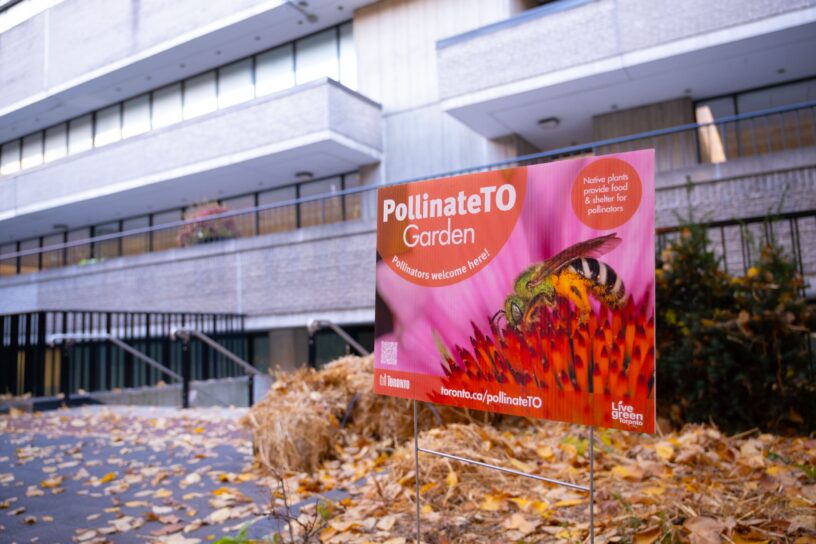
The club’s most visible project is a pollinator garden along Nelson Mandela Walk, which was planted over the summer alongside TMU’s Sustainability Office. The space includes native plants meant to draw in bees and butterflies. In a city where green space is fragmented, Hafez said even small amounts of native greenery “go a long way.”
The club also received funding from the Jane Goodall Institute—a global charitable organization founded by the late antropologist. Hafez said securing funding was a big moment for such a young group. Goodall herself received an honorary Doctor of Science degree from TMU in 2001.
Hafez believes the club’s existence is an achievement in itself, because it offers young people a way into conservation that isn’t built on dread.
On Oct. 27, the Wildlife Club screened Shark Whisperer (2025), a Netflix documentary that follows a marine conservationist on a mission to protect sharks. The event was hosted in the George Vari Engineering and Computing Centre, and followed a keychain-making event the week prior.
Selehna Torres, a first-year media production student, attended both events. She said she’s passionate about marine conservation, particularly wildlife like sharks.
Cameron Cayab is a fourth-year biology student and a member of the club’s events team. He said a documentary he saw as a child about shark finning—the practice of harvesting shark fins for food—changed the way he’s seen animals and the environment.
“We’re using their fins to make shark fin soup, and it’s super wasteful. So why do we do that?…Why not just work towards trying to make it better?”
Cayab said events like this help build the kind of public support conservation movements need.
For Anushen Selvasegar, a third-year environment and urban sustainability student, the screening was his first time watching a “wildlife-related” documentary.
“I want to get connected with the TMU Wildlife Club,” said Selvasegar, He said he’s heard from other students in his program that they’d also like to get involved with the group.
Selvasegar said when we talk about wildlife, it doesn’t necessarily have to mean animals from outside Toronto. He said focusing on urban wildlife is also important.
“We got bees, we got birds flying around, and how do they help our local environment?” he said.
Hafez said the idea behind the pollinator garden was “kind of self-explanatory.”
“We planted a bunch of pollinator plants that would encourage the presence of pollinator species like bees, butterflies, that sort of thing, which I feel like is really important because of how fragmented downtown is,” she said.
Fifth-year biology student and events team member Lauren Szewczuk has written the Red-Tailed Hawks’ species account—a record that summarizes key information about animal, plan and other nature observations—for the Ontario Breeding Bird Atlas.
Szewczuk said the club connects her with people who she can go birding with or look for reptiles and salamanders together. She said the club welcomes students outside the Faculty of Science, including those who don’t have a background in wildlife. “We’re not one of those clubs that are kind of closed doors,” she said.
Hafez said community initiatives are the heart of the club, saying the fact it exists is already one of the club’s achievements. Watching students her own age get excited about nature in a big city like Toronto is “something that I never thought I would see,” she said.
The club’s challenge is now visibility. Hafez said she wishes more TMU students knew that the club exists.
The Wildlife Club is currently open for applications and is looking for more students interested in being general members, Cayab said.
“I feel like a lot of young people,
especially, associate anything regarding environmental conservation with so much doom and gloom because we’ve been told all our lives how much global warming is impacting us,” Hafez said. “It’s important to have that little piece of hope for people.”
“It’s not the end of the world, and we still have time…We still have hope.”









Leave a Reply