

By Colin Morley and Sophie Wallace
Timothée Chalamet made headlines last month for his controversial comments about ballet at a Variety and CNN town hall.
“I don’t wanna be working in ballet, or opera, or things where it’s like ‘hey, keep this thing alive’ even though no one cares about this anymore,” he said in conversation with Matthew McConaughey.
The work of Sofia Beraldo, a Toronto Metropolitan University (TMU) Master of Arts in Fashion graduate, would imply otherwise.
Her recently curated exhibition at the Image Arts Centre, Staging Celia Franca, showcased photographs of Franca, the founder and first artistic director of the National Ballet of Canada’s wardrobe from 1951 to 1959. Beraldo, who graduated in 2024, wrote her major research project (MRP) on the prominent figure in Canadian ballet.
“I was really interested in fifties fashion because of how intertwined it was with ballet,” said Beraldo. According to the BBC, ballet has had a long and enduring impact on fashion.
Beraldo said the 1950s’ pivot to more restrictive, feminine clothing was partly modelled on the hyperfeminine figure of the ballerina. “Ballet…requires a level of physical discipline, which also comes into what is worn, like the pointe shoe.”
This came alongside a societal pushback to traditional gender roles after women wore more utilitarian clothing whilst in the workforce during World War II, Beraldo explained. “It’s a very specific silhouette that lends well to specific movements and not to others. And so to see that kind of echoed in mainstream fashion, really, to me, kind of points to the role of women in society,” she said.
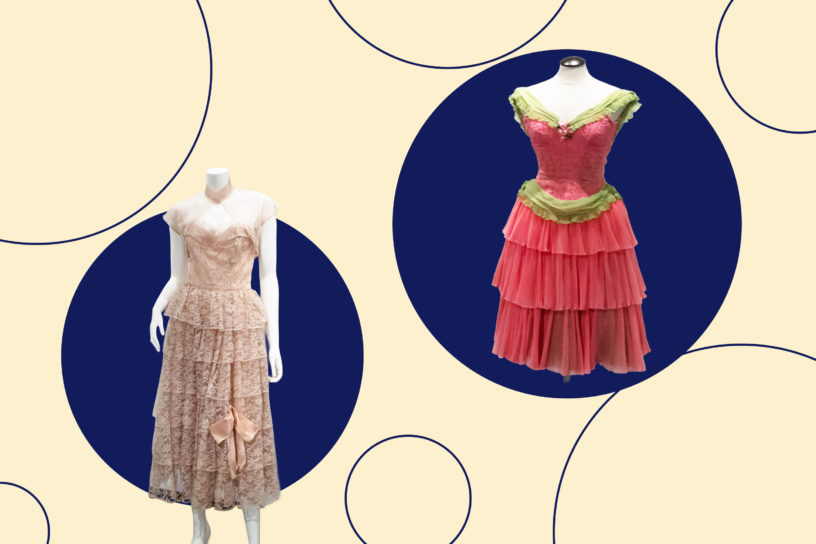
Christian Dior’s “New Look” of the late-forties featuring a tight waistline and voluminous skirts, became emblematic of this shift and was worn by prominent dancers like Franca. Beraldo said Franca also had a unique “aura” that made her stand out at a time when women were often not in positions of power.
Beraldo’s comments were echoed by Caroline O’Brien, TMU’s School of Performance chair, who worked with Franca. She said Franca “built the world” for future prominent dancers at the National Ballet of Canada, including Nadia Potts, who became the director of the dance program at TMU in 1989—Potts passed away this February.
O’Brien said women’s fashion in the 1950s fashion adopted the silhouette of the Romantic ballet costume with a fitted bodice and full skirt.
Ballet dancers, “have an ability to influence fashion and to influence social and cultural norms in ways that not everyone does because they’re in the spotlight, because they’re on stage,” O’Brien said.
According to Vogue, ballet’s influence on fashion is not just a thing of the past. Modern designers such as Miu Miu are heavily influenced by the aesthetic of the ‘off-duty dancer’—characterized by comfortable but elegant feminine silhouettes.
But the trend dubbed ‘ballet-core’ on the internet is not without controversies of its own. Ballet has historically favoured a particular body-type—white, tall and thin—and according to Vogue, the ballet-core aesthetic has not always been inclusive.
O’Brien said that it was only very recently that ballet has begun to diversify. “Within the past 10 years, even less than 10—dancers who [weren’t white] had to use makeup to colour shoes, and we would use tea or coffee to color tights.”
Bridget Laur, a third-year journalism student at TMU, danced ballet for 14 years. She said her love of ballet was complicated by the aesthetic expectations that came with it.
“There were many girls who were excelling in ballet who looked nothing like me,” she said. “I am a big person in comparison to ballet dancers, and I think that was a big part of why I never excelled in it, and I was never looked at as someone who could excel in it.”
Laur shared that in her experience, girls whose bodies fit the “ballerina shape” were given more opportunities in her studio. “I hope for it to be more inclusive…I think a dancer’s body can look like anything,” she said.
Madison Stewart, a fourth-year public health student who has attended the National Ballet of Canada, said she too is drawn to imagery of ballet dancers and wishes more people understood the skill that goes into it. “I remember going to see last year’s Swan Lake when it was playing…it brought me to tears, it was such a beautiful performance.”
Beraldo hopes her work leads more people to become interested in ballet. “I wanted to bring ballet out of its context, because it can seem a little bit inaccessible…and bring it to people in a way where they can look at it and think ‘oh, I had no idea.’”








Eyeopener Staff
Do you see ballet influence on fashion on campus or in the city?