
By Aditi Roy
As the unemployment rate continues to skyrocket, some Toronto Metropolitan University (TMU) students have taken to LinkedIn to increase their chances of landing a job—viewing the platform as crucial, not optional.
According to Sprout Social in 2025, LinkedIn has seen 1.77 billion monthly visits. The platform has 1.2 billion members, most falling under the 25 to 34 age range. These figures are projected to increase in 2026, with LinkedIn set to exceed 1.3 billion users and 600 million active users.
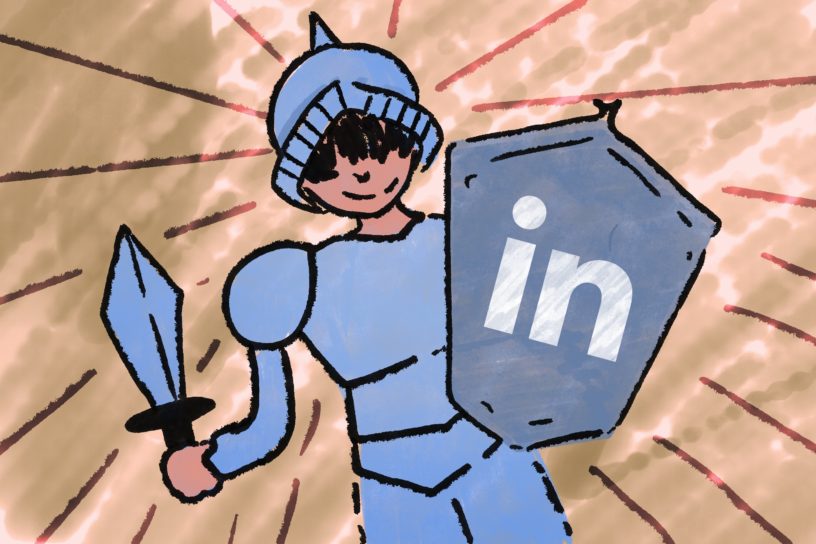
With the growth of platform engagement, “The LinkedIn Warrior” trope has cemented itself as a cultural meme on Instagram and TikTok.
Darby Roland is a PhD candidate in human resource management and organizational behaviour at TMU, where her research focuses on employee wellbeing.
She defined the term ‘LinkedIn Warrior’ as, “someone who is highly visible and actively curating their professional identity…it’s less at this point about networking and more about signaling some level of ambition, competence, even employability.”
As memes and reels surface on social media about this character archetype, a deeper story emerges about ambitious young adults trying to make it in the current adverse economy.
Vince Cabansag is a fourth-year professional communications student at TMU who said they see why people may designate them as a LinkedIn Warrior. Cabansag checks the platform daily and is actively posting professional milestones and learnings.
“I’m [the] first in my family to graduate university. So I have a lot of anxiety in me that I need to succeed,” they said.
Cabansag doesn’t care about being labelled a LinkedIn Warrior, instead they are focused on leveraging the platform to boost their career trajectory.
“I don’t have the same opportunities as the people who grew up with rich parents or people who have connections through their parents,” they said.
Cabansag’s anxiety about landing a job is reflected throughout Canadian youth and their struggles to find stable employment.
“They’re competing for attention…they have no other choice, it’s a double-edged sword, it amplifies this pressure, performance basis anxiety,” said Roland.
Statistics Canada reports that in February 2026, unemployment rose to 6.7 per cent—youth unemployment has also headed upward, reaching 14 per cent.
The pressure is mounting on the backs of young adults aged 18 to 24 with 37 per cent of them classifying unemployment as top concern for Canada, according to the Angus Reid Institute.
For third-year computer science student Ram Kanakamedala, the engagement is also fueled by bigger concerns.
“Whether I live in this country long-term…directly depends on the job I get and what kind of job I get. Because for [permanent residence]…you only qualify if you’re in the top three tiers [of jobs],” he said, as an Indian international student.
Kanakamedala reflects on the added pressure to post and stay active on the networking platform given his desire to switch career paths.
“For Student Affairs, there’s no specific program that you can go through. All that matters is your experience…that’s why I’m very active on LinkedIn and most of the stuff I post is related to student affairs,” he said. Actively working for TMU’s Student Life & Learning Support as a leadership assistant.
Nearing his final year, Kanakamedala has amped up his LinkedIn post to nearly three every week.
“Given this current economy, you need to take whatever advantage you can get from the hundreds of other candidates that are also applying for your role,” he said, attributing he said, attributing his LinkedIn for his current network in the industry.
Darby reflects on psychological scarcity, spawning these LinkedIn Warriors, “what we’re actually seeing [is] a behavioural response to this idea of perceived scarcity in the labour market—[an] increase in the sense of urgency,” she said.
For 2025 accounting and finance alumnus Dennis Chen, the platform is a way to cement his personal brand.
“In an age where AI can mass apply to jobs…there’s so little differentiation between resumes. Having a personal brand that’s highly visible [on LinkedIn,] people can go see your posts and see the type of person you are,” he said.
Chen said he noticed a shift in the platform content.
“It used to be just a platform to humble brag about your career achievements but it has transitioned lately to becoming transparently showing your journey, career and figuring things out,” he said.
Despite the platform being used to build authenticity and one’s personal voice, Artificial Intelligence (AI) content has plagued LinkedIn feeds.
Originality.ai reports more than 50 per cent of long-form posts were likely AI-generated or altered.
Chen uses an AI tool called Stanley to help write and curate his LinkedIn.
Kanakamedala uses ChatGPT to correct his grammar mistakes and help his writing flow—an issue he frequently faces as English is his second language.
Darby explains the pitfalls of AI use to produce seemingly us content. “AI can help you craft a wonderful LinkedIn post, but AI is not going to help you in the interview when it comes time for you to actually explain all the things you’ve accomplished,” she said.
Drawing on her experience in business and organizational research, Darby advised, “you don’t have to be the loudest person on LinkedIn to be the most compelling and often leaning into more authentic versions of yourself is what actually resonates with people.”






Eyeopener Staff
Do you know any LinkedIn warriors? Do you wish you could be more active one the platform? Let us know!