By: Negin Khodayari
The heavy air in the subway shifts as people rush to find an empty seat. I hear a murmur of laughter in the distance buried behind the sound of the tapping feet of the person sitting next to me. The quiet humming of the air conditioning and the subtle lack of oxygen slowly put me to sleep but just as I’m dozing off I hear it: “Arriving at TMU, TMU Station. Doors will open on the right.”
I’ve been taking this commute for eight years.
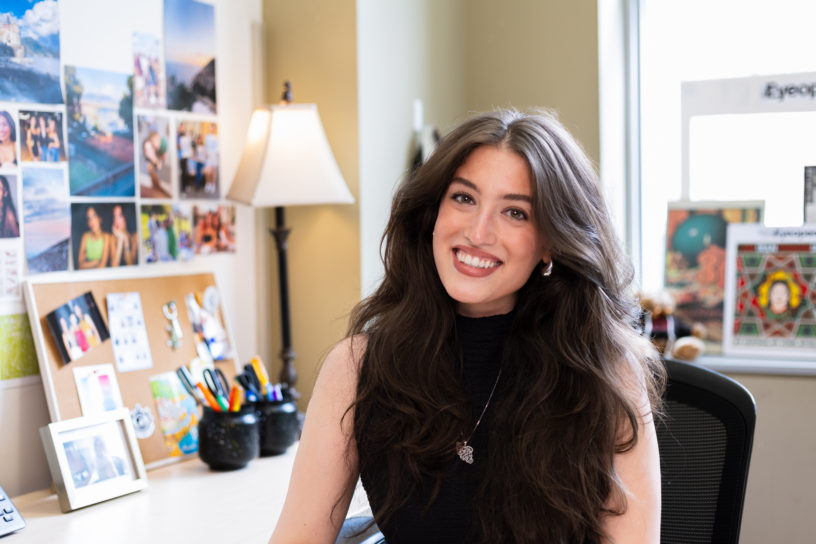
I’ve lived several lifetimes at Toronto Metropolitan University (TMU). I was first an undergraduate student during the COVID-19 pandemic, then a graduate student and landed a job as communities editor at The Eyeopener. I later became the editor-in-chief (EiC) of The Eye, then a part-time instructor with the RTA School of Media—and now both.
When I first stepped foot on this campus in 2018 to drop off my journalism portfolio, I wouldn’t have imagined all the lessons these halls would teach me. The first time I walked into The Eye’s office in the Student Campus Centre (SCC) in November 2022, I again had no idea the whirlwind I was about to embark on.
I was 22, overwhelmed by the state of the world and terrified of what was to come. But my then-debilitating fear of staying stagnant forced me to seek new experiences and when the communities editor position opened up in late-2022, I went for it and I haven’t looked back since.
I can’t adequately articulate my experience as the communities editor but I can confidently say if it wasn’t for The Eye I may have never left my bed that winter.
In September 2022 Mahsa Zhina Amini died in custody of the Islamic Republic’s (IR) so-called “morality police” in Iran. She was detained for allegedly not properly abiding by the regime’s mandated dress code. Her death sent shockwaves across the Iranian diaspora. For months, protests and rallies were held in Iran and internationally in what became the Woman Life Freedom movement.
In Iran, the Islamic Revolutionary Guard Corps (IRGC) which is tasked with defending the regime’s ideology in the region, murdered, blinded and arrested innocent civilian protestors. As of October 2022, the IRGC began sending student protesters to psychiatric institutions. As of November 2022, a series of chemical attacks began mass poisoning school girls across the country. As of December 2022, the regime began executing protestors following sham trials.
The internet was shut down, bodies were abducted, victims’ families were threatened and the international community failed to protect them.
As an Iranian woman, I was distraught.
But at The Eye I slowly discovered I could turn my anger into conversation, and while I wasn’t necessarily writing about Iran, I was given one page a week to talk about anything that mattered.
This is where I learned almost everything I know about journalism. About the responsibility of telling people’s stories and telling them right. About how a simple 15-minute interview can make someone feel heard for the first time. But most of all, I learned how to stay curious.
By my third month at The Eye I was nominated to become EiC of the next volume and so began one of the most exhausting, tedious, exciting and fulfilling journeys of my life.
In April 2023 I was elected as EiC of volume 57. The world continued to unravel in ways that felt impossible to hold in a small student newsroom.
First came Bill C-18—the Online News Act. This piece of legislation was meant to bolster Canadian journalism but due to Meta’s response it in turn reshaped how we access news online for the worse. As a newsroom we were left to grapple with what this meant for us, for our visibility and our survival. How do we reach our readers?
And then, almost immediately after, the world shifted again.
In October 2023 the genocide in Palestine began unfolding.
I remember scrolling on my phone and feeling like I was split in two: trying to be a journalist, trying to be a human being, trying to find the right words that always felt too small for what the world was witnessing. While hospitals, schools and homes were reduced to dust, we were expected to report on it with clarity, with accuracy, while the internet screamed in every direction.
We didn’t always get it right, no newsroom did. But I’m proud our group of twenty-somethings showed up every day with empathy. I’m proud that we tried and we held conversations some journalists fail to ever come to.
When I walked away from The Eye in April 2024, I thought it’d be forever—but in a funny turn of events, in spring 2025, I was asked to return as the EiC of volume 59.
By the time we started production in August of last year, the world hadn’t gotten any quieter.
The first curveball this time was Bill 33, the provincial government’s Supporting Students and Children Act, another piece of legislation which threatened student services, access and the very funds which keep The Eye alive. And again our job wasn’t simply to report on what was happening, it was to understand how it impacted the real people who were suffering the consequences.
And then, Iran.
Iran never really leaves me but during volume 59 it became impossible to hold it at a distance.
In January the situation there deepened into something heavier, more painful and more relentless every day. A mix of protests, ongoing repression, arrests, executions, global silence and irrelevant noise all at once. I was forced to remember how quickly the world decides what to pay attention to and what to forget. I think about it often—how selectively outrage gets distributed virtually and how easily people online speak over those who are actually living through it.
On Feb. 28 the U.S. and Israel began striking Iran under the guise of liberation.
Today, on April 7, civilian infrastructure and an entire population is being threatened, and it’s yet again Iranians who are paying the price. Meanwhile the IR has shut off the internet for the longest period in global history.
As of today there have been over 2,000 casualties in Iran alone, thats not including innocent civilians of Lebanon, UAE, Iraq, and neighbouring countries, since the start of the war. And this comes after the regime in Iran killed possibly over 30,000 civilians on Jan. 8 and 9 during anti-government protests.
Iranians are stuck between a repressive regime and foreign bombs.
And I need to say this clearly: governments that abuse power, that silence people, wrongfully imprison or kill their own citizens are never the victims. They are the perpetrators, even when that doesn’t align with your political opinion. If you are only outraged when it fits your narrative, then it was never about justice in the first place.
What I’ve learned by now is that listening has to come first. Listening before speaking, before posting, before assuming you understand—I hope the rest of the world comes to that realization soon too.
Somewhere between the early mornings, late nights and never-ending deadlines, I started to understand what journalism truly means.
It means having patience in a world that rewards speed. Seeking varied perspectives in a culture that rewards certainty. And it means carrying empathy for your sources, for your readers, for yourselves.
Cancel culture, or whatever you want to call it, has made our choices feel permanent and final. One mistake becomes your identity. I don’t say this to dismiss accountability but I do think we’ve lost something in how quickly we discard people instead of trying to understand them. How quickly we attack instead of asking questions without giving each other space to grow.
At The Eye I was given that space. It wasn’t without tension or criticism but it was enough space to make mistakes and keep going. And I don’t take that lightly, I know how rare it is. I hope I’ve been able to create that environment for my mastheads.
I think that’s what I’m most grateful for. Not the titles, not the number of issues we published or the amount of stories we told.
I’m most grateful for learning, for making mistakes, for having conversations that changed my mind. The moments we tried to get it right even when we had no idea what “right” was.
My wish for the world is to build more spaces like this one—for journalists, students and for anyone trying to make sense of a world that often feels like it’s moving too fast to understand.
Because if there’s one thing I know after all these years, all these volumes, all these stories, all these versions of myself, is that we need more patience with each other. Not less.
Now I’m 26, overwhelmed by the state of the world and excited for what’s to come. I’m honoured to have spent my early twenties with you all.
The doors of the subway open and I dash out with the wave of students trying to make it to class on time. I speed walk on the edge of the platform, go up the stairs that lead me to Yonge and Dundas. I walk through Victoria Street and pass Lake Devo. I look into the Balzac’s windows in hopes of catching the gaze of someone I know but to no avail. I keep walking to the SCC, tap my OneCard and enter. I struggle to get up the stairs to the second floor and as I walk to our office doors I see everyone laughing. The lights are dimmed, slow music is playing, the air is stuffy and no one has done the dishes.
I think I’m gonna miss this.


Leave a Reply