

By Naseema Raja Mohamed
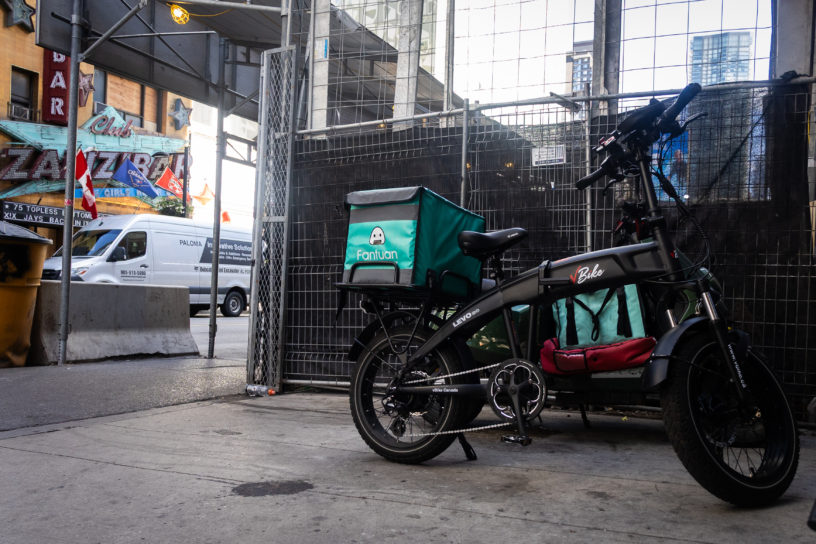
The Toronto Police Service (TPS) has launched a two-week safety and enforcement campaign for micromobility vehicles, including e-bikes and e-scooters.
The campaign, which will run from Aug. 10 to 24, focuses on educating road users about laws and regulations to promote safe riding, as well as increasing law enforcement where misuse is common.
According to Toronto by-laws, it is illegal to ride e-scooters on public roadways and sidewalks. The city also has similar restrictions for e-bikes, which cannot be ridden on sidewalks and certain roadways.
E-bikes and e-scooters are among one of many ways Toronto Metropolitan University (TMU) students get to and from campus and some are skeptical about how the campaign will be enforced.
Zain Fayaz, a second-year civil engineering student at TMU, uses an e-bike regularly as a mode of transportation. He says he thinks the campaign is overreaching.
“To be fair, I think that the removal of the Yonge Street, Bloor Street and University [Avenue] bike lanes are a much, much bigger issue, given that thousands of people ride those [streets] every single day, myself included,” said Fayaz.
“My direct route to school is being removed and it is making me decide to maybe even switch modes on how I get there.”
According to data from TPS, Toronto has seen 514 micromobility vehicle collisions this year, including two fatal collisions.
TPS has not released the specific locations where they will be conducting their campaign.
“Officers can and will use collision and enforcement metrics to position themselves in areas where the data shows an increased risk to vulnerable road users or where observed volume and operator behaviours warrant it,” TPS wrote in a statement to The Eyeopener.
Fayaz fears at the end of the two-week blitz campaign, problematic riders will return back to their previous behaviors.
Ammaz Baig, a 2023 graduate from TMU’s law school, said he regularly rode an e-bike during the time he attended TMU and had similar concerns.
Baig said that informing the community is safe and reasonable, but doesn’t believe the approach will remain effective in “the long run.”
“My direct route to school is being removed and it is making me decide to…switch modes on how I get there”
“After these two weeks, what if everyone just goes back to doing what they’re doing before? What if they don’t really take the lesson that’s being taught here and do anything with it?” said Baig.
Tommy Lazarou is a cycling coach and founder of Bike Foundations, an organization that provides bike lessons. He thinks that the enforcement program may encourage cyclists to be more careful on the roads.
“I think encouraging people to be more aware, if they’re taking courses… or somehow participating in actively becoming better [road users], would be beneficial to everyone,” said Lazarou.
“What if they don’t really take the lesson that’s being taught here and do anything with it?”
While optimistic, Lazarou warned that a campaign based around enforcement instead of education could negatively impact cyclists.
“Students will be affected if they feel like they’re going to be chased down…. It’s not a good scenario. I believe [in] making a workshop, making a seminar, something like that, where everybody’s included and can learn the rules of the road,” Lazarou said.
“Because better pedestrians and better cyclists make for a much safer city.”






Leave a Reply