

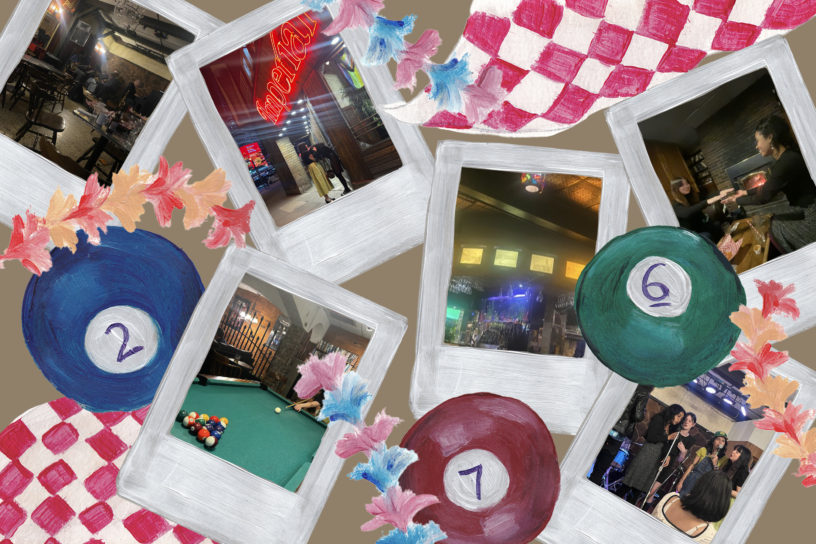
After 81 years in operation, the Imperial Pub is closing its doors—with it comes the end of a decades-long affair with the students of TMU
By Edward Lander
It’s August 2023 and Brenden MacGowan has just laid eyes on the Imperial Pub for the first time. He’s been in Toronto for a day or two, has already moved into his suite in Pitman Hall and just sang at an open mic on campus with a few other students in the professional music program. Performing is his favourite thing to do and he’s flying high.
After playing two songs, MacGowan and a group of his soon-to-be classmates shuffle down Bond Street towards Dundas. They’re not really sure where they’re going—but that doesn’t matter to them.
After turning the corner, they notice the sidewalk is awash in a reddish glow emanating from a neon sign on a two-storey building. Upon closer inspection, they see that it’s a pub—a pretty cool looking one at that.
The students wander inside to see what all the fuss is about. MacGowan is sure it’s a dive bar at first—but once inside, he realizes it’s an old-school kind of place. They sit down at a table and get to talking. They chat about everything—school, music, where they’re from, what they hope to do in their futures—all to the soundtrack of jazz and the soft chatter of the other guests.
After that night, the Imperial becomes MacGowan’s spot. He starts bringing friends there, telling people in his program and floormates in Pitman Hall about it. When his family comes to visit from Ottawa, he takes them to the Imperial. He says he now goes about once a week. Even if he’s out seeing a show or headed to a different bar, the night either starts at the ‘Imp’ or ends there.
There are many students with stories like MacGowan’s—stories that go back eight decades to the opening of the Imperial, a bar whose past is deeply woven with that of Toronto Metropolitan University (TMU) and its student body.
Later this year, however, the Imperial will be closing permanently. Its owners sold the property to a developer who’s not keen on keeping them around much longer. Nov. 15 will be its last day in operation. After that, the assets will be liquidated, the leftover liquor will be drunk and the doors will be locked for good.
In many ways, walking into the Imperial Pub is like walking into Toronto’s past. You can feel the history inside and out—it’s on the walls above the circular bar in the form of images of old Toronto buildings, it’s heard in jazz playing on the bar’s two jukeboxes, installed 75 years ago.
The Imperial Pub’s history and TMU’s history have always been intertwined. The bar opened in 1944 and the university—then-institute of technology—in ‘48. It didn’t take long for students to relish in the convenience of a pub near class. In those early days, the O’Keefe brewery sat at Victoria and Gould Streets, a colossal brick factory that emitted a boozy aroma across campus—surely enticing students to the Imperial where O’Keefe lager was on draught.
The Library Bar—the cozy second floor dining area that feels more like a living room than a pub—is no doubt the most popular spot in the Imperial among the student crowd. This space was the brainchild of Fred Newman, the second-generation owner of the establishment.
“They’d gut the upstairs, jam it full of books, chairs and couches and call it a library”
Newman grew up in his father’s pub. Some of his earliest memories are maneuvering between the maze of chairs, eating free peanuts and staring in awe at the bright blue aquarium between the bar’s two separated dining rooms. In those days, bars were divided into men’s and women’s sections.
Newman’s father Jack—who died in 2008—was an entrepreneur. When he bought the building at 54 Dundas St. E, it was a cafeteria. On the advice of his father Sam, he sold the office furniture factory of which he was proprietor and got to work on making the Imperial Pub—then called Imperial Hotel—the classy joint he envisioned it could be.
Newman spent nearly every Sunday of his childhood at the pub alongside his brother and father. When he was old enough to handle alcohol, he was moved to behind the bar. He spent many of his nights pouring hundreds of 15 cent beers in seven-ounce glasses—a size then-mandated by the Liquor License Board of Ontario. Although that didn’t stop patrons from ordering 20 at a time.
Until the 70s, the second floor was home to nine small hotel rooms—not much larger than the condos on Toronto’s market today, Newman says. Back then, alcohol could only be served in hotels. When that law was scrapped, Newman got to decide what’d go in the space and came up with something he still considers genius. They’d gut the upstairs, jam it full of books, chairs and couches and call it a library—the idea being that students could say they’re “headed to the library,” when they’re really out for a drink.
“We did it for the students,” he says. “And the students understood it.”
Newman says the Library Bar has been a hit ever since and the steady stream of students making the journey from TMU after class has never slowed down—not even when the first campus pub opened in 1975. He says all kinds of students visit the Imperial for all kinds of reasons—and he’s right.
Each fall, after a week of orientation activities and purple-dye baths frosh leaders from the various engineering programs are known to kick back at the pub, populating the second floor and outdoor patio with around 40 upper-year students, some still wearing cyan coveralls tied around their waists.
“It will be missed by my generation of engineering students,” said Maxwell Steer, a 2025 chemical engineering grad and frosh leader several times over.
“We did it for the students,” he says. “And the students understood it”
Second-year philosophy student Conor Hassaram-Leblanc says he made long-term friends at the Imperial. In his first week on campus, he attended a social there with other students in his program where he got to chat with upper-years about philosophy.
“That was sort of my introduction into how the university social life…was,” he said.
On the last Thursday of every month, the Library Bar is flooded with people in Toronto’s film and television industry. It’s a casual atmosphere where students can approach insiders with questions or even an elevator pitch.
Farrell Candy, a Seneca Polytechnic graduate and freelance prop master says he attends these as often as he can.
“You’ll run into people working on Star Trek or current Toronto productions or just a lot of film students,” he says.
Candy says he met a costume designer for Netflix there one night, which led him to a freelance gig making prop prototypes for use in one of their productions’ wardrobe departments.
He isn’t sure how long the events have been running but he says he’s met industry folk who’ve been going for upwards of 10 years.
One thing is common among all these students: they’re going to miss the hell out of the Imperial Pub.
Towards the end of the winter semester in 2024, fourth-year RTA media production students and close friends Gus Cousins and Nic McAllister are sitting in class awaiting a highly-anticipated guest lecture by Toronto actor Paul Sun Hyung-Lee.
The 53-year-old rising star is hot off The Mandalorian, his titular role in the CBC comedy Kim’s Convenience and has just nabbed a Governor General’s Performing Arts Award.
Midway through Lee’s talk, Cousins’ phone vibrates—it’s a message from a classmate in a group chat he and McAllister are part of.
“We should ask him if he wants to go to the Imperial after,” writes the student.
Cousins and McAllister look at each other. There’s no way he’s going to a bar with a bunch of RTA students.
Class wraps up and Cousins and McAllister leave while others stay back for a chance to chat with the actor.
The pair are a few blocks off campus when McAllister gets a notification on his phone. It’s a photo of Lee, at the Imperial, sitting at the big table at the front of The Library Bar surrounded by 12 of his peers—all grinning.
“I was like, oh my god, these guys just convinced a dad—who had like a family to go back to and all that—to go play pool until one-thirty in the morning,” he said.
Cousins says not tagging along with them is one of his biggest regrets.
In his words—Cousins has been to the Imperial “about a million times.” It’s been his go-to spot since discovering it in the early days of in-person classes after the university reopened during the COVID-19 pandemic. He’s met friends there, made memories and knows the staff well—including bartender Jacob, Fred Newman’s great-nephew. Even after graduating last winter and moving from The Village to the Distillery District, he remains a regular.
“Jack felt students were being left out. So he built the room as a space for them”
When Cousins found out the Imperial would be closing, he was devastated. His friends had similar reactions.
“It’s so much older than any of us, by three times over, it’s just sad to see things go,” he said.
If you’re a housing developer, securing the lot where the Imperial Pub sits might feel like winning the lottery. It’s in the heart of downtown, adjacent to two transit routes, borders on the TMU campus and overlooks the bustling Yonge-Dundas intersection. The Newmans have been receiving handsome offers on the property every year since 1997 but have only now decided to take one up. It’s the right offer at the right time, says Newman.
According to documents submitted to the City of Toronto, the land is being developed by Vaughan-based developer Bazis. The pub, along with several other properties around it will be razed for the construction of a 23-storey residential tower with retail on the bottom. Bazis’ website refers to the proposed building as a “jewel location for students.”
Though the building that houses the Imperial was constructed in 1924, it is not listed under the Toronto Heritage Register or the Ontario Heritage Act, meaning it’s not protected from demolition by the city or province.
However, when the development was first proposed in 2021, a Heritage Impact Assessment (HIA) had to be completed due to the site’s proximity to the heritage-listed 105 Bond St.—TMU’s South Bond Building.
The assessment concluded that the property contained “minimal design and historical value,” citing that its facade has been heavily-altered from its original design.
Nevertheless, the HIA suggested that “appropriate commemoration measures may be considered to commemorate the social history of the property,”—meaning the developer could incorporate some kind of recognition of the Imperial into the design of the new structure.
It’s unclear whether the developer is considering something like this in the new tower. The Eyeopener reached out to Bazis on Sept. 9 but did not receive comment.
In Cousins’ opinion, it wouldn’t matter either way.
He relates it to the demolition of famed Toronto discount store Honest Ed’s—which was demolished in March 2018 for the construction of a multi-tower rental housing development.
Growing up in Toronto, Cousins says he visited Honest Ed’s many times as a kid. While the commemorations in the new development are a nice gesture, you can’t get a bargain at Honest Ed’s anymore. For him, it’s the same thing with the Imperial.
“When it closes and people who have not heard about it walk by and it gets taken off of Google Maps, nobody gives a shit about a plaque—because they want a beer,” he says.
Near the end of MacGowan’s first year, he walks onto the stage in the dimly lit back room of the Imperial. The wood-panelled space is small but around 60 people have managed to cram in. He’s opening for a friend who goes by the stage name Magenta—she’s debuting a new EP tonight.
They didn’t intend to play at the Imperial, but after a fruitless search for a venue, MacGowan stumbled upon the bar’s backroom. At that point, he didn’t even know the pub had one. MacGowan asked a staff member if they do rentals he was told ‘yes’—better than yes, actually—they could play there for free.
Magenta, MacGowan and the other opening act had all met at the Imperial on that first night in 2023. MacGowan thought it was fitting that he was now playing his very first show in Toronto at the pub where they met.
MacGowan came to Toronto because that’s where the music scene is in Canada, he says. This made that first show very special for him.
“It was a really fulfilling moment,” he says. “Doing it with my friends made it all the more special to me.”
The back room at the Imperial was installed in 1960 by Newman’s father Jack. At the time, the crowd at the pub was mostly working men from the nearby Simpsons-Sears warehouse on Mutual Street—they’d stop in for a drink on their way to the subway, he says. Jack felt students were being left out, so he built the room as a space for them.
Like they would with The Library Bar years later, Newman says the kids caught on quick. They didn’t just drink there, but they’d also use it for academic purposes. Newman says professors from TMU were giving lectures there as recently as 2019.
MacGowan also used the back room for his studies. In his professional music courses—where he and his classmates were responsible for putting together a full live music event—MacGowan chose the Imperial’s back room as a venue.
“It was close and it was cheap,” he said.
In the spring of 2024, Cousins watches his RTA classmates cross the stage at the Mattamy Athletic Centre on a YouTube livestream from his cubicle at work. He’s taking an extra semester and won’t be graduating until next winter but it’s a joy to watch his peers receive their degrees—besides, he’ll be seeing them in just a few hours.
Cousins leaves the office. It’s a nice night, he thinks. When he arrives at the Imperial around 8:00 p.m., many of his friends are already there, still dressed in rented suits, collared shirts and dresses. They haven’t booked The Library Bar—but tonight, they’ve filled it.
He makes his way past the worn leather couches and up the step onto the back patio. The illuminated billboards and screens at Yonge-Dundas cast the crowd in flickering multicoloured light. He’s surrounded by his classmates on the precipice of a new chapter in their lives, listening to jazz on the jukebox at the pub where he spent so many of his university nights.
He’s going to miss it—so are his friends and the many, many students who’ve haunted its red brick walls. But much like this time in their lives, it can’t stick around forever.





Leave a Reply