

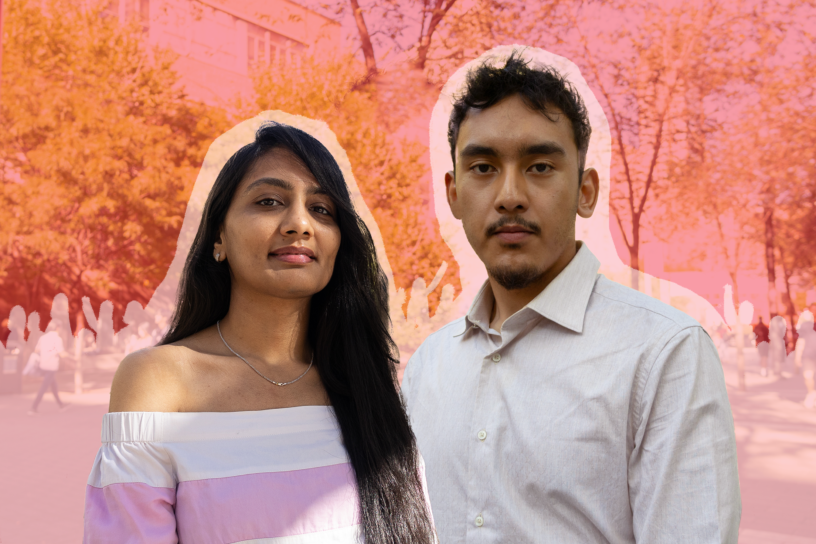
By Shaaranki Kulenthirarasa
Disclaimer: The source Aasim Ul haq Khwajawas was previously affiliated with the TMSU. He had no role in the editing process of this article.
South Asian international students at Toronto Metropolitan University (TMU) are worried about their safety.
Earlier this month, the “Canada First Rally” took anti-immigration stances into the public eye at Christie Pits Park, sparking worry amongst the South Asian community at TMU, especially international students.
Priyanka Prakash, a third-year nutrition and food student said she and her fiancé did not leave their house on the day of the rally in fear for their safety.
“We found articles that there were more people counterprotesting than the protesters…It makes me feel better, but the fact that it’s there, it’s still going on, it’s a mixed bag,” she said.
Harshi Shah, another third-year nutrition and food student said that though the rally was not only aimed at South Asians, comments on social media were mostly targeted towards this demographic, making her feel concerned for her safety.
“At least for two weeks [after the rally], I used to wear masks and come to campus,” she said.
Apart from leaving South Asian students concerned, the rallies have caused fear amongst their families back home.
Aasim Ul haq Khwaja, second-year business technology management student said the first thing his family asks him during calls is whether he feels safe.
“They took that big burden spending all of that money [to send] me here but now they are restless and they’re scared about what’s happening,” he said.
Prakash and Shah agreed. They both said phone calls back home dominantly consist of family members asking about their safety in Toronto.
A persistent worry amongst some South Asian students is doing anything that may raise attention towards them. For Shah, this is wearing her cultural clothing in public.
“Sometimes I feel like I want to wear an Indian dress but I can’t wear it because [people would say something],” she said.
Prakash said she finds herself constantly aware of her surroundings to make sure she does not do anything that would provoke anyone.
“I do understand that people are worried [about] big changes…but I feel like that anger often lands on innocent people who are just here to study and work hard,” she said.
Many students have experienced acts of hate in the city, though mostly indirectly.
“There are always microaggressions [when] you are a person of colour that is very evident,” said Prakash.
She noted that pronouncing someone’s name wrong despite correcting them multiple times is a common example of how South Asians face microaggressions.
Ul haq Khwaja has heard people in public say they miss the times when Canada did not have many immigrants.
Though indirect forms of racism are most common, students still face explicit acts of hate too.
Shah recounted an instance where she was pushed by a man as she was walking home. She said the man proceeded to walk away but witnesses helped her get up.
“Sometimes it becomes stressful. [There] are already so many things going [on] and then if people hate you, you [start to ask if you are] safe. That always comes to mind,” she said
Usha George, a professor in the School of Social Work emphasizes the importance of having relatable support services on campus environments to help support international and domestic South Asian students.
“Having counselors or having student engagement workers from minority communities is a first good step,” she said.
Some South Asian students say the inclusive campus community has kept them grounded amidst their toughest moments.
“My friends are very supportive even though they aren’t [from] the same culture,” said Shah. After being pushed by the man, her friends started to walk her home regularly.
Prakash and Ul haq Khwaja agree. Prakash said her non-South Asian friends stayed at her house with her on the day of the anti-immigrant rally in solidarity.
Despite the struggles, these students are taking efforts to not only succeed but help each other.
Shah is the executive director of events for the Faculty of Community Services Society and was an orientation events lead for incoming students. Ul haq Khwaja was on TMU’s Board of Governors for the 2024-25 academic year, where he brought forth student voices. Prakash was the co-president of the Malayalee Students Association (TMMSA), tasked with overseeing the student group.
For Prakash, who is Malayalee—an ethnolinguistic group in Southwestern India—being a part of TMMSA has made it easier to celebrate cultural celebrations like Onam—a yearly harvest festival—and Vishu—the Malayalee
new year.
“It was a safe space where I could eat food with my hands and I could wear cultural clothes,” she said.
She said it was nice to see non-Malayalee students at these events who were willing to learn more about her culture.
South Asian international students say they want the rest of the city’s population to be open-minded too.
“I would say ‘how about we give it a try to [understand South Asians] before judging them?” asked Harshi.








Leave a Reply